



In the restaurant business, every detail matters, and few details are as powerful as your menu. Beyond showcasing dishes, the menu acts as a silent salesperson, shaping how guests order and directly influencing profit margins. Whether you run a single mom-and-pop restaurant or a multi-concept franchise, menu engineering ripples across costs, operations, and guest satisfaction.
Some common restaurant menu design choices include size, flexibility, and dietary inclusivity. Should your menu be large or small? Fixed or adaptable? Broad enough to cover restrictions or tightly focused? These aren’t just creative decisions — they’re financial ones.
With fluctuating food costs, uncertainty surrounding tariffs, and labor in short supply, the menu can be a powerful tool to balance guest expectations and operational realities. Operators who treat restaurant menu design as a profit lever will be better positioned to thrive.
Fixed vs. Flexible Menus
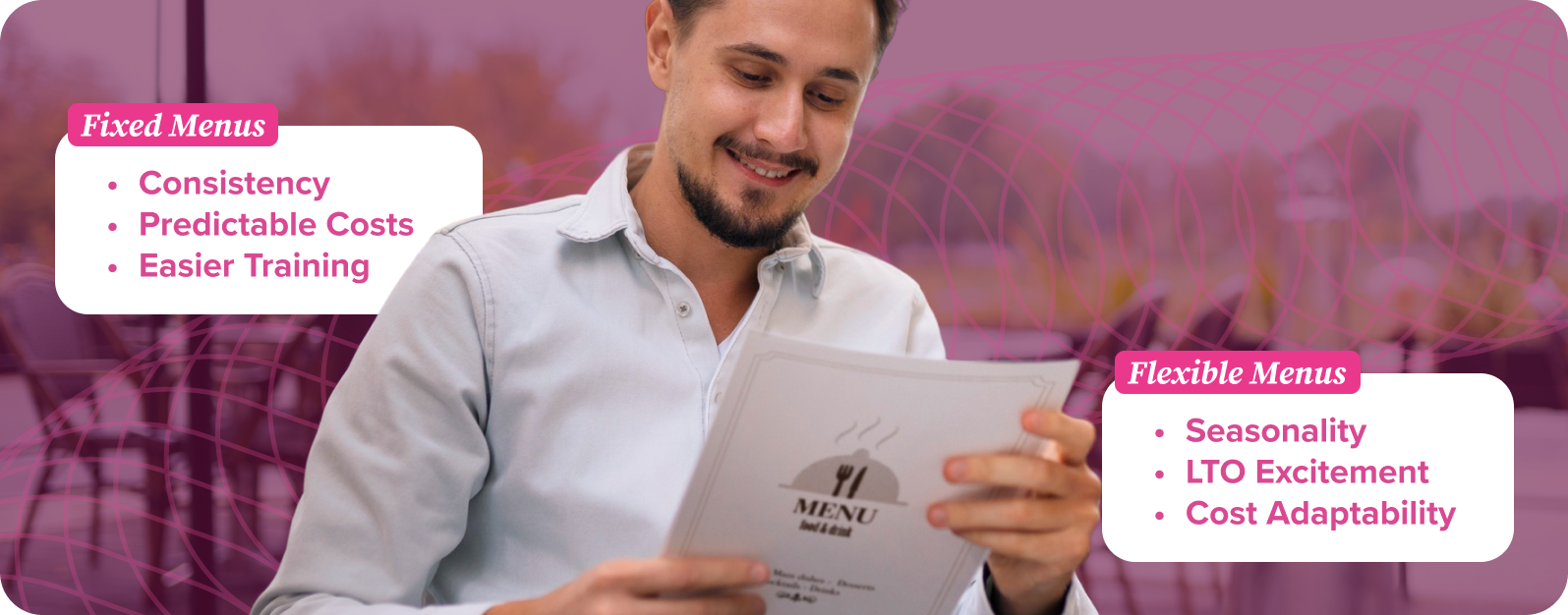
The first strategic decision is whether to keep your menu largely static or embrace seasonal flexibility. A fixed menu provides consistency, which guests appreciate, and makes training easier for staff. It also keeps costs predictable, since there is no need to reprint or reengineer the menu on a regular basis.
On the other hand, flexible menus allow you to pivot. Seasonal dishes can highlight local ingredients, offset commodity price spikes, or create buzz around limited-time offers (LTOs). The trade-off? Frequent changes require diligent recipe costing, clear communication, and stringent training. Too much unpredictability can frustrate loyal customers or confuse staff.
Many operators use flexible menus to test LTOs or trial new items before committing to permanent placement. This approach not only keeps menus fresh, but it allows operators to gather real data on guest demand before investing heavily in inventory or staff training.
Flexibility protects you against fluctuating food costs, but only if you have tight controls. For example, if avocado prices spike, an operator with flexible menu pricing can adjust quickly to protect margins. Without real-time tracking, though, these changes can erode profitability.
Technology like Back Office’s recipe and food costing tools help operators decide whether that seasonal crab cake special is really pulling its weight.
Large vs. Small Menus
It’s tempting to want something for everyone. After all, a larger menu can appeal to a wider range of diners. But there’s a hidden cost: every added dish introduces new SKUs, storage needs, training, and prep.
There’s also psychology at play. Too many options can lead to decision fatigue, causing diners to default to “safe” choices — or worse, feel dissatisfied after ordering. The paradox of choice is a well-documented marketing concept that shows that when people are offered too many options, they’re less likely to make a confident decision and more likely to second-guess themselves afterward.

Financially speaking, large menus can drive up labor and inventory costs, and they often lead to food waste. Smaller menus can concentrate purchasing power, reduce spoilage, and streamline the kitchen. Many fast-casual leaders thrive by focusing on limited but high-quality offerings, which often show stronger profit per square foot compared to concepts with more diverse offerings.
Some independent restaurant operators are embracing this ethos with streamlined menus that allow for tighter cost control and faster service times. A well-structured small menu can still feel abundant to guests if items are thoughtfully described and unique flavor combinations are highlighted.
Accommodating Dietary Restrictions
Diners today expect options that fit their needs — whether they’re looking for vegetarian, vegan, gluten-free, or allergen-friendly menu items. But how much do these accommodations cost you, and what do they contribute to your bottom line?
Stocking specialty ingredients can increase inventory costs, especially if demand is inconsistent. A gluten-free pizza crust or vegan cheese may be requested only occasionally, yet those items require storage and careful handling. Ignoring these diners altogether, however, risks alienating a growing market segment.
Operators need to measure whether these items justify their place on the menu. Allergies and restrictive diets are on the rise, and many consumers actively seek out restaurants that cater to their dietary needs. With margin reporting tools, you can see if gluten-free pasta is profitable enough to keep stocked, or if vegan dessert sales are trending upward. The goal isn’t to accommodate every request, but rather to strategically align your offerings with both guest demand and profitability.
Add-ons, Sides, and Upselling
Sometimes the biggest margin boosters aren’t entrées at all. Add-ons like extra protein, premium toppings, or sides can significantly lift check averages. But should sides be bundled or sold à la carte?
This is where good restaurant menu design comes into play. Items with high margins should be strategically placed on the menu, and highlighted with callouts or visual cues. Staff training is equally important. When servers or cashiers know which add-ons are most profitable, they can naturally guide guests toward them.
When done well, upselling add-ons can deliver margin gains without significant new costs. But when done poorly, it can backfire to balloon waste or create confusion. A side of truffle fries may be highly profitable, but only if you’ve tracked the food cost and ensured demand justifies the extra inventory.
With tools like Back Office’s recipe costing, you can identify high-margin items and confidently coach staff on which ones to spotlight.
The Financial Strategy Behind Every Menu
Menu design is a critical part of a restaurant’s financial strategy. Each choice, whether to expand the menu, add modifiers, or spotlight upsell items, ties directly back to food cost, labor, and prime cost.
Prime cost, which is the sum of food and labor, is among the most important profitability metrics for restaurant operators. When you understand how restaurant menu design impacts both halves of the equation, you can be more in control of your bottom line.
This is where data becomes indispensable. Using software allows you to track item-level profitability, monitor food and labor costs, and spot trends over time. With that visibility, restaurant menu design becomes less about guesswork and more about intentional, profit-driven decision-making.
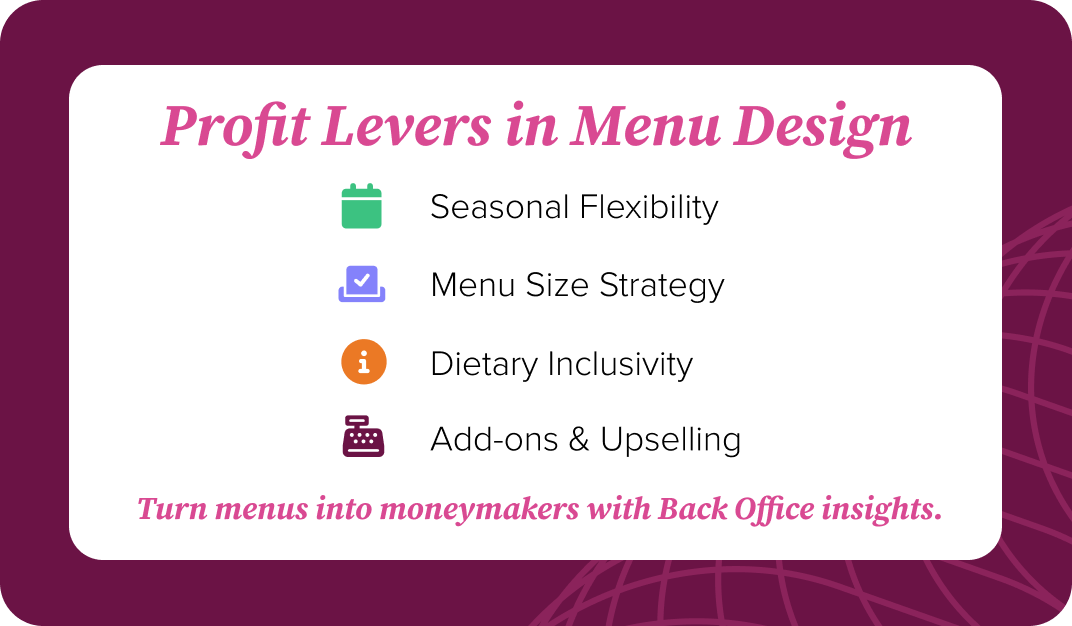
Turn Menus Into Moneymakers
The menu is more than a list of dishes. It’s one of the most powerful business tools a restaurant has. Whether you streamline offerings, experiment with seasonal flexibility, or optimize add-ons, every menu decision has financial consequences. In an economic environment where every percentage point matters, rethinking your menu design is essential to long-term success.
To learn more about Back Office and how it can help you master your restaurant’s money, download our new guide book, Mastering Restaurant Accounting, which breaks down exactly what you need to track, measure, and manage to run a smarter, more profitable operation.