

If you’ve noticed your margins dipping lately, you’re not alone. According to the National Restaurant Association’s 2025 State of the Restaurant Industry report, 95% of restaurant operators say rising food costs are posing a significant challenge to their operation. The same report shows that food and labor costs have both risen more than 30% since 2019, making it increasingly challenging for operators to maintain profitability.
Fortunately, a solution that’s gaining momentum and supported by the report is AI-powered inventory optimization for restaurants. Rather than reacting to inventory problems after they happen, these tools bring real-time insight and predictive intelligence to help managers anticipate needs and quickly adapt to changing conditions.
Common Inventory Problems Restaurants Face
Whether you run a small quick-service deli or a multi-location branded fine dining venue, you are likely to face predictable inventory challenges. Operators tend to respond to these common inventory pressures in similar ways, including:
Overstocking and Food Spoilage
Many restaurants order more product than they actually need in an effort to avoid running out of ingredients. While this approach may feel safer, it often leads to excess inventory that spoils before it can be used. Over-ordering not only increases food waste but also ties up valuable cash and storage space that could be used more efficiently.
Frequent Stockouts
Running out of key ingredients during peak service periods is another common challenge. When this happens, restaurants may have to remove menu items temporarily or make urgent purchases from retail suppliers at higher prices. Frequent stockouts can disrupt operations, increase costs, and negatively impact the customer experience.
Inaccurate Manual Tracking
Many restaurants still rely on manual spreadsheets, handwritten counts, or disconnected systems to track inventory. These methods are time-consuming and prone to human error. Even small inaccuracies can compound over time, making it difficult for managers to understand what inventory is truly available.
Poor Demand Planning
Purchasing decisions are often based on intuition, historical averages, or outdated reports. However, customer demand can change quickly based on factors like promotions, seasonality, or unexpected spikes in traffic. Without accurate forecasting, restaurants may consistently overestimate or underestimate their inventory needs.
Individually, these inefficiencies may seem minor, but together they create costly cycles that are difficult to break without smarter inventory optimization tools.
What AI-Powered Inventory Optimization Means for Restaurants
At its core, AI-powered inventory optimization for restaurants uses advanced analytics to support faster, more accurate inventory decisions. With AI-supported software, restaurants can:
- Analyze sales trends, purchasing history, and operational patterns in real time.
- Maintain optimal inventory levels to avoid overstocking or shortages.
- Reduce food waste by aligning purchasing with actual consumption.
- Prevent stockouts by forecasting demand more accurately.
- Maintain more consistent food costs through smarter purchasing decisions.
How AI Optimizes Restaurant Inventory in Real Time
AI-powered inventory optimization works by shifting inventory management from a reactive, manual process to a dynamic, real-time data-driven one. Instead of having to manually evaluate and recalculate inventory levels as things change, the software runs in the background to continuously analyze your operation for you. It delivers value through a set of interconnected capabilities:
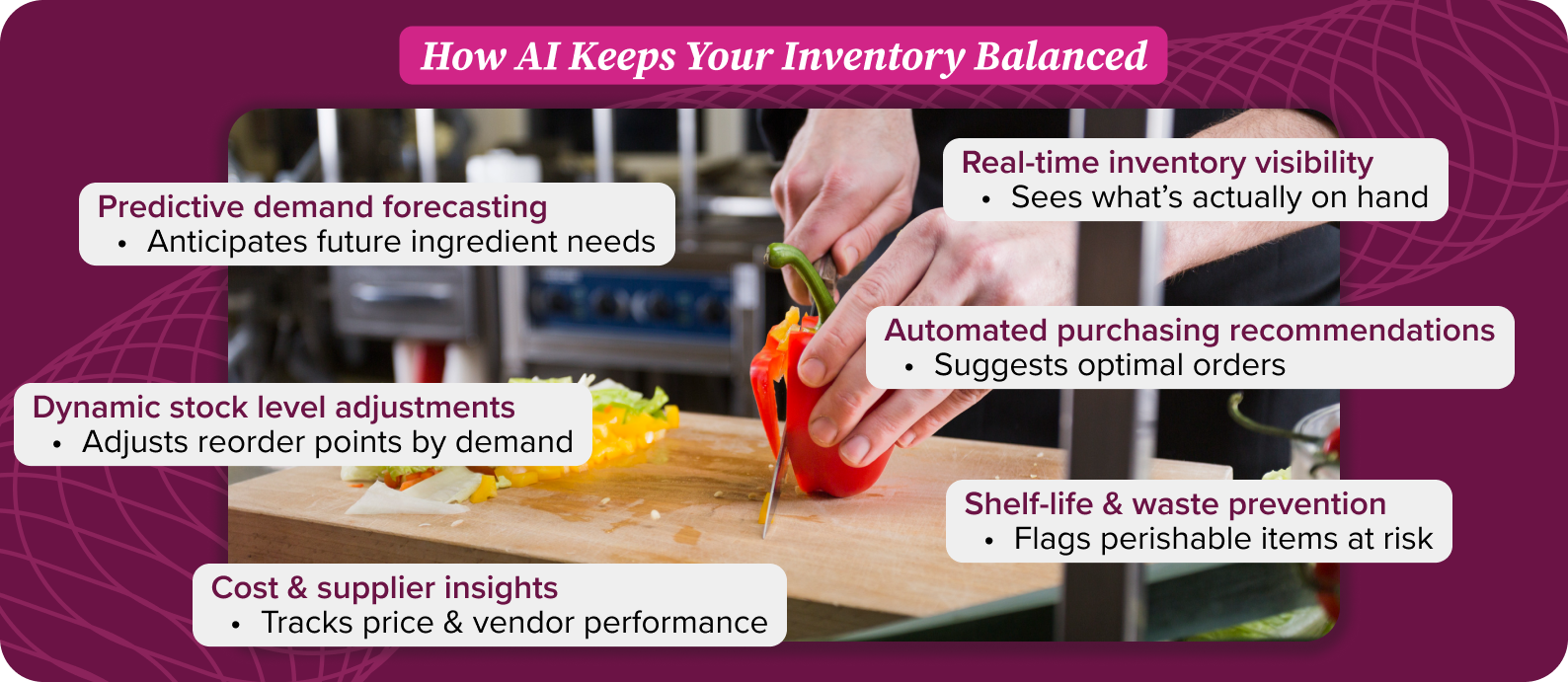
Smart Demand Forecasting
AI systems analyze historical sales patterns, seasonal trends, and operational data to forecast future demand. This forecasting allows restaurants to anticipate inventory needs more accurately and prepare for fluctuations caused by promotions, events, or changing customer behavior.
Real-Time Stock Monitoring
Real-time inventory visibility allows restaurants to automatically update stock levels as items are sold or received. By integrating with POS systems and purchasing platforms, AI tools ensure that inventory records remain accurate and up to date throughout the day.
Automated Reordering Systems
Based on demand forecasts and current stock levels, AI-powered systems can generate recommended purchasing quantities for each ingredient. These recommendations help managers maintain ideal stock levels without the need for manual calculations or guesswork.
Expiry and Shelf-Life Management
AI tools can also monitor shelf-life thresholds and usage patterns to identify potential waste risks. Alerts can notify managers when ingredients are approaching expiration or when usage patterns appear unusual, allowing teams to address issues before spoilage occurs.
Together, these capabilities help restaurants maintain the right balance between having enough inventory and avoiding costly overstocking.
Benefits of AI Inventory Optimization for Restaurants
Incorporating AI into your inventory processes is about much more than simple automation. By building your inventory processes on top of an AI-powered system, you can shift away from reactive problem management to a proactive, strategic approach that improves your restaurant’s performance.
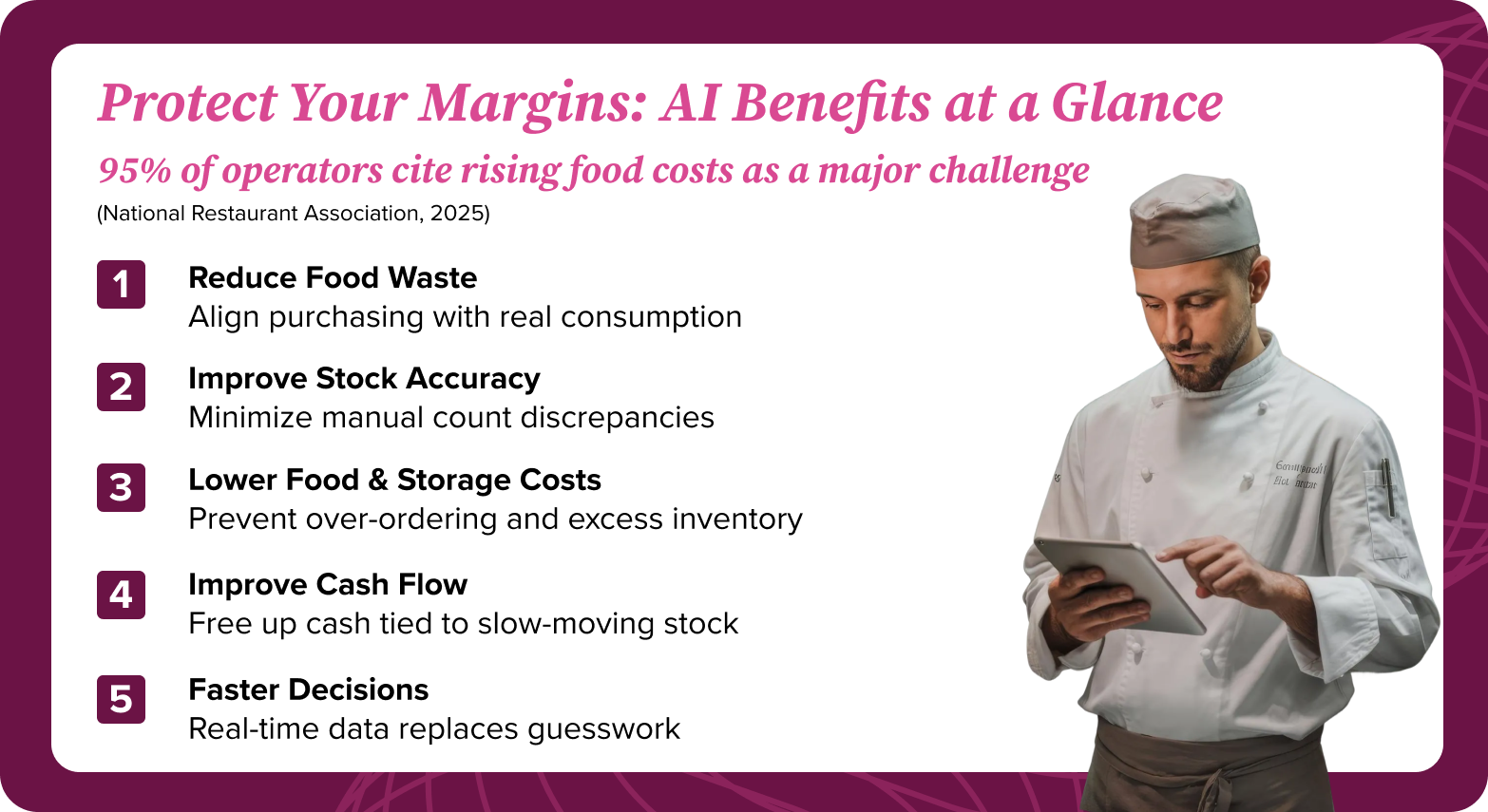
Key benefits of AI-powered inventory optimization for restaurants include:
Reduced Food Waste and Spoilage
AI systems align purchasing with actual consumption patterns and provide alerts for potential waste risks. By preventing over-ordering and identifying aging inventory early, restaurants can significantly reduce food waste.
Improved Stock Accuracy
Automated inventory tracking ensures that stock records accurately reflect what is actually on hand. This reduces discrepancies caused by manual counts and provides managers with a clearer picture of inventory levels.
Lower Food and Storage Costs
Maintaining optimal inventory levels helps prevent over-ordering and reduces excess stock that occupies valuable storage space. Over time, this can lead to meaningful reductions in both food and storage costs.
Better Cash Flow Management
By avoiding unnecessary inventory purchases and reducing emergency buying, restaurants can free up working capital that would otherwise be tied up in unused ingredients.
Step-by-Step Guide to Optimizing Restaurant Inventory with AI
Adopting AI-powered inventory optimization doesn’t have to be overwhelming. With a clear, manageable step-by-step approach, you can modernize your inventory processes without disrupting your day-to-day operations or feeling pressured into a significant financial risk before seeing measurable results.
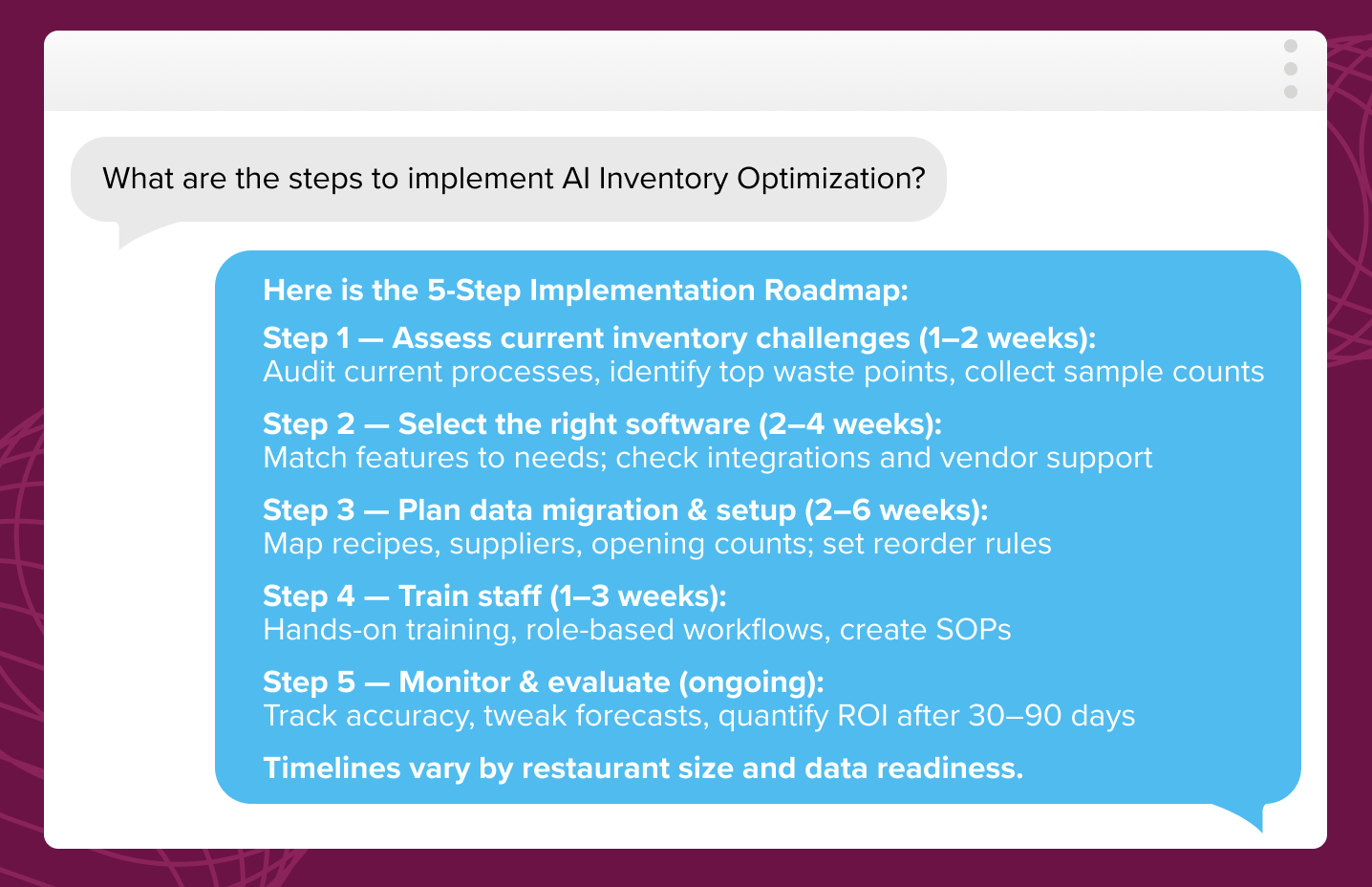
1. Assess Current Inventory Challenges
Start by identifying where inventory issues show up most often. Look at waste reports, food cost trends, and time spent on inventory management tasks to identify the most high-impact areas.
2. Select the Right AI Restaurant Inventory Software
Not all tools are designed to solve the same problems, and not every AI tool is purpose-built for restaurant inventory. Evaluate solutions based on how well they align with your target operational needs, size, complexity, and goals. Ideally, select a solution with customer support and a simple setup process for integrating with your existing POS system.
3. Plan Your Data Migration and System Setup
Collaborate with your vendor support team to identify how your existing inventory data will be transferred to the new system and map out a plan for any preparatory steps, such as tagging or standardization, that may be necessary ahead of an official launch.
4. Train Your Staff
Train managers and key team members on how to use the system, interpret recommendations, and respond to alerts. Emphasize how the tool supports their routine decision-making rather than replacing their judgment.
5. Monitor and Evaluate Your Performance
Once your new system is live, regularly review performance metrics, alerts, and suggestions to evaluate accuracy and identify opportunities for fine-tuning. Compare suggested ordering levels to actual needs to build confidence in the system and maximize long-term value.
Challenges of AI-Powered Inventory Optimization
Like any operational change, implementing an AI inventory system can come with challenges, especially for restaurants with manual or legacy systems. The good news is that most of these challenges are manageable when combined with a little strategic planning and a supportive technology partner. Challenges include:
High Initial Setup Costs
Initial implementation costs can feel intimidating, especially for smaller restaurants. However, scalable solutions allow operators to start with essential capabilities and expand as the business grows.
Poor Data Quality and System Accuracy
AI systems rely on accurate data to generate reliable insights. Taking time to clean and standardize inventory data during setup can significantly improve system performance.
Complex Integration with Legacy Tools
Integrating AI tools with existing POS, accounting, or inventory systems can sometimes create technical challenges. Choosing a solution that is proven to integrate smoothly with your existing technology stack can help streamline the process.
Staff Learning Curve
Restaurants with high staff turnover may worry about training requirements. However, modern AI platforms often provide intuitive interfaces, role-based access, and simplified workflows that help team members adapt quickly.
Choosing the Right AI Inventory System for Your Restaurant
While adopting new technology can sometimes feel daunting, incorporating AI into your inventory system can help you effectively manage one of your most complex operational challenges. The key is to choose a solution that fits your operation, integrates smoothly with your existing tools and processes, and supports your team with easy-to-understand, actionable insights so you can capture value immediately.
Back Office works with restaurant teams across the country to evaluate their current inventory challenges and provide solutions that meet real operational needs. If you’re ready to move beyond spreadsheets and guesswork, book a demo to see how AI-powered inventory optimization can work in your restaurant and protect your valuable margins.
Frequently Asked Questions
How does AI improve restaurant inventory management?
AI analyzes sales patterns and demand signals to optimize ordering, reduce waste, and prevent stockouts. Working with an established partner that has a proven track record and clear data policies ensures reliability and protects your operation.
Is AI inventory optimization suitable for small restaurants?
Yes. Reputable AI-powered inventory solutions are designed to scale from single locations and targeted feature sets to enterprise-level, multi-unit operations with robust needs.
What software is best for AI-powered inventory control?
The best software is one that integrates seamlessly with your POS and accounting systems while providing the features you need to meet your operational goals. Back Office helps restaurants identify and implement AI-powered inventory solutions tailored to their specific needs.
How quickly can restaurants see ROI?
Most restaurants begin seeing ROI within the first few months, though operators who are highly committed to setup, staff training, and using the insights strategically may see meaningful returns in as little as a few weeks. As with any technology investment, results will vary depending on data quality, consistency of use, and operational complexity.
Can AI prevent food shortages completely?
No system can prevent food shortages entirely, and any vendor that claims to prevent 100% of food shortages is likely overpromising and underdelivering. However, AI can significantly reduce preventable food shortages by more accurately monitoring stock levels and alerting managers before shortage issues impact service.