



Calculating restaurant tax in California isn’t as simple as applying a flat rate across every item. Between differing rules for prepared versus non-prepared food, varying local tax rates, and multiple ordering channels, even straightforward transactions can introduce complexity. For operators, understanding how and when tax applies is essential for compliance, accurate reporting, and a smoother guest experience.
Does California Tax Food?
The short answer? It depends. In California, whether food is taxed depends on how it’s sold. Most grocery food items are not taxed, but prepared food is. The distinction is where things get complicated for restaurant operators.
Generally, food sold for immediate consumption, whether it’s hot, plated, packaged to-go, or delivered, is subject to sales tax. That includes meals from restaurants, food trucks, and some grab-and-go setups. On the other hand, grocery items sold in a way that’s considered “non-prepared” (think produce, chips and cookies, cold sandwiches) may be exempt.
Where this matters for operators isn’t just at the register. It affects:
- How items are categorized in your POS
- How taxes are applied across dine-in, takeout, and delivery
- How accurately revenue is reported and reconciled
Misclassifying items, even unintentionally, can lead to undercollecting or overcollecting tax. Both create problems: one exposes you to audits and penalties, while the other can lead to guest complaints and refund issues.
This is where accounting and reporting systems play a critical role. Clear item mapping and consistent categorization help ensure taxes are applied correctly across every order type, especially as menus and service models evolve.
What Food Is Taxable vs. Non-Taxable in California?
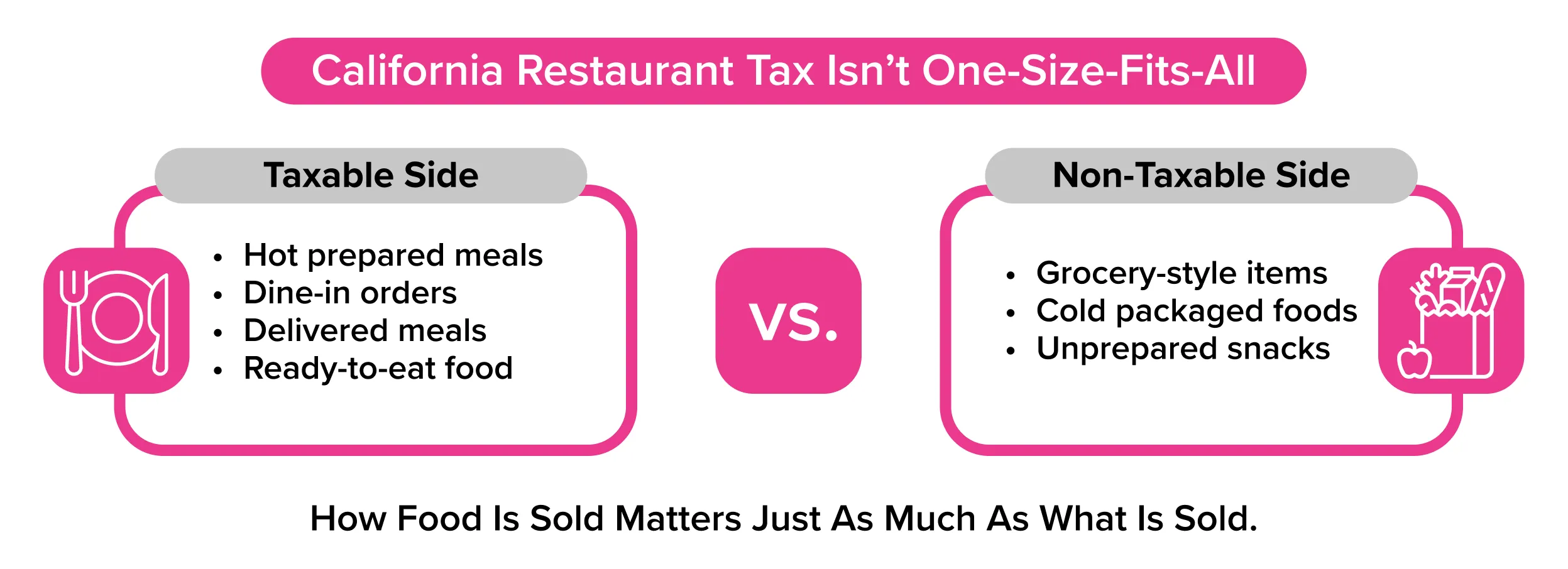
In California, the taxability of food depends on both the type of item and how it is sold.
Generally, prepared food is taxable, while most grocery-type items are not. Taxable food includes hot meals, restaurant dishes, food sold for immediate consumption, and items that are prepared or heated by the seller.
Non-taxable items typically include cold grocery staples like produce, packaged snacks, and unprepared bakery goods sold without service or heating. However, there are important exceptions such as when cold items are sold in a ready-to-eat format or as part of a catered or prepared meal. Classification depends heavily on context and service level.
What Is the 80/80 Rule in California Restaurant Tax?
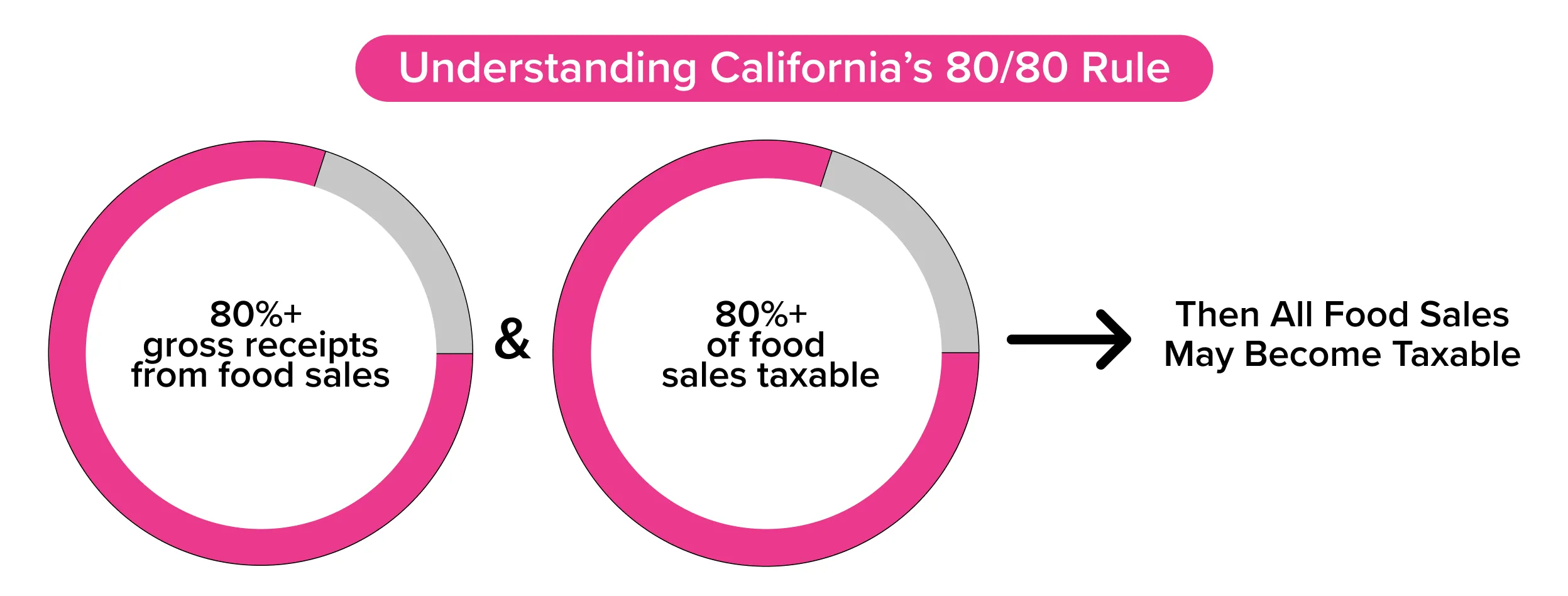
The 80/80 rule is a guideline used in California to determine when food sold in certain establishments becomes taxable. If more than 80% of a business’s gross receipts come from food sales, and more than 80% of those food sales are taxable (i.e., prepared for immediate consumption), then all food sales in that establishment are generally considered taxable. This rule helps simplify tax treatment for restaurants and similar operators, but it requires careful tracking of sales categories to ensure proper compliance and reporting accuracy.
How Is Restaurant Tax Calculated in California?
California restaurant tax is based on a combination of statewide and local sales tax rates. The base rate is 7.25%, but cities and counties can add taxes on top of that. In many areas, the total rate lands closer to 8.5%–10% or higher.
For operators, the calculation comes down to whether the item is taxable and where the transaction takes place.
Here’s an example:
A customer orders a hot meal for takeout in Los Angeles, where the total sales tax rate is 9.5%.
- Food item: Taxable (prepared food)
- Order total: $20
- Sales tax: $1.90
- Total charged: $21.90
That math may seem straightforward, but most restaurants are not operating in a single, controlled environment. Multiple locations, third-party delivery platforms, and mixed menus introduce additional layers. A packaged retail item may be treated differently than a prepared dish. Even within the same brand, tax handling can vary if systems are not aligned.
Each of those factors can change how tax is applied or reported. For instance, delivery orders may require you to account for the location where the food is prepared versus where it’s delivered, depending on how the transaction is structured.
This is where things tend to break down for operators relying on manual processes or loosely configured systems. Even small inconsistencies, such as applying the wrong local rate or misclassifying a menu item, can accumulate over time and complicate reporting.
How Is Prepared Food Defined in California?
Prepared food in California refers to any food that is sold in a ready-to-eat state. This includes food that is heated, cooked, assembled, or served by the seller, as well as meals sold with utensils provided. Examples include hot sandwiches, plated meals, and food from restaurant counters or food trucks. Even cold items can be considered prepared if they are sold with eating utensils or combined with other prepared components. The key factor is whether the seller has modified the food for immediate consumption.
How Do Delivery and Online Orders Affect Restaurant Tax?
Delivery and online orders are generally taxed the same as in-store purchases when the food is considered taxable. However, complexity arises from platform fees, delivery charges, and how transactions are structured. In many cases, delivery fees may or may not be taxable depending on whether they are separately stated or bundled with food costs. Third-party platforms can also apply different reporting structures, which may impact how tax is recorded and remitted. Consistent POS configuration is critical to ensure accuracy across channels and jurisdictions.
Why Tax Errors Are Costly for Restaurants
Tax mistakes don’t usually show up all at once. Instead, errors like miscategorized items, outdated rates, or inconsistent handling of delivery orders tend to compound over time.
When you’re already operating on thin margins, these small discrepancies can have a big impact. The bigger issue, however, is visibility. If you can’t clearly see how taxes are being applied across locations and channels, business decisions are rooted in assumption, not data.
What Strong Back-Office Systems Help You Do
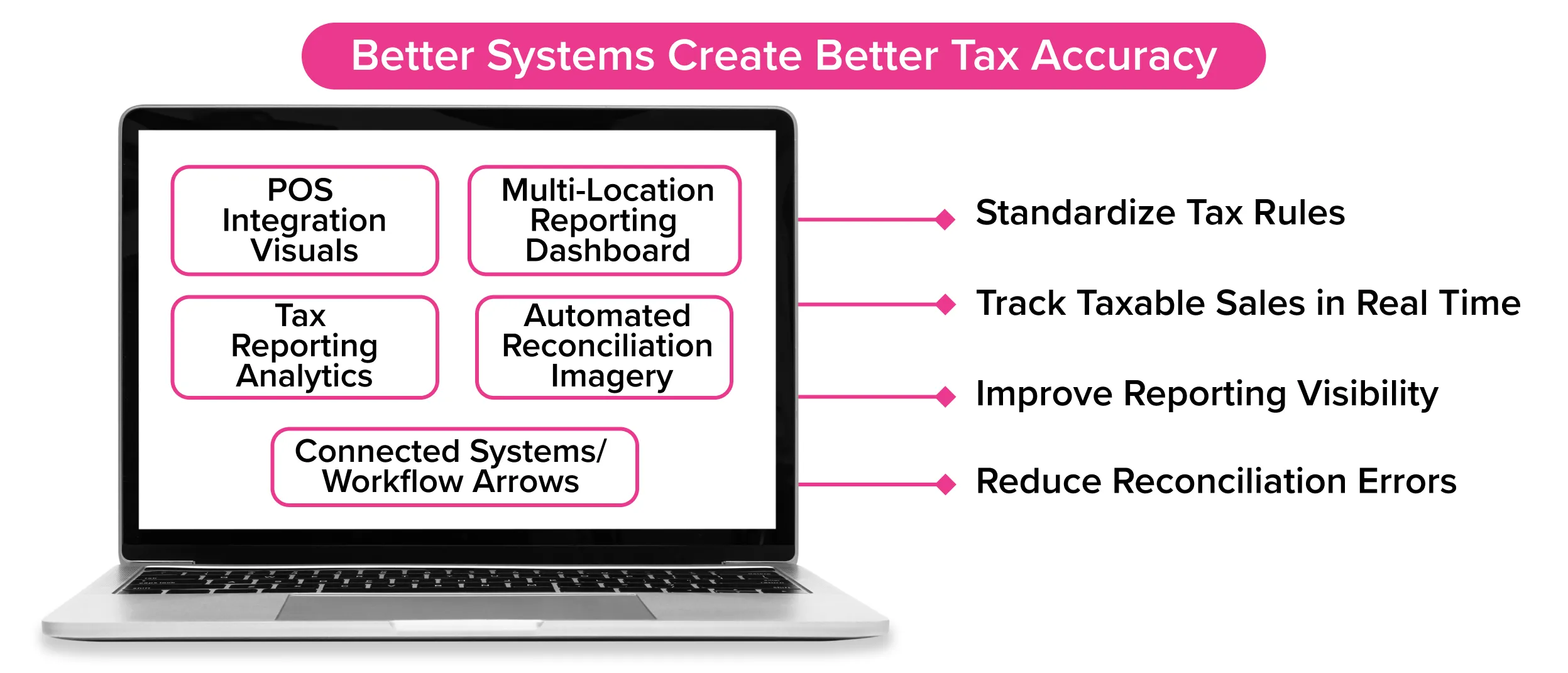
Managing California restaurant tax effectively comes down to consistency. The goal is to build accuracy into your systems.
A well-structured back office setup helps operators:
- Standardize tax rules across all locations so each store is working from the same playbook
- Connect POS data with accounting systems to reduce manual entry and reconciliation errors
- Track taxable vs. non-taxable sales in real time for cleaner reporting
This is where purpose-built restaurant accounting can change the game. Instead of piecing together spreadsheets and reports, operators can rely on systems designed to handle nuances like multi-location complexity and evolving tax requirements. Solutions that integrate with POS systems can simplify how tax data flows into reporting, which makes it easier to maintain accuracy as the business grows.
It also helps to approach tax readiness as part of a broader operational process rather than a once-a-year task. When systems are set up correctly, preparing for filing periods is more manageable and less reactive.
For a closer look at how these systems support ongoing financial management, operators can explore how dedicated accounting platforms fit into the larger restaurant tech stack. With the right setup, California restaurant tax doesn’t need constant attention. It simply works in the background so you can focus on the business.
FAQ’s
What restaurant items are taxable in California?
In California, hot prepared food is generally taxable whether sold for dine-in or to-go. Cold food is usually taxable when sold for on-site consumption, but cold food sold to-go is generally not taxable unless a special rule applies. Soda and alcoholic beverages are taxable, while hot beverages sold to-go may be exempt in some cases. Taxability can also change when items are sold as part of a combination package.
What is the 80/80 rule for restaurants?
The 80/80 rule applies when more than 80% of a restaurant’s gross receipts come from food products, and more than 80% of those food products are taxable. If this rule applies, all food and beverage sales may be treated as taxable, including many to-go sales, unless the restaurant separately accounts for exempt cold food to-go sales with proper documentation, such as guest checks or POS records.
Are delivery charges taxable on restaurant orders?
Delivery charges usually follow the taxability of the food being sold. If the order includes taxable hot prepared food, the delivery charge is generally taxable. If the order is for nontaxable cold food sold to-go, the delivery charge is generally not taxable. For mixed orders containing both taxable and nontaxable items, the delivery charge may need to be prorated.
Are tips, service charges, and restaurant surcharges taxable?
Optional tips left by customers are generally not taxable. However, mandatory service charges, automatic gratuities, and restaurant surcharges added to help cover operating costs are generally taxable. Other charges such as corkage fees and cake-cutting fees are also typically taxable.
How should restaurants track taxable and nontaxable sales?
Restaurants should use their POS system and sales records to clearly distinguish between dine-in and to-go sales, as well as between hot taxable items and potentially exempt cold to-go items. This is especially important for businesses affected by the 80/80 rule, since inadequate documentation can result in 100% of sales being treated as taxable.