

Restaurant accounts payable is about far more than paying invoices on time. It encompasses the people, processes, and controls used to receive vendor invoices, verify charges, route approvals, manage payments, and maintain accurate financial records across the business.
For restaurants, an effective accounts payable process plays an important role in day-to-day operations. It helps support healthy cash flow, maintain strong vendor relationships, improve financial visibility, and ensure expenses are recorded accurately. As restaurants grow, managing accounts payable also becomes more complex, with higher invoice volumes, additional vendors, multiple locations, and more stakeholders involved in the approval process.
Whether a restaurant operates a single location or a large multi-unit organization, building a consistent and well-managed accounts payable process can reduce administrative challenges while creating a stronger foundation for financial oversight. While technology can help simplify many aspects of accounts payable, success starts with establishing efficient workflows, clear responsibilities, and standardized processes that keep invoices moving from receipt to payment with greater accuracy and accountability.
Challenges and Modern Solutions in Restaurant Accounts Payable
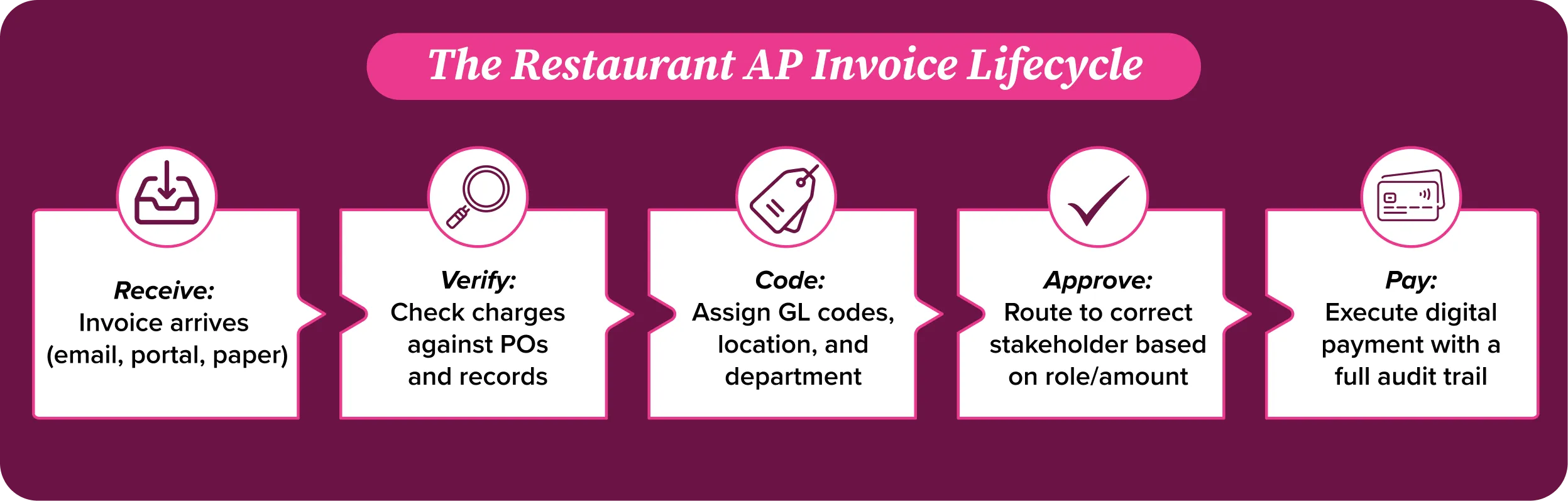
Restaurant accounts payable involves much more than paying vendor invoices. Every invoice must move through a consistent process, from receipt and verification to approval, payment, and record retention. When those steps vary between locations, departments, or managers, even routine tasks can become difficult to manage.
As restaurants grow, accounts payable often becomes more complex. Invoice volumes increase, vendor relationships expand, approval responsibilities become less clear, and financial oversight becomes more challenging. Without standardized processes, organizations may experience inconsistent invoice coding, delayed approvals, duplicate payments, or limited visibility into outstanding liabilities.
Multi-location operators often face additional challenges. One location may follow different approval procedures than another, invoices may arrive through multiple channels, and accounting teams may spend unnecessary time tracking down documentation or resolving discrepancies. These inconsistencies can make financial reporting more difficult and create administrative burdens across the organization.
Building a strong accounts payable process starts with establishing consistent workflows, clearly defining responsibilities, maintaining organized vendor records, and creating standardized procedures for managing invoices across every location. Once those operational foundations are in place, technology can help reinforce those processes by improving visibility, supporting consistency, and simplifying day-to-day administration.
Key Benefits of Streamlining Restaurant Accounts Payable
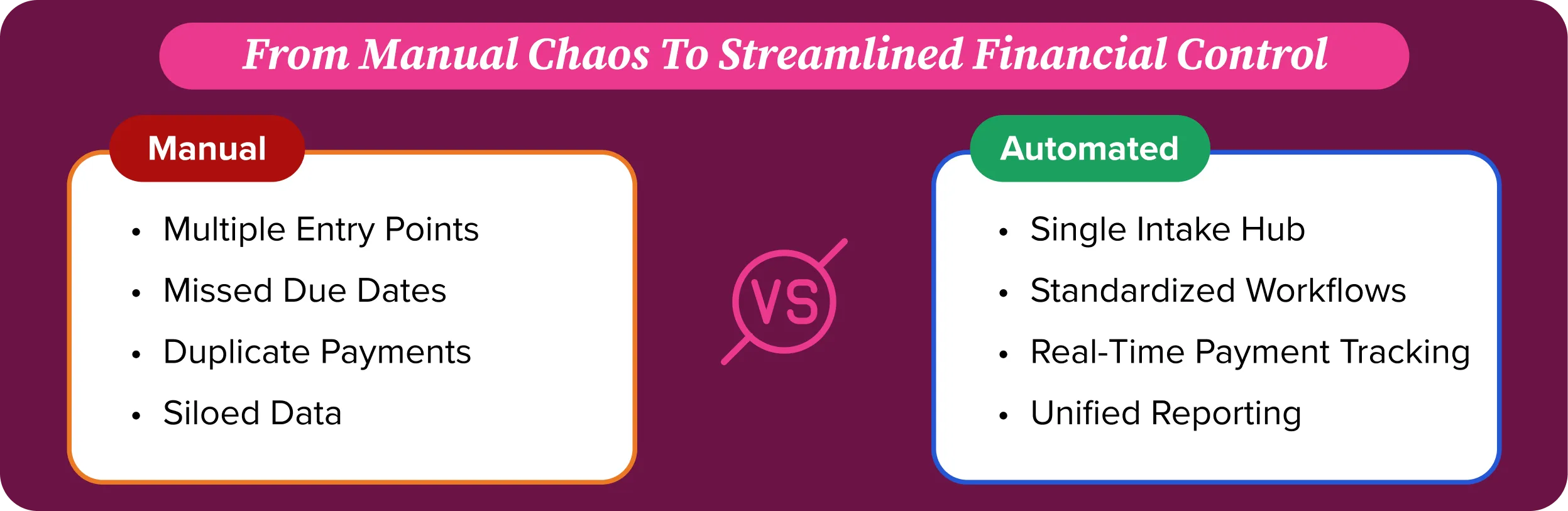
Modern restaurant AP solutions do more than digitize invoices and automate payments. They help operators create more efficient workflows, improve financial visibility, strengthen internal controls, and make more informed business decisions. Here are some of the key benefits restaurants can achieve by streamlining their accounts payable process.
Save Time and Reduce Manual Work
One of the most effective ways to improve restaurant accounts payable isn’t simply processing invoices faster. It’s creating a standardized process that every location and department follows consistently.
Restaurants often receive invoices from dozens of vendors in a variety of formats, including paper copies, emailed PDFs, electronic invoices, and vendor portals. Without a consistent intake process, invoices can be misplaced, duplicated, or delayed before they even reach the approval stage.
Centralizing invoice management helps create a single, organized workflow for every invoice, regardless of where it originates. Establishing consistent procedures for receiving, reviewing, coding, and routing invoices reduces confusion while making it easier for accounting teams to locate documentation and track invoice status throughout the payment process.
As invoice volumes grow, maintaining standardized workflows becomes increasingly important. When every location follows the same process, organizations can reduce administrative inconsistencies, improve collaboration between operations and finance teams, and spend less time resolving exceptions or searching for missing information.
Technology can help reinforce these standardized workflows by centralizing invoice records and supporting consistent processes across the organization, but the foundation of an efficient AP operation is a clearly defined process that everyone follows.
Improve Payment Security and Tracking
A well-managed accounts payable process includes clear controls that help ensure invoices are reviewed, approved, and paid accurately. As organizations grow, maintaining accountability throughout the payment process becomes increasingly important, particularly when multiple people are involved in approving invoices or issuing payments.
Establishing defined payment controls helps reduce the risk of duplicate payments, unauthorized purchases, and processing errors. Separating responsibilities between invoice entry, approval, and payment authorization creates additional oversight while ensuring financial policies are applied consistently across the organization.
Maintaining complete records of invoices, approvals, and payment history also supports stronger financial governance. Organized documentation makes it easier to answer vendor questions, reconcile transactions, prepare for audits, and demonstrate compliance with internal financial procedures.
Technology can support these controls by maintaining a searchable record of invoice activity, approval history, and payment status. When combined with clearly defined policies and accountability, these tools help restaurants strengthen financial oversight while maintaining confidence in their accounts payable process.
Gain Better Control Over Approval Workflows
As restaurants expand, invoice approvals often involve multiple stakeholders across different departments or locations. Without clearly defined approval responsibilities, invoices can remain in limbo, creating delays that impact payment schedules and financial reporting.
Establishing approval hierarchies helps ensure invoices are reviewed by the appropriate individuals based on factors such as location, department, vendor, or dollar amount. Clearly documented approval policies also create consistency across the organization, making expectations easier to follow regardless of who is responsible for reviewing invoices.
It’s equally important to account for exceptions. Managers take vacations, employees change roles, and urgent invoices don’t always arrive during business hours. Defining delegation procedures and escalation paths helps keep invoices moving when primary approvers are unavailable, reducing bottlenecks while maintaining appropriate financial controls.
For multi-unit restaurant organizations, standardized approval workflows create greater consistency across every location. Whether an invoice originates from a single restaurant or a regional operation, following the same approval process helps improve accountability, strengthen governance, and ensure invoices move through the organization efficiently.
Technology can help support these workflows by routing invoices to the appropriate approvers and documenting each step of the approval process, but clearly defined policies remain the foundation of an effective accounts payable operation.
Enhance Flexibility in Cash Flow Management
Effective cash flow management starts with understanding not only what has already been paid, but also what financial obligations are coming due. A well-managed accounts payable process gives restaurant operators a clearer picture of upcoming payments, helping them plan expenses while meeting vendor commitments.
Establishing consistent payment schedules and monitoring vendor terms can help restaurants prioritize invoices appropriately and avoid unnecessary late fees or missed payment opportunities. Understanding due dates, payment windows, and negotiated terms also supports stronger vendor relationships and more predictable financial planning.
Maintaining visibility into outstanding liabilities is especially important for multi-unit organizations, where invoice activity across several locations can make it difficult to understand the organization’s overall financial position. Regularly reviewing unpaid invoices and upcoming obligations helps accounting teams make informed decisions while reducing the risk of unexpected cash flow challenges.
Technology can support these efforts by organizing invoice information and providing timely access to payment schedules and outstanding balances. Combined with a disciplined accounts payable process, these insights help restaurants make more informed financial decisions and better prepare for future expenses.
A Smarter Way to Manage Restaurant Accounts Payable
A strong accounts payable process relies on more than technology alone. It starts with standardized workflows, clearly defined responsibilities, and financial controls that help ensure invoices move efficiently from receipt to payment. As restaurants grow, technology can help reinforce these best practices by improving consistency, visibility, and organization across the AP process.
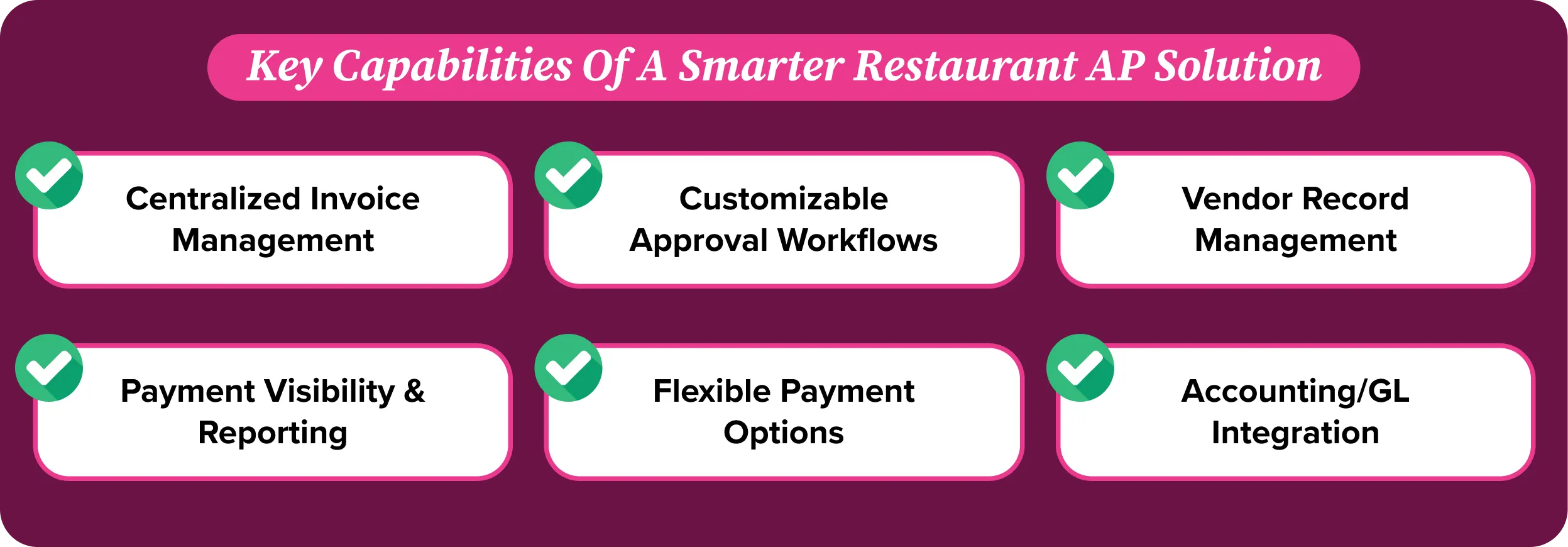
When evaluating a restaurant accounts payable solution, operators should look for capabilities that support a well-managed AP process, including:
- Centralized invoice management to organize invoices in one location, making it easier to locate documentation, maintain records, and establish a consistent intake process across the organization.
- Customizable approval workflows that support defined approval hierarchies, delegation, and routing rules while helping organizations maintain consistent governance across locations.
- Vendor record management that keeps supplier information, payment preferences, and supporting documentation organized and easily accessible.
- Payment visibility and reporting that provides insight into outstanding liabilities, payment status, and historical activity to support financial planning and decision-making.
- Flexible payment options that allow restaurants to manage vendor payments based on negotiated terms, business needs, and supplier preferences.
- Accounting integrations and data exports that help maintain accurate financial records while reducing duplicate data entry between systems.
Back Office AP Automation is designed to support each stage of the restaurant accounts payable process. From centralized invoice management and customizable approval workflows to vendor record management, payment processing, and accounting integrations, the platform helps restaurants apply consistent processes while maintaining greater visibility and control as they grow.
Final Thoughts
Restaurant accounts payable impacts far more than bill payment. It influences financial oversight, operational efficiency, vendor relationships, and an organization’s ability to make informed business decisions.
As restaurants continue to face labor constraints, rising costs, and increasing operational complexity, manual AP processes often struggle to keep pace. Modern AP automation solutions provide the structure, visibility, and control needed to manage growing invoice volumes more effectively. By creating a more organized and scalable accounts payable process, restaurants can reduce administrative burdens, improve financial management, and position their business for long-term growth.
FAQ’s
How do restaurants manage accounts payable efficiently?
Restaurants typically manage accounts payable more efficiently by standardizing how invoices are received, approved, and paid. Many operators use AP automation software to digitize invoices, route approvals automatically, track payment status, and maintain organized vendor records. Centralizing these tasks helps reduce administrative workload, improve visibility into outstanding obligations, and ensure invoices are processed accurately and on time.
What are common challenges in restaurant AP processes?
Restaurant AP teams often face challenges such as manual data entry, misplaced invoices, delayed approvals, duplicate payments, and limited visibility into upcoming expenses. These issues become even more difficult to manage as the number of vendors, invoices, and locations increases. Without a structured process, operators may spend significant time reconciling records, resolving payment discrepancies, and tracking down supporting documentation.
How does AP automation help restaurants?
AP automation helps restaurants streamline the entire invoice lifecycle, from invoice receipt and approval to payment and record retention. Digitized invoices, centralized vendor records, and automated workflows reduce manual work while improving accuracy and visibility. Automation also provides greater insight into invoice status, payment activity, and vendor spending, helping operators make more informed financial decisions.
Why are digital payments important for restaurants?
Digital payments help restaurants improve efficiency, security, and financial visibility. Unlike paper checks, digital payment methods provide real-time tracking, electronic records, and a complete audit trail for every transaction. They also help reduce administrative work, minimize payment delays, and support stronger cash flow management by giving operators greater control over when and how vendor payments are made.