

Running a restaurant requires information from multiple systems, but those systems do not always communicate with one another. When POS data must be manually transferred into accounting software, operators spend more time reconciling records, correcting errors, and waiting for reports that may already be outdated. As costs rise and margins tighten, that disconnect makes it harder to see what is happening across the business, delaying your ability to respond quickly.
A restaurant POS integration solves this problem by creating a direct flow of information between the POS system, restaurant accounting software, and other essential platforms. Beyond simply recording transactions, integration can improve financial reporting, labor and inventory visibility, payroll accuracy, and day-to-day decision-making. For operators prioritizing efficiency and scalable growth, connected systems provide the timely, reliable data needed to manage the restaurant more proactively.
What Is Restaurant POS Integration?
Restaurant POS integration is the direct connection between a restaurant’s point-of-sale system and its accounting software. It automatically transfers sales, labor, tax, and other transaction data into the appropriate financial records, reducing manual entry and improving accuracy. As the backbone of your restaurant’s technology stack, it can also synchronize critical information, such as hiring and boarding, marketing, inventory, and customer management systems, providing improved financial clarity into your business.
Why Disconnected Restaurant Systems Create Financial Blind Spots
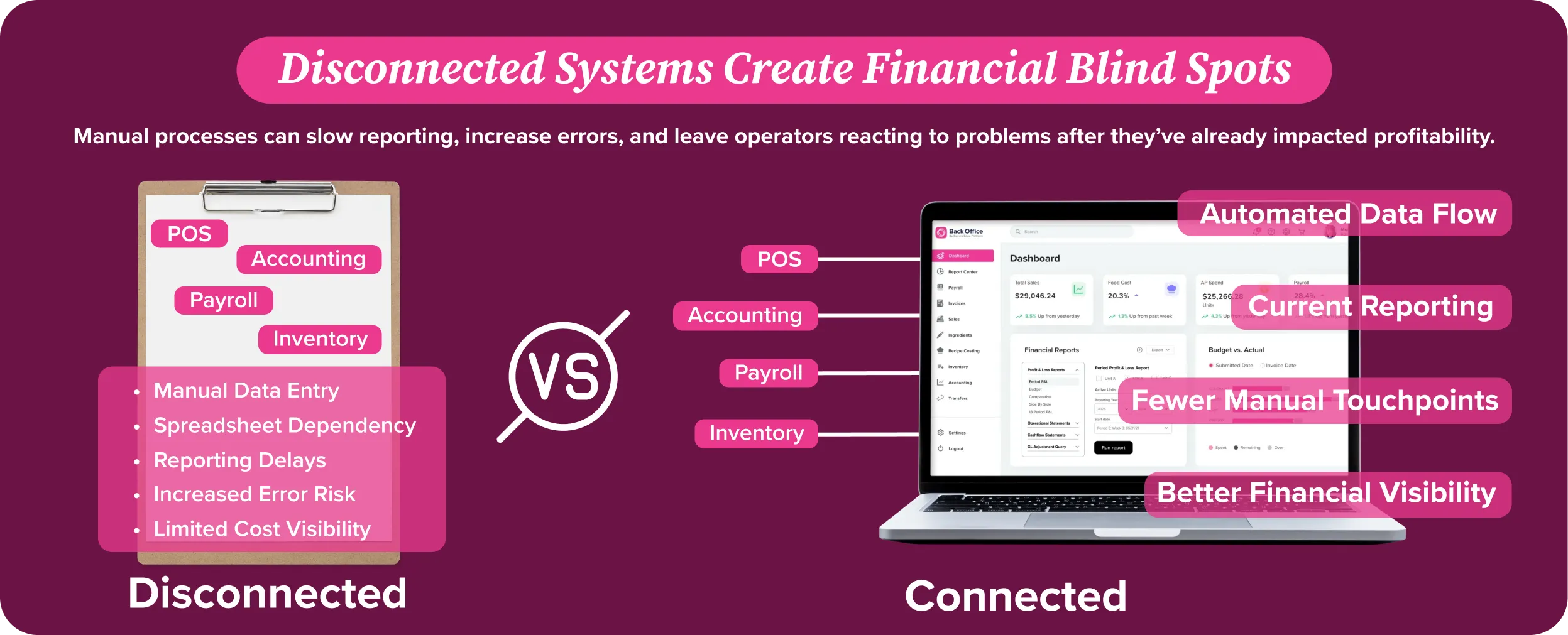
When restaurant systems don’t communicate, operators often lack the timely and accurate information needed to understand performance and make confident financial decisions. This disconnect can lead to:
Manual reconciliation delays
Comparing data manually can result in hours of extra time spent identifying discrepancies before closing the books each month. An integrated system automatically aligns data across platforms, making reconciliation faster and providing a clearer view of financial performance.
Spreadsheet dependency
Disconnected systems often force operators to export, organize, and analyze data in spreadsheets that quickly become outdated. Integration consolidates information in one place, giving operators access to more consistent and current reporting.
Duplicate data entry
Entering the same information into multiple systems consumes valuable time and can create conflicting records. Connected systems transfer data automatically, eliminating redundant work and establishing a more reliable source of financial data.
Human error risks
Manual entry increases the likelihood of typos, inaccurate amounts, missed transactions, or misclassified expenses. An integrated system reduces manual touchpoints and helps maintain more accurate records.
Delayed financial reporting
Reports that rely on human calculations and manual data gathering can often take days or weeks to process once the period ends. Integrated restaurant accounting software accelerates data flow and provides operators with in-the-moment reporting, helping to identify emerging trends sooner.
Lack of real-time visibility into labor and food costs
Without connected accounting systems, operators may miss labor or food cost overages until they show up in financial reports after they’ve already hit the bottom line. Integration brings sales and cost data together, allowing managers to monitor labor and food costs in real-time.
Reactive decision-making
Delayed or incomplete information leaves operators relying on outdated operational plans and a reactive approach to running the restaurant. An integrated system provides earlier visibility into changing conditions, allowing managers to adjust staffing, purchasing, pricing, and other cost controls proactively.
How POS Integration Improves Restaurant Accounting Accuracy
POS integration helps accounting teams maintain cleaner financial records by connecting sales and payment data directly to the accounting system. This makes it easier to categorize revenue, reconcile deposits, close periods, and monitor cash flow.
An integrated system achieves these efficiencies through:
- Sales categorization: Sales can be automatically categorized by location, revenue center, payment method, discounts, comps, and taxes, giving accounting teams a more consistent view of revenue.
- Payment reconciliation: POS sales can be matched against payment processor activity and bank deposits, making it easier to identify discrepancies and investigate missing or mismatched payments.
- Cleaner period closes: Fewer data errors throughout the period means operators can close the books more efficiently and feel more confident in the accuracy of their financial statements.
- Improved cash flow visibility: Timely sales and payment provides visibility into how much cash is coming into the business and when deposits should arrive, allowing for more precise budgeting and cash flow planning.
Together, these capabilities give accounting teams cleaner records and greater visibility into the financial performance of the restaurant.
The Connection Between POS Data, Payroll, and Labor Costs
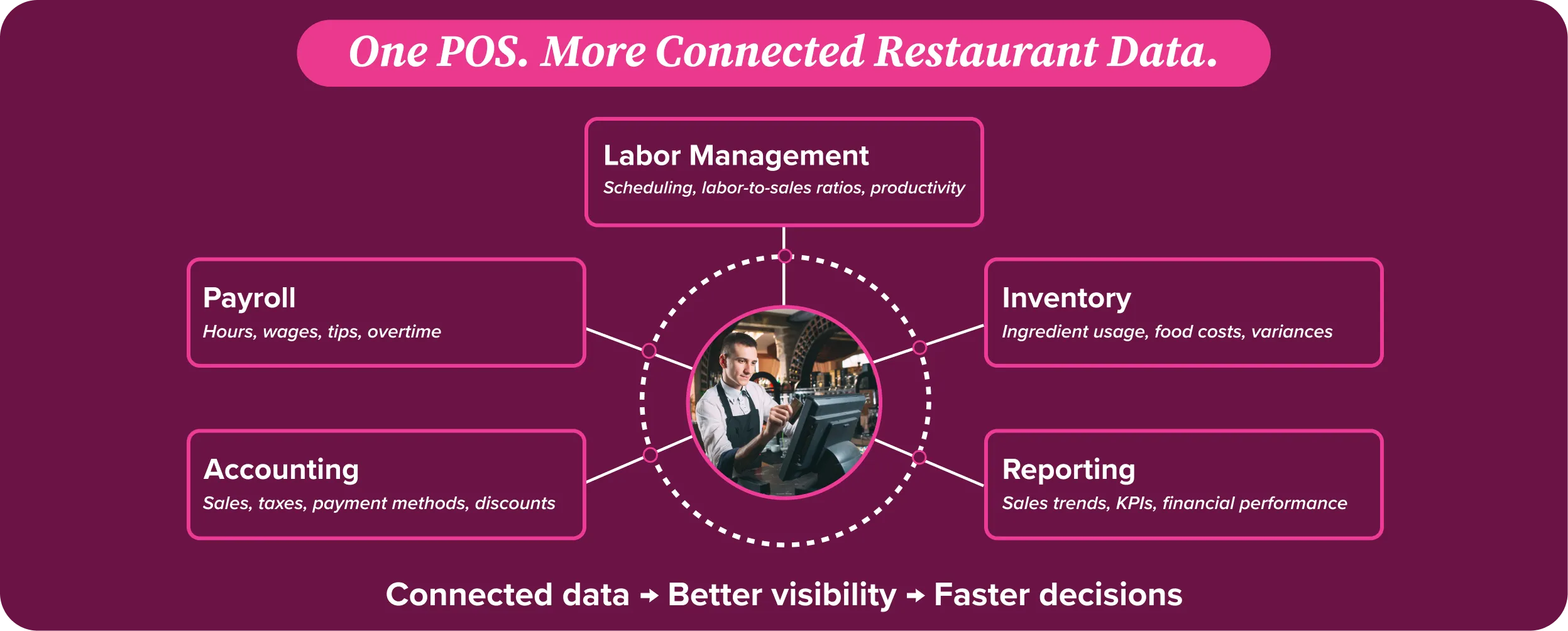
Integrating POS data with payroll systems gives operators a more complete view of how scheduled and actual labor compare with sales. Daily flash reports can combine sales, employee hours, wages, overtime warnings, server productivity, and employee tip data, reducing manual payroll work while helping managers identify missed punches, unexpected overtime, or other discrepancies before payroll is processed.
Connected data also helps managers build schedules around forecasted demand and monitor labor spend vs. sales throughout each shift. Monitoring staffing levels by shift, role, or unit can help managers identify when labor is being under- or overutilized and make adjustments accordingly. This supports healthier labor costs without relying on broad staffing cuts that could compromise both sales and service.
How Integrated POS Reporting Helps Restaurants Spot Problems Faster
Integrated POS reporting brings sales, labor, menu, and financial data together, providing timely insights into where performance may be falling short. Instead of waiting for period-end reports to identify areas for improvement, managers can spot emerging problems quickly and make informed adjustments sooner.
An integrated system supports more proactive restaurant operations by monitoring key performance indicators, including:
- Daily sales visibility: Current sales data shows when revenue is falling below forecasts or historical performance.
- Labor-to-sales ratios: Integrated reporting aligns staffing costs with sales, allowing managers to make corrections and address staffing issues sooner.
- Menu engineering insights: Item-level sales and profitability data reveals which menu items are popular, profitable, or underperforming.
- Identifying low-margin items: Tying sales data to ingredient costs makes it easier to find items that generate revenue but contribute little profit.
- Spotting unusual trends: Unexpected changes in sales, discounts, comps, costs, or customer demand are highlighted so they can be addressed before they become larger problems.
- Exception reporting: Automated alerts can flag results outside established tolerances, helping managers focus on the areas that require immediate attention.
- Proactive operational decisions: Faster access to reliable data allows operators to adjust staffing, purchasing, pricing, promotions, and menu offerings before performance issues significantly affect profitability.
What Restaurant Operators Should Look For in a POS Integration Strategy
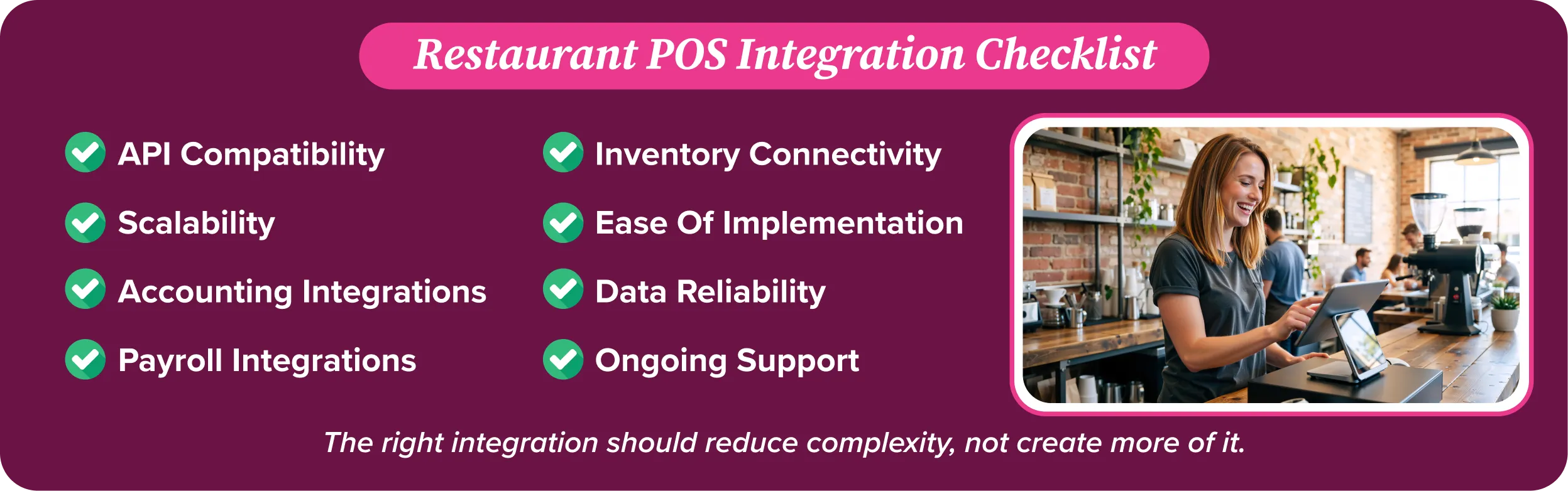
The right POS integration strategy should connect the systems that influence both daily operations and long-term financial performance. Before selecting a vendor, restaurant operators should evaluate the following factors:
- API compatibility: Confirm that the POS offers reliable APIs that can exchange data with your currently used systems, including accounting, payroll, inventory, and other platforms.
- Scalability: Choose an integration that can support additional locations, higher transaction volumes, and new features or technology needs as the restaurant grows.
- Accounting integrations: Look for direct connectivity with accounting software that accurately categorizes sales, taxes, payment types, discounts, and other transaction data.
- Payroll integrations: Ensure employee hours, wages, tips, and overtime information can flow securely into your current payroll system without putting employees’ sensitive information at risk.
- Inventory connectivity: Verify that sales data can connect with inventory systems to update ingredient usage, suggest ordering levels, monitor food costs, and identify variances.
- Ease of implementation: To minimize the disruption on your team, ask your potential vendor about setup requirements, expected timelines, testing, and available support to ease the transition.
- Data reliability: Ask for a demonstration of how the integration validates transferred data, handles errors, and prevents missing or duplicate transactions.
- Ongoing support considerations: Confirm who will be responsible for troubleshooting integration problems, what support hours are available, and how quickly critical issues are typically resolved once your integrated system is in place.
Why Restaurant POS Integration Matters
Restaurant POS integration provides faster access to reliable sales, labor, inventory, and financial data. By connecting your POS system directly with your restaurant accounting software and other essential restaurant systems, you can reduce manual work, improve reporting accuracy, and identify cost or performance issues while there is still time to respond.
For growing operators, this connectivity also creates a scalable foundation for multi-unit expansion. Standardized data and reporting make it easier to compare locations, maintain consistent financial processes, and oversee performance without adding unnecessary administrative work. With the right systems and support in place, operators can spend less time compiling information and more time using it to support profitable growth.
Reach out to the Back Office team to learn how the right POS integration strategy can help your restaurant operate more effectively.
FAQ’s
What is a restaurant POS integration?
A restaurant POS integration connects your point-of-sale system with accounting, payroll, inventory, and other back-office systems. This allows sales and operational data to flow automatically between platforms, reducing manual data entry and giving operators more accurate, timely financial information.
Why should a restaurant POS integrate with accounting software?
Integrating your POS with restaurant accounting software helps automate the transfer of sales, payment, tax, and other transaction data. This reduces manual reconciliation, improves reporting accuracy, and gives operators better visibility into the financial health of their business.
Can POS integration help restaurants control food and labor costs?
Yes. Connecting POS data with labor, inventory, and accounting information gives operators greater visibility into two of their largest expenses. Managers can compare sales against food and labor costs, identify variances sooner, and make more informed decisions to protect profitability.
What restaurant systems can integrate with a POS?
Depending on the technology, a restaurant POS can integrate with accounting, payroll, inventory management, AP automation, scheduling, online ordering, and other operational systems. Connecting these tools creates a more centralized view of restaurant performance and reduces the need to manage data across disconnected platforms.
How does POS integration help multi-location restaurants?
POS integration standardizes how sales and financial data flows across locations, making it easier to compare performance and maintain consistent accounting processes. Operators gain centralized visibility across their business without adding unnecessary administrative work as they grow.