
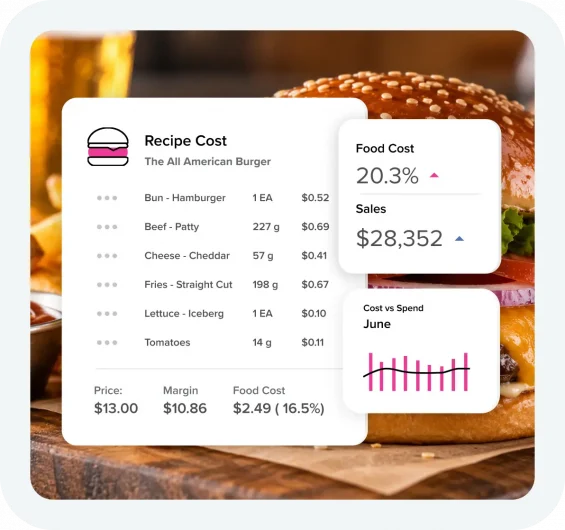
Recipe cost shows how much it costs your restaurant to make a specific recipe, based on the ingredients and quantities used. Use the calculator to find your total recipe cost and cost per serving. Knowing these costs helps you price menu items, understand margins, and see how changes in ingredient costs affect profitability.
Recipe Cost Formula
- Total Recipe Cost = Sum of (Ingredient Quantity × Unit Cost)
- Cost Per Serving = Recipe Cost ÷ Number of Portions.
Expert Insight
One of the biggest mistakes I see is inconsistent units of measure. An ingredient might be purchased by the case but used individually in a recipe. If those units aren’t accounted for correctly, your recipe costs won’t reflect what you’re actually spending. I always recommend making sure the unit used for costing matches how the ingredient is measured in your operation.
Accounting Specialist, Back Office
Add each ingredient in a recipe to find the total cost per portion — and what that means for your food cost %.
Looking for your restaurant's overall food cost % instead? Use the Food Cost Calculator — it works from inventory and total sales, not individual recipes.
Servings from the full batch
What you charge per portion
$Ingredients
One line each, priced the way you buy it, like $4.99 for 1 lb. Units convert automatically.
Recipe total
Cost per portion
—
Enter an amount and price for an ingredient to see its cost.
Drag to set the food cost % you're aiming for.
Is this a prep recipe?
For a sauce, dough or dressing, save the batch as one ingredient and cost the dish that uses it.
The calculator clears for the dish and adds this batch as its first ingredient, priced at the batch's total cost.
Costing every recipe on your menu? Back Office builds each recipe once and updates its cost with every invoice. See recipe costing software.
Want to see how this dish performs against your whole menu? Read the menu engineering guide.
A good recipe food cost percentage depends on ingredient costs, menu pricing, and the role each dish plays on your menu. While 28–35% is a commonly cited restaurant food cost benchmark, individual recipes can fall outside that range and still be profitable, depending on their contribution to margins and overall menu profitability.
The example below shows why it’s important to look beyond the percentage alone.
| RECIPE METRIC | EXAMPLE RECIPE |
|---|---|
| Cost per serving | $4.50 |
| Menu selling price | $15.00 |
| Recipe food cost percentage | 30% |
| Contribution margin per serving | $10.50 |
What this tells us: A 30% recipe food cost falls within a commonly cited benchmark, but the $10.50 contribution margin shows how much remains from the selling price after ingredient costs, before labor and other operating expenses.

There’s no magic food cost percentage that works for every restaurant. We worked with an operator who kept a ribeye on the menu at a 70% food cost because he believed it brought in business. But when we reviewed his product mix and daily sales reports, we found that the dish was driving his overall food cost percentage up by five percentage points. That’s why I always look beyond an individual recipe’s food cost to understand its impact on the business.
Onboarding Specialist, Back Office
Calculating recipe costs is Step 1. Keeping ingredient costs accurate, using that information to make informed menu pricing decisions, and identifying opportunities to reduce waste and control portions can help restaurants protect their margins over time.
Recipe costs can become outdated as supplier prices, ingredient, and portions change. Review costs when vendors update pricing, recipes change, or food cost trends shift unexpectedly. To keep costs current:
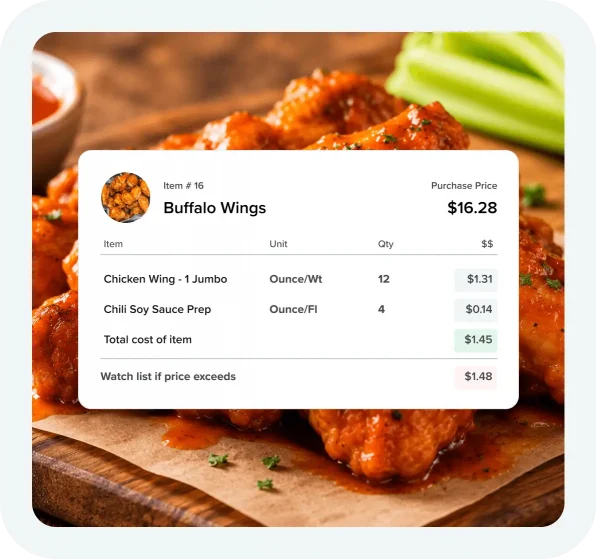
Track supplier price changes. Update ingredient costs when purchase prices change.
Account for usable yield. Factor in trimming, preparation loss, and waste to understand the true cost of each ingredient.
Standardize portions. Use consistent ingredient quantities so the cost of each serving stays aligned with your calculated recipe cost.
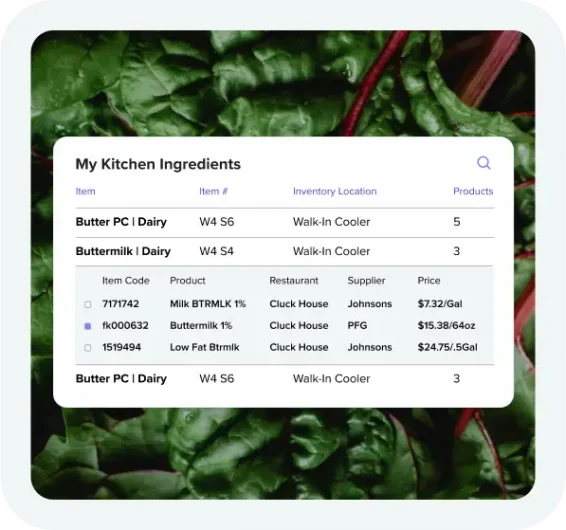
Check units of measure. Make sure purchase quantities convert correctly to the units used in each recipe.
Recipe costs provide a starting point for setting menu prices, but the right price depends on more than the cost of making a dish. Consider these factors:
Target food cost percentage. Divide cost per serving by your target percentage to estimate a starting menu price.
Contribution margin. Evaluate how much each sale contributes toward other expenses and profit after ingredient costs.
Sales volume. Consider how often a dish sells alongside its margin per serving to identify which items may need pricing adjustments.
Customer demand. Factor in perceived value and what guests are willing to pay before adjusting prices.
Reducing recipe costs starts with identifying ingredients and kitchen practices driving unnecessary spending, then making targeted changes that protect margins without sacrificing quality.
2-3%
Operators using Back Office have seen a 2-3% improvement in food costs across their business.
20%
Back Office members have seen a 20% reduction in food waste within the first 3 months of using our food costing software.
14%
First year members see, on average, up to a 14% increase in NET profit when using our tools.
See How Food Waste Impacts Your Recipe Costs
Accurate recipe costing helps you understand what a dish should cost. But spoilage, overproduction, and wasted ingredients can drive actual spending higher.
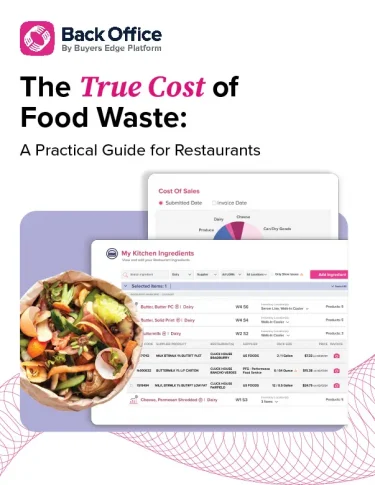
Download The True Cost of Food Waste to learn where waste occurs, how it affects profitability, and practical ways to reduce losses across purchasing, prep, inventory, and daily operations.
Everything you need to know about recipe costing, from calculating ingredient costs to pricing menu items and managing margins.
Recipe costing is adding up what every ingredient in a dish costs, then dividing by the number of portions it makes. It tells you what a plate actually costs before you decide what to charge for it.
Recipe Cost = the sum of (ingredient quantity × unit cost) for every ingredient. Divide that total by the number of portions to get cost per serving.
Add up total recipe cost, then divide by how many portions the recipe yields. A $3.85 recipe that makes one portion has a $3.85 cost per serving. The same recipe scaled to make 4 portions would run $0.96 per serving.
Recipe cost is the total ingredient cost of preparing a recipe, which may produce multiple servings. Plate cost is the ingredient cost of a single dish as served to a customer, including any sides, sauces, or garnishes. If a recipe produces multiple servings, its total cost is divided by the number of servings to calculate the cost per portion.
$3.85 per serving with a 30% target food cost percentage would have a starting price of $12.83. From there, consider your margins, customer demand, and market pricing before setting the final price.
A good recipe food cost percentage depends on the dish, restaurant concept, and overall menu profitability. While 28–35% is a commonly cited restaurant food cost benchmark, individual recipes may fall above or below that range. Evaluate each dish's contribution margin and sales volume alongside its food cost percentage to determine whether pricing or recipe adjustments are needed.
Divide the ingredient's cost by its yield, the share left after peeling, trimming or boning. Onions lose about 10% to stem ends, sprouts and defects (USDA), so 2 lb of diced onion at $0.48 a pound costs $0.96 ÷ 0.90 = $1.07.
In this calculator, open Trim / yield on the line and it suggests the USDA figure for common produce. Leave whole items like 5 each onions at 100%: you paid for the whole onion, so the trim is already in the price. Cooking shrinkage works the same way; enter your own number for it.
Review recipe costs whenever supplier prices, ingredient quantities, or preparation methods change. Even without noticeable changes, a consistent review process can help catch outdated costs and protect margins. High-volume dishes or recipes with frequently fluctuating ingredient prices may need more frequent updates.

Reach out today and one of our local reps will contact you to discuss your goals.
Looking for more solutions? Explore other helpful calculators below.