

Scaling a restaurant business goes far beyond opening additional locations. It’s about implementing standardized processes that can be repeated across units, financial controls that provide clear and timely insights, and a tech stack that keeps the entire operation connected.
Scaling a restaurant starts with establishing controls before pursuing growth. With a strong technology foundation, operators gain the reporting, visibility, and consistency they need to manage location 10—or 100—with the same clarity as location one.
Common Challenges Restaurants Face When Scaling
Scaling a restaurant business often reveals weaknesses that were manageable at one location, but that become harder to control as additional units open. As operations expand, patterns tend to emerge.
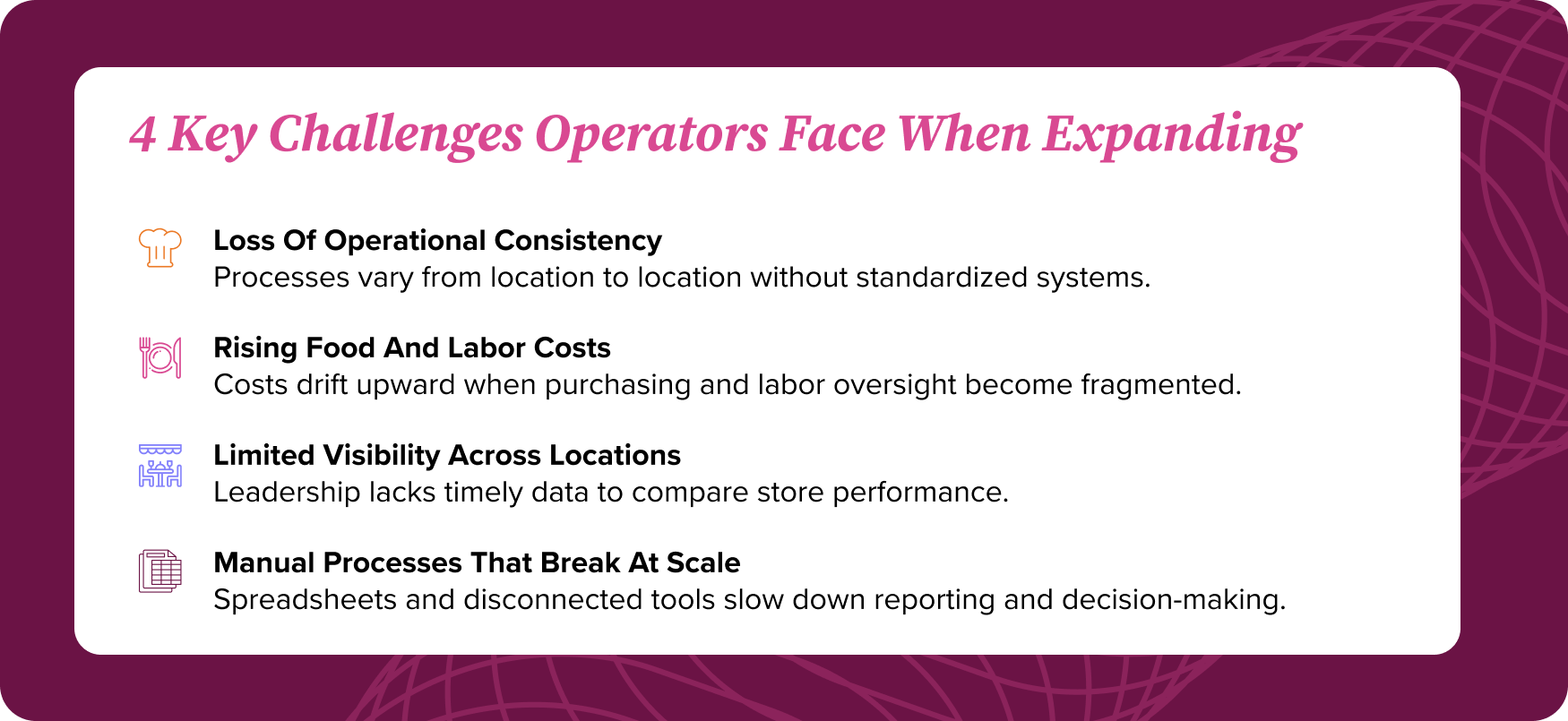
Loss of Operational Consistency
What worked because of one strong general manager won’t automatically translate to a different location. Without standardized inventory procedures, recipe execution, and financial reporting, each unit operates differently. This is where margin erosion lives.
Rising Food and Labor Costs
During expansion, purchasing becomes more layered and harder to monitor. Vendors may differ by region, and receiving procedures often shift depending on the layout or setup of each location. Without a centralized way to track and compare performance, food and labor costs can drift upward gradually, making it difficult for leadership to spot issues before they start affecting margins.
Limited Visibility Across Locations
When reporting depends on emailed spreadsheets or manual uploads, decision-making lags behind on-the-ground reality. By the time leadership sees the full picture, the issue may already be impacting multiple stores.
Manual Processes That Break at Scale
As operations expand, everyday administrative tasks can become overwhelming. Payroll may require approvals across multiple systems, invoices might sit waiting to be manually entered, and managers could be tracking inventory in different formats from one location to the next. What once felt manageable at a single store can quickly slow down the entire organization as additional units come online, turning routine processes into operational bottlenecks.
Building a Strong Operational Foundation Before Scaling
Before adding locations, operators need to make sure the business runs consistently and predictably. Growth tends to magnify whatever systems are already in place, including the subpar or outdated ones.
Standardization should be the first priority. For example, receiving procedures should follow the same structure at every unit. Inventory counts should be conducted the same way, on the same schedule. Reporting cadence and vendor management should be consistent so leadership can compare apples to apples in terms of store performance. This makes deviations much easier to spot and correct.
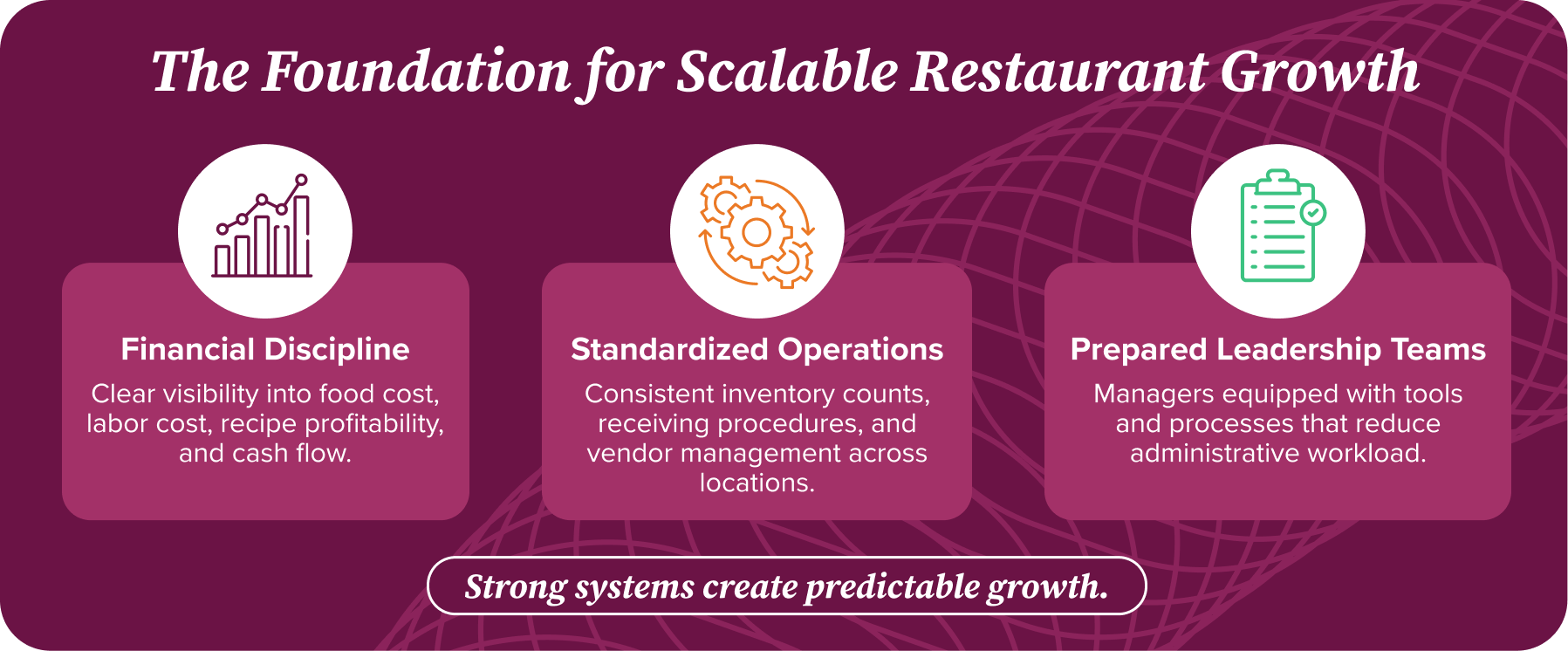
Financial discipline is also critical. Operators need timely visibility into food and labor costs, consistent invoice coding, accurate recipe costing, and cash flow tracking. With centralized financial data, leaders can compare store performance without stitching together spreadsheets at the end of the month.
Finally, teams must be prepared for the realities of growth. Scaling is not only operational—it’s cultural, too. It requires clear roles, accountability, and tools that reduce administrative time. When managers aren’t overwhelmed by paperwork and disconnected systems, they can focus on delivering strong guest experiences across every location.
How Technology Helps Scale a Restaurant Business
One of the most important advantages of modern systems is centralized oversight. Cloud-based platforms make it possible to monitor multiple locations from a single dashboard, whether reviewing inventory usage, labor performance, or financial summaries. Instead of piecing together reports from different stores, leadership can quickly identify trends and respond when one location starts to drift.
Automation also plays a critical role. Invoice processing, payroll integration, and consolidated reporting no longer have to depend on repeated manual entry. As these tasks become streamlined, errors decrease, and managers recover valuable time that can be redirected toward team leadership and guest service. Stronger restaurant forecasting, for example, allows operators to better plan labor and purchasing.
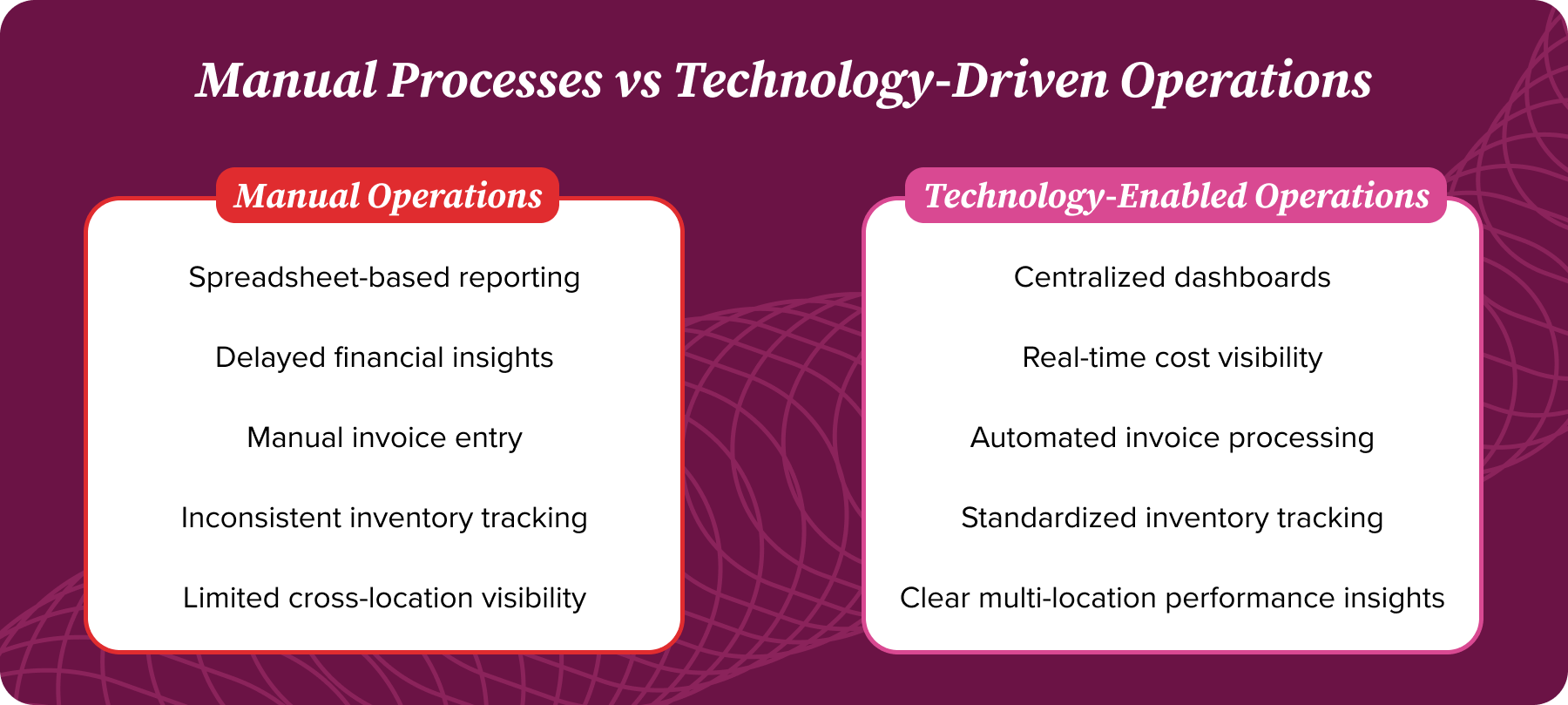
Real-time cost visibility is another must-have. Access to up-to-date cost-of-goods data, labor costs and variance reporting enables leadership to address issues before they escalate. Integrated data analytics bring these insights together to support more informed pricing, vendor negotiations, and workforce planning.
Tools That Matter Most When Scaling a Restaurant
As growth accelerates, the systems that once supported a single unit need to handle a much larger operational footprint. Choose tools that are built to manage the complexity of several locations, not just one store.
Accounting Software
Centralized accounting ensures financial statements are comparable across units. It simplifies budgeting and helps leadership evaluate store-level profitability accurately.
Inventory Software
Inventory platforms standardize counts, track usage patterns, and reveal variance across locations. This reduces waste and tightens food cost controls.
Reporting and Analytics Software
Consolidated reporting replaces manual spreadsheet aggregation. Integrated analytics tools provide a clearer performance snapshot across multiple units.
Payroll Software
Payroll systems must integrate with timekeeping and accounting to reduce duplication and errors. As headcount increases, efficiency becomes critical.
Recipe Costing Software
Recipe costing platforms protect margins by tracking ingredient-level changes and updating menu item profitability in real time.
Food Cost Management Software
Integrated restaurant software brings these pieces together. Solutions that consolidate accounting, inventory, forecasting, and reporting into one ecosystem simplify scaling.
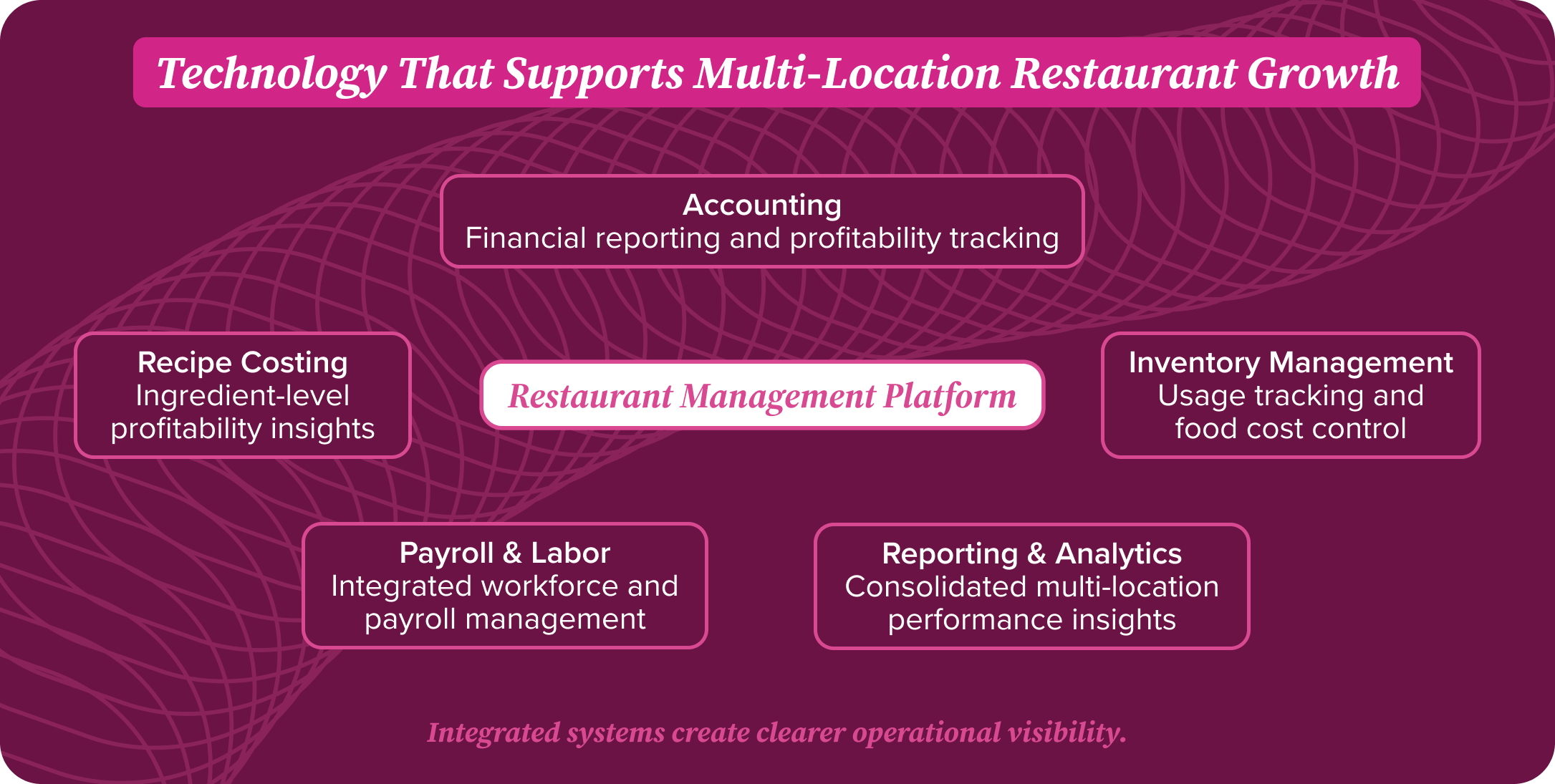
Operators looking to evaluate options may consider reviewing different types of restaurant software and features before adding new systems.
How to Select Tools for a Scalable Restaurant Business
When selecting technology to support scaling a restaurant business, think about whether a system will still serve the business effectively at three, 10, or 50 locations. Here are some factors to keep in mind:
Ability to Support Multi-Location Growth
Ensure the system can handle multiple entities, consolidated reporting, and unit-level visibility without requiring separate accounts or workarounds.
Integration With Existing Systems
The tech stack should connect POS, payroll, vendor systems, and accounting without manual exports. Strong integrations reduce friction and improve data accuracy.
Ease of Use for Operators and Finance Teams
If managers avoid using a system because it’s complex, adoption suffers. Tools should simplify workflows, not add steps.
Long-Term ROI and Operational Impact
The right system reduces errors, shortens reporting cycles, and improves financial control. ROI should be measured in time saved, errors reduced, and margin protected—not just subscription cost.
Scale Your Restaurant Business with Confidence
Expansion should feel structured, not chaotic. When processes are standardized and systems are unified, scaling is sustainable, not reactive.
The growth phase is an exciting time for any brand. Having the right technological foundation empowers operators to expand with clarity, control, and confidence.
If you’re ready to bring greater visibility, control, and consistency to every location, contact our team at Back Office to see how we can help you scale with confidence.
FAQs
When is the right time to scale a restaurant business?
When your current location runs smoothly without constant supervision, it’s time to scale. If your inventory procedures, recipes, financial reports, and management duties are already the same across the board, it will be much easier to grow. When a business grows, it tends to make existing systems work better. This is why it’s important to have clear processes and good financial visibility before opening a new location. This will help make sure that the new units run just as smoothly as the first one.
Can technology help scale a restaurant without increasing costs?
Yes. The right technology often reduces costs by replacing manual work and improving visibility into operations. Automated invoice processing, inventory tracking, and centralized reporting help managers spend less time on administrative tasks and more time running the business. Just as important, better data helps operators spot cost issues early and protect margins as they grow.
What systems should be in place before opening a new location?
Before opening another location, it helps to have a few core systems running smoothly behind the scenes. Financial reporting should be clear and consistent, so you know exactly how the business is performing. Inventory counts and ordering should follow the same process every week, and recipes should already be costed so you understand your margins. When those basics are dialed in, opening a second or third location feels much more manageable because you’re repeating a system that already works.
How does back office technology support multi-location restaurants?
Back office technology lets operators see what’s going on in multiple restaurants without having to go to each one to get reports. Leaders don’t have to rely on spreadsheets or emails from managers anymore. They can log in and see all of their purchases, inventory, and financial performance in one place. It’s much easier to spot small problems early and keep all locations running the same way when you can see that.