

If you’ve ever looked at your restaurant’s bank account and wondered why the balance doesn’t match what your POS says you made, you’re not alone. Between card payments, cash deposits, and delivery-app payouts, there’s a lot to keep track of. Restaurant bank reconciliation helps you sort through those transactions and figure out where the differences are coming from.
What Is a Bank Reconciliation Report?
A bank reconciliation report compares your internal financial records to the records in your actual bank statement. The goal is to make sure that every transaction recorded in your books matches what your bank says happened. This process can help you spot errors more quickly, ensuring that your cash balance is accurate and preventing costly mistakes down the line.
Why Bank Reconciliation Matters for Restaurants
Calculating a bank reconciliation report helps ensure your restaurant’s cash records are accurate, helping you stay on the most solid financial footing. Regularly comparing your book balance and bank statements also helps to protect your business from fraud or bank errors that might otherwise go unnoticed. This report also serves as an important verification tool by ensuring that any vendor fees or other variable charges are in alignment with your expectations and your contract agreements. Cash is one of your most valuable assets, so effective cash management should be a priority for your business.
How to Reconcile Your Restaurant Bank Account: 6 Steps
Here’s how it works:
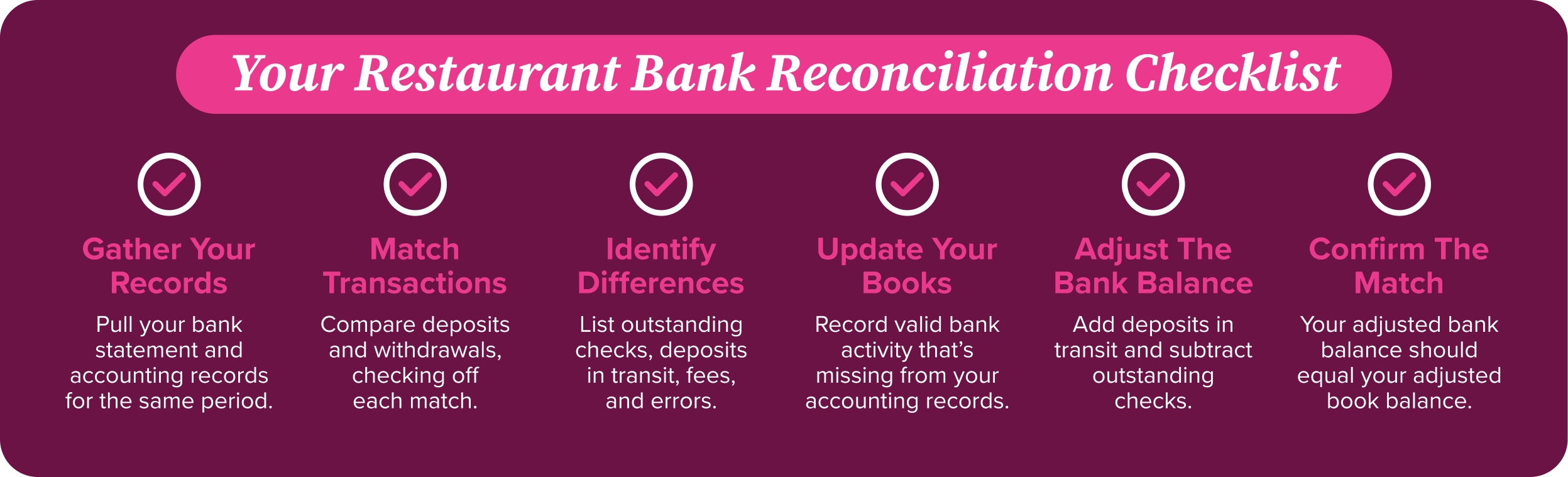
- Start with your bank statement from the period you want to reconcile.
- Compare each deposit and withdrawal from your bank statement to the same transactions in your internal accounting records, checking them off as they are matched.
- Make a list of discrepancies, such as outstanding checks or bank fees that haven’t been entered into your internal records.
- Adjust your books as needed to include any bank activity that is valid but hasn’t yet been included in your accounting system.
- Calculate your adjusted bank balance by taking the balance listed on your bank statement, subtracting any outstanding checks or charges that you have recorded but haven’t yet processed through the bank, then adding in any deposits in transit or other cash increases that you have recorded but haven’t arrived at the bank.
- Verify that your adjusted bank balance and the current cash balance in your accounting records match.
The Right Reconciliation Cadence: Daily, Weekly, Monthly
There’s nothing fun about sitting down at the end of the month and trying to figure out why a deposit from three weeks ago doesn’t match your records. By then, the manager who closed that night might not remember what happened, and finding the paperwork can be a project of its own.
That’s why bank reconciliation shouldn’t be something you only think about once a month.
- Daily: Check your cash drawers against the POS report. Make sure safe drops and deposits are documented, and flag anything that doesn’t add up before the next shift starts.
- Weekly: Look at card payments that haven’t settled, outstanding checks, delivery-app deposits, and processing fees. If something’s been sitting there longer than expected, find out why.
- Monthly: Go through the full bank statement and reconcile it against your accounting records.
Doing a little throughout the month beats having to untangle everything at once.
POS-to-Bank Reconciliation: Matching Sales to Deposits
Here’s where restaurant bank reconciliation can get tricky. Your POS tells you what you sold, but the bank tells you what actually landed in your account. Those numbers aren’t always going to match, at least not right away.
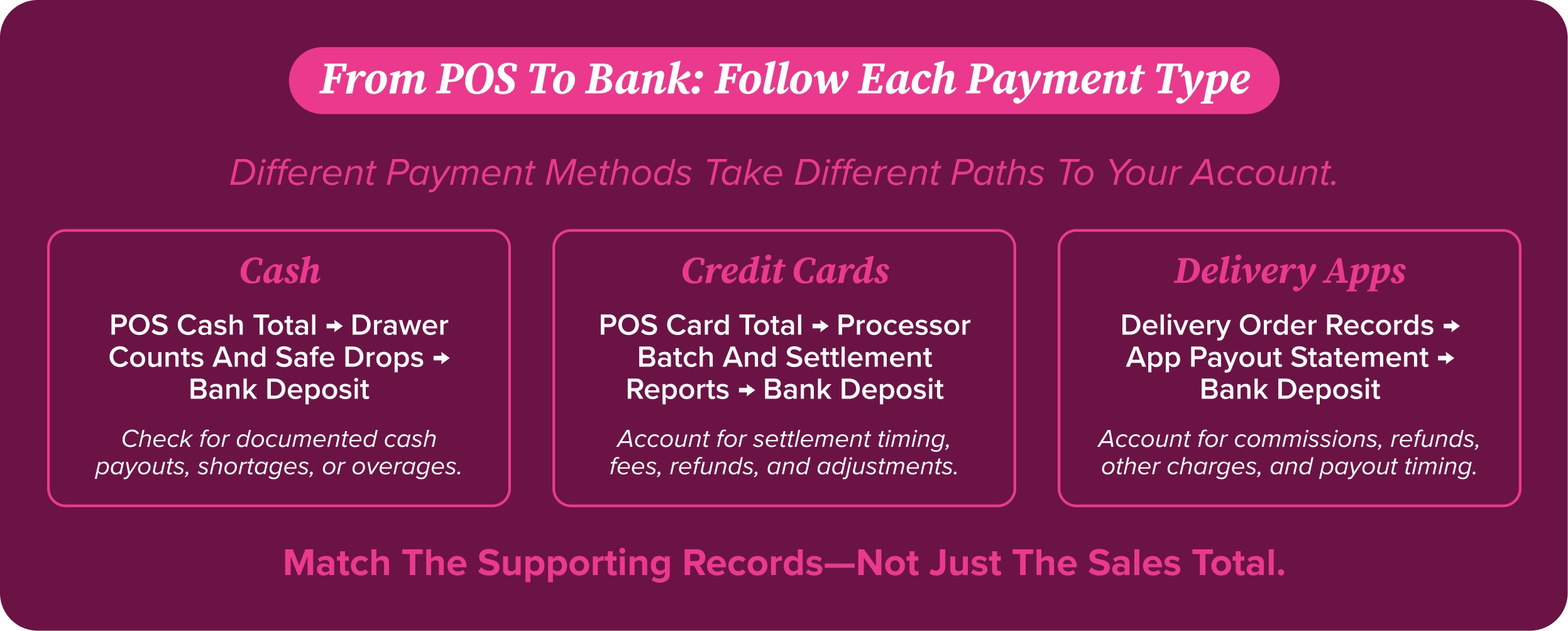
Say your restaurant closes out a busy Saturday with $6,200 in sales. That doesn’t mean you’re going to see a $6,200 deposit on Sunday morning. Some of those sales were cash, some were credit cards, and some might have come through a delivery app that won’t pay you until later in the week.
To figure out what’s what, start with your POS Z report. This is your end-of-day sales summary, and it’s what you’ll use to check how much came in through each payment type.
Next, pull your credit card batch reports. Compare those totals against the deposits coming from your processor. Keep in mind that weekend transactions may take a few business days to settle.
For cash, compare the POS totals against what was counted in each drawer. Check the safe drops and make sure the amount taken to the bank matches what’s documented.
Tips need attention, too. Depending on how your restaurant handles them, credit card tips might be paid out in cash or through payroll. Either way, they need to be accounted for separately so they don’t throw off your numbers.
Before closing out the day, keep the Z report, batch totals, cash counts, and deposit information together. If something doesn’t match later, you won’t have to go hunting through a pile of paperwork to figure out what happened.
Common Restaurant Reconciliation Variances
You can have a perfectly normal day of sales and still end up with a bank deposit that doesn’t match your POS. That’s because the amount you sell isn’t always the amount you receive.
A few common reasons:
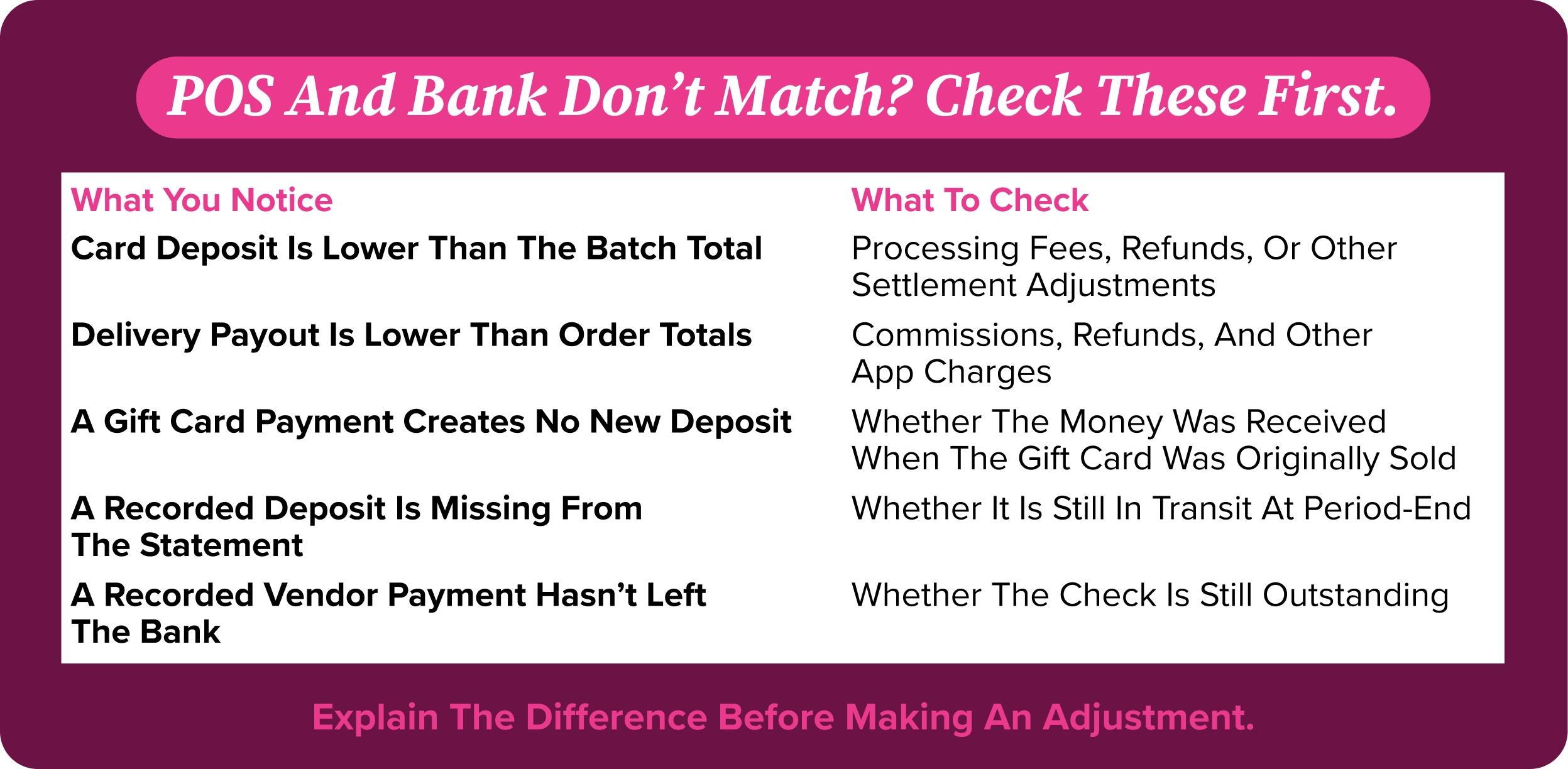
- Credit card processing fees: Let’s say your restaurant processes $4,000 in card payments, but the processor deposits $3,900. If the missing $100 went toward processing fees, you’ll need to record that expense rather than treat it as missing revenue.
- Delivery-app payouts: Third-party delivery services don’t necessarily send you the full amount of every order. Commissions, refunds, and other charges can come out before the payout reaches your account.
- Gift card redemptions: When someone pays for dinner using a gift card they bought last month, you’re not collecting new money. You’re using funds that were already received and recorded as a liability.
- Deposits in transit: A deposit recorded on the last day of the month might not appear in your bank account until the first few days of the next month.
These differences aren’t necessarily problems. You just need to know what’s causing them and make sure they’re recorded correctly.
Clearing Accounts & a Clean Chart of Accounts
One thing that can make bank reconciliation a lot less frustrating is having separate clearing accounts for payments that haven’t hit the bank yet.
Think about your credit card sales. Your POS records the transaction today, but the processor might not send the money until two days from now. A clearing account gives you somewhere to track that amount while you’re waiting.
The same idea works for delivery-app payments.
When the deposit finally comes through, you match it against the clearing account and account for any fees or adjustments.
This works best when your chart of accounts isn’t a mess. Keep card payments, delivery payouts, and gift card activity organized under the appropriate accounts. Otherwise, you’re still going to spend time sorting through transactions that should have been separated in the first place.
Internal Controls & Separation of Duties
Nobody wants to find out three weeks later that a cash drawer was short and no one knows why.
That’s why cash-handling procedures matter just as much as the actual bank reconciliation.
Have employees count their drawers at the end of each shift. Document safe drops, keep deposit records, and make sure shortages or overages are written down, even when they’re small.
A few dollars might not seem worth chasing, but if the same drawer keeps coming up short, that’s something a manager needs to look into.
It’s also a good idea to have someone other than the person handling the money review the records. In a smaller restaurant, that might be the owner checking the deposits and reports.
You don’t need a complicated process. You need one that people follow consistently.
Example: A Restaurant Bank Reconciliation
Let’s say you’re reviewing your restaurant’s finances at the end of the month.
Your bank statement shows $18,500, but your accounting records say you should have $20,000. That’s a $1,500 difference, and you need to find out what’s behind it.
You start going through your reports.
Your POS Z report from the last day of the month shows $5,000 in sales. Of that, $3,500 came from credit cards and $1,500 was cash.
The cash was deposited and has already cleared. The $3,500 credit card batch, however, is still being processed.
You also find $2,000 in vendor checks that have been recorded in your books but haven’t cleared the bank.
Now the difference makes sense.
Transaction
Amount
Bank statement balance
$18,500
Add: Credit card deposit in transit
+$3,500
Less: Outstanding vendor checks
-$2,000
Adjusted bank balance
$20,000
Book balance
$20,000
Difference
$0
Nothing was actually missing. The transactions just hadn’t finished moving through the bank.
That’s what you’re looking for during bank reconciliation: an explanation for the difference and confirmation that your records are right.
Final Thoughts
Bank reconciliation probably isn’t the part of restaurant ownership that gets anyone excited. But when you’re dealing with cash, credit cards, delivery payments, and vendor bills every day, you need to know that your numbers are right.
And the longer you wait to check them, the harder it gets to figure out what happened.
Keeping up with your daily reports and monthly bank reconciliation gives you a much better picture of where your money stands.
Of course, finding time for all of that while running a restaurant isn’t always easy. That’s where Back Office by Buyers Edge Platform can help. Our restaurant accounting services take some of that work off your plate, so you can spend less time sorting through transactions and more time running your business.
Click here to learn more about how Back Office can help with your restaurant accounting needs. You can request a demo here!
Frequently Asked Questions
What does a bank reconciliation report do?
A bank reconciliation report compares your internal financial records to the records in your actual bank statement. The goal is to make sure that every transaction recorded in your books matches what your bank says happened.
How often should a restaurant do a bank reconciliation?
Reconcile each period consistent with your accounting periods, and ideally run a daily check on register transactions.
What causes discrepancies in a bank reconciliation?
Common causes are outstanding checks or bank fees that haven’t been entered into your internal records, plus processing fees, delivery payouts, and deposits in transit.
What is an adjusted bank balance?
Calculate your adjusted bank balance by taking the balance listed on your bank statement, subtracting any outstanding checks or charges that you have recorded but haven’t yet processed through the bank, then adding in any deposits in transit or other cash increases that you have recorded but haven’t arrived at the bank.
How do you reconcile POS sales to bank deposits?
Start with your POS Z report and look at how much you collected in cash, credit cards, and other payment types.
For card sales, compare your batch reports against the deposits from your payment processor. Remember, those payments might not reach your bank for a day or two.
For cash, check the drawer counts and safe drops against the amounts deposited.
You’ll also need to account for tips, processing fees, delivery-app commissions, and gift card transactions. Those can all affect the amount that reaches your bank.
If something still doesn’t add up, go back through the individual transactions and settlement dates. Sometimes it’s just a timing issue. Other times, there’s a fee or adjustment that hasn’t been recorded yet.