


Over the past few years, artificial intelligence (AI) has fundamentally reshaped how food businesses forecast demand, manage labor, control inventory, and protect margins. From predictive scheduling to automated purchasing, the use of AI in the food industry promises faster decisions and leaner operations. Yet for many business owners, the challenges of AI in the food industry cause its adoption to feel less like a secret sauce and more like stone soup—throwing in random ingredients and hoping for the best. AI becomes a true secret sauce only when operators follow a recipe that includes a defined strategy, quality inputs, and a solid operational framework.
Why AI Adoption Is Difficult in the Food Industry
AI is becoming an increasingly valuable part of food operations, especially as restaurant operators look for smarter ways to control costs, improve forecasting, and operate more efficiently in a high-pressure environment. From demand prediction and labor optimization to inventory automation, AI is transforming the restaurant industry by helping leaders make faster, more data-driven decisions. Yet despite its growing presence, adoption has not been simple or seamless for most food businesses.
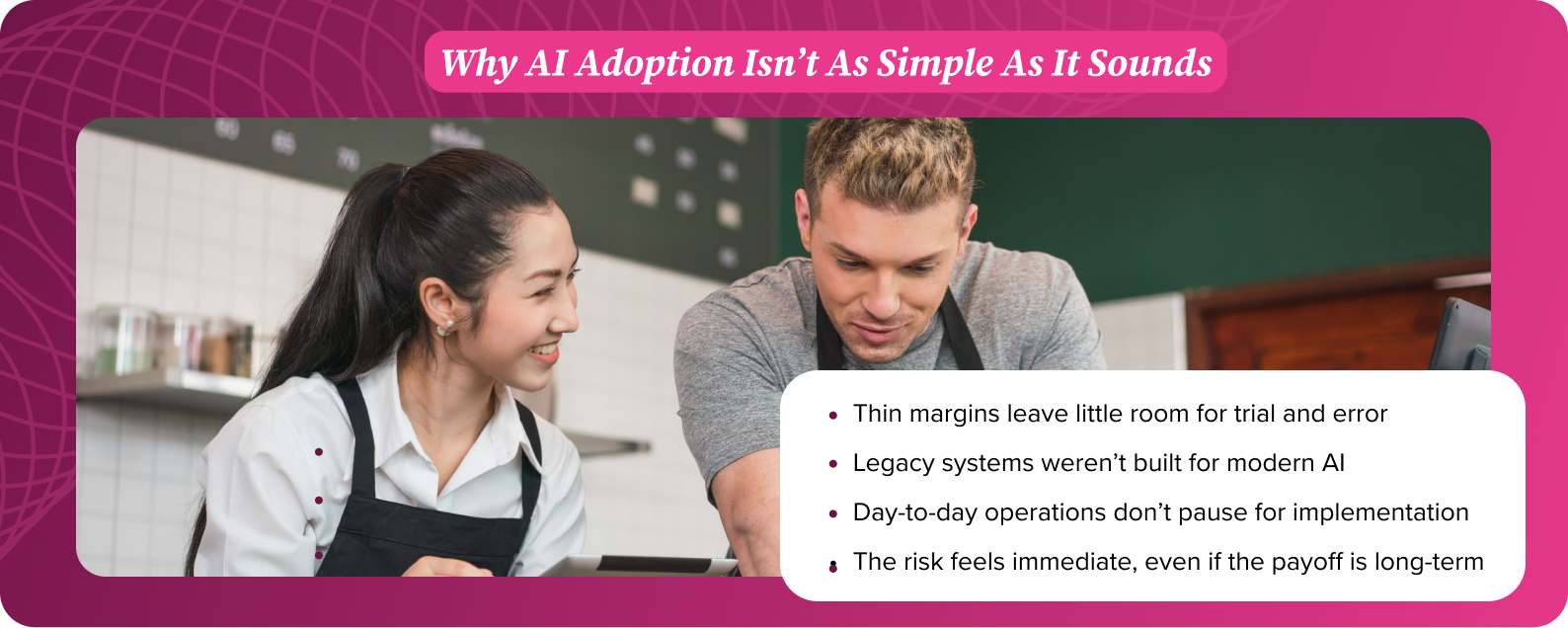
The reality is that restaurants operate within complex environments that require balancing competing priorities. Thin margins leave little room for error and day-to-day operations rarely slow down enough to allow for intentional decision-making. The promise of a tool that can streamline operational processes is compelling, but the path to AI implementation that actually delivers results can feel risky, expensive, and overwhelming. Ultimately, the successful use of AI in restaurant operations depends on clearly understanding common challenges and putting the right strategies in place to overcome them.
Technical Challenges of AI in the Food Industry
While AI offers powerful capabilities, its effectiveness in the food industry is heavily dependent on a strong technical foundation. Many adoption issues stem from the underlying systems, data, and infrastructure required to make AI work reliably at scale.
Poor Data Quality
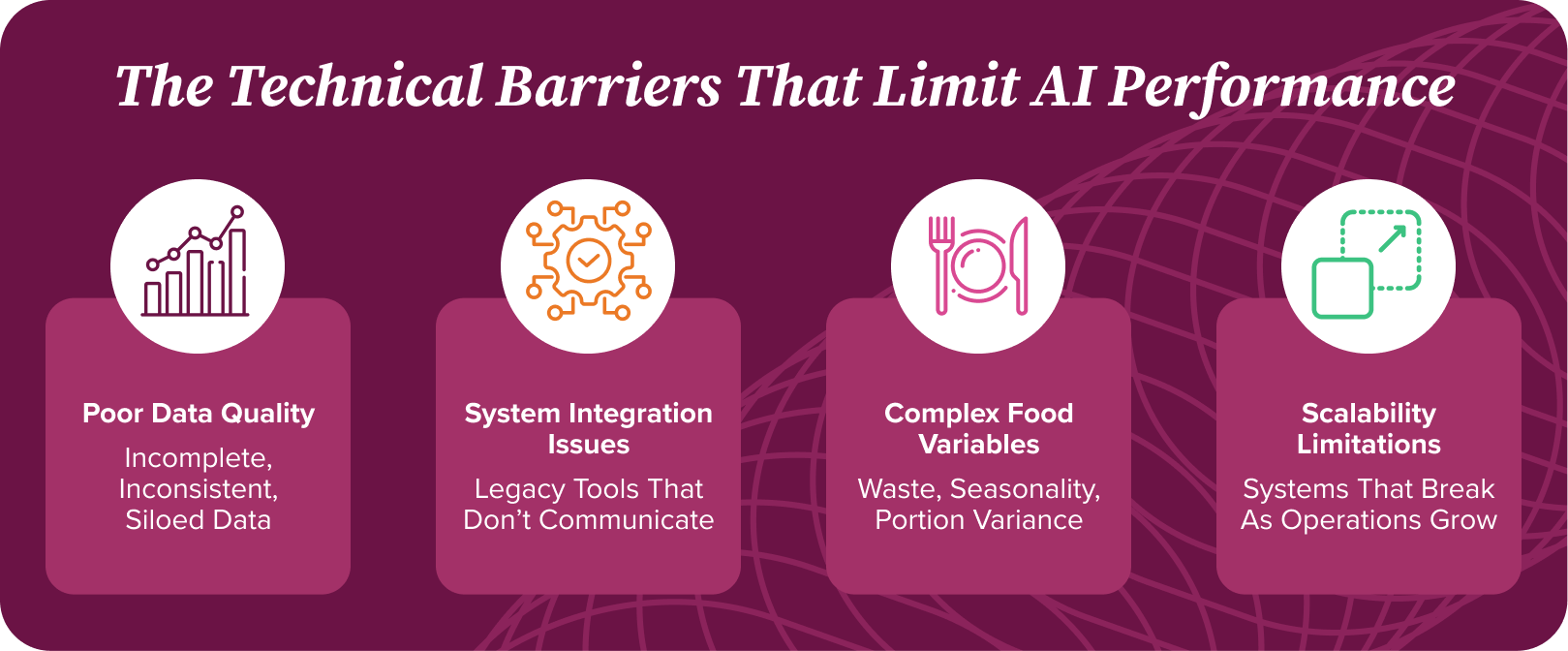
AI systems are only as effective as the data they’re trained on. In many restaurants, data is incomplete, inconsistent, and siloed across POS, inventory, and labor systems. Standardizing data inputs and integrating systems creates a single source of truth, leading to improved inputs (and outputs) for your AI tools.
Difficulty Integrating AI with Existing Systems
Many AI initiatives struggle because they are introduced into legacy systems that were never designed to work together. Restaurants often rely on legacy accounting and inventory systems that don’t easily sync with modern AI platforms. Selecting AI solutions built specifically for restaurant tech stacks reduces friction and makes your AI projects more seamless.
Complexity of Food Attributes
AI models perform best in predictable environments, but food operations are quite the opposite. Operators must consider variables like perishability, waste, menu changes, portion variance, and seasonality, all of which complicate forecasting and automation. Using AI tools purpose-built for food operations helps ensure these nuances are properly factored into any recommendations.
Scalability Limitations
Even AI solutions that work well in a small, controlled environment can struggle when volume and operational complexity increase. In restaurant environments, differences across locations, concepts, vendors, and pricing can strain systems that aren’t designed to scale. Choose flexible, cloud-based platforms that scale across locations and grow with the business to prevent performance issues as operations expand.
Financial and Operational Challenges
Beyond the technical hurdles, many restaurant leaders struggle with the financial and operational realities of implementing AI. Even when the long-term value is clear, short-term costs and workflow disruptions can make adoption feel risky in an industry where stability and consistency are critical to daily success.
High Maintenance Costs
AI solutions often come with ongoing costs beyond the initial purchase. For restaurants operating on thin margins, expenses tied to system updates, data management, and vendor support can make AI feel financially risky. Clearly defining ROI goals upfront and starting with high-impact use cases helps to ensure costs are paired with measurable savings.
Lack of Skilled AI Professionals
AI adoption can sometimes fall flat due to the additional expertise needed to manage and interpret AI insights. Many restaurants are not staffed with data scientists or technical specialists, leaving managers feeling overwhelmed with how to effectively use the results. Choosing intuitive tools and investing in targeted training allows you to benefit from AI insights without the need to expand your team’s headcount.
Operational Disruption During Transition
Introducing an AI initiative often requires making changes to existing workflows, which can temporarily disrupt day-to-day operations. In fast-paced restaurant environments, even small process changes can create confusion or slow down your team if not managed carefully. Aligning your AI tools with existing workflows minimizes disruption, while phasing implementation gives your team time to adapt.
Ethical and Human Challenges
As restaurants introduce more automation and data-driven tools, leaders must carefully balance efficiency gains with ethical responsibility, employee trust, and the guest experience that defines their brand.
Data Privacy and Security Concerns
AI systems rely on large volumes of sensitive data, including employee information, sales trends, and customer behavior. Without strong security protocols, this important restaurant data can be vulnerable to breaches, eroding trust with your customers and employees. Choosing AI solutions with built-in access controls, encryption, and regular security audits helps protect data while maintaining trust and compliance.
Fairness and Bias in AI Algorithms
AI models learn from historical data, which can unintentionally reflect existing biases in scheduling, hiring, or performance evaluation. If left unchecked, these biases may lead to unfair outcomes that impact employee morale and compliance. Conducting routine audits and maintaining human oversight ensure AI-driven recommendations stay fair and balanced.
Job Displacement and Workforce Uncertainty
Automation often raises concerns about job loss or reduced hours, particularly among frontline staff. Restaurant employees may fear being replaced when technology is introduced without clear context. Providing transparent communication about AI’s role in helping team members to accomplish their jobs more efficiently can help to build trust and encourage adoption.
Loss of Human Touch in Food Experiences
AI-driven automation can create concerns that efficiency will come at the expense of hospitality. In the food industry, automating customer-facing processes can limit the personal interactions that define the guest experience. Using AI primarily to streamline back-of-house tasks allows you to leverage efficient tools, freeing you up to spend more time engaging with guests.
Regulatory and Compliance Challenges
As the use of AI expands, restaurant operators must also contend with an increasingly complex regulatory landscape. Once AI starts guiding real-world operational decisions, restaurants are accountable for how those decisions are made and documented.
Adapting to Evolving AI Regulations
AI regulations are still taking shape, with new guidelines emerging around data usage, automation, and algorithmic decision-making. For restaurant operators, keeping pace with changing requirements can be challenging, especially when operating across multiple regions with varying regulatory expectations. Work with a technology partner who can actively monitor regulatory changes and notify you when updates are relevant to your operation.
Data Governance and Accountability
AI-driven decisions rely on accurate, well-managed data. Without clear ownership, access controls, and documentation, it becomes difficult to trace how decisions are made or who is responsible when errors occur. Establishing defined data ownership and documentation processes ensures accountability and supports compliance initiatives.
Compliance with Food Quality and Safety Standards
AI tools increasingly influence ordering, inventory rotation, and food handling decisions. If systems aren’t aligned with established food safety protocols, this can introduce risk. Use AI workflows that are purpose-built for food safety monitoring and that reinforce quality and safety standards.
Audit and Traceability Challenges
Regulatory audits often require detailed documentation of inventory movement, supplier data, and operational decisions. AI systems that lack audit-ready reporting can make compliance more difficult. Verify that your platforms provide traceable, clear data outputs to protect your business and simplify the process of meeting audit requirements.
How to Overcome AI Challenges in the Food Industry
Despite the obstacles, many innovative restaurant owners are successfully managing AI in their operations by taking a practical, phased approach. By starting with some important fundamentals, operators can turn AI from a challenge into a competitive advantage.
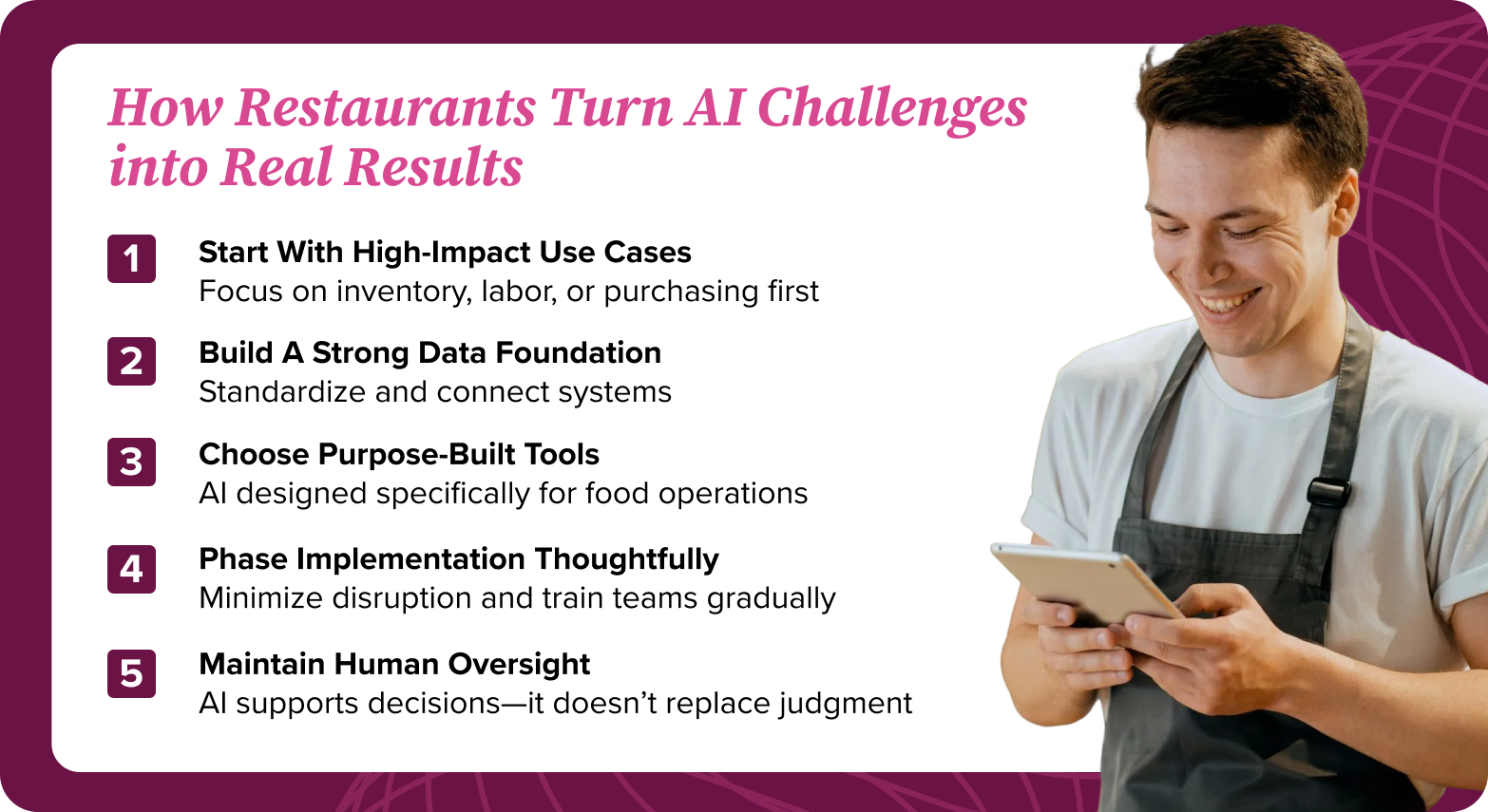
- Invest in quality data and infrastructure: Start by cleaning, standardizing, and centralizing data across integrated POS, labor, and inventory systems. Reliable data and modern infrastructure ensure AI tools generate accurate insights that you can trust and act on confidently.
- Train employees and build digital skills: Provide ongoing training that helps managers and teams understand AI insights and how to use them. Building digital literacy increases adoption, reduces resistance, and ensures technology supports operations.
- Implement clear ethical guidelines: Define how AI will be used, what decisions it can influence, and where human oversight is required. Clear guidelines promote transparency, minimize bias, and help maintain trust among employees and stakeholders.
- Choose scalable and flexible AI solutions: Select AI platforms tailored to the food industry that can adapt across locations, menus, and concepts. Flexible solutions reduce future rework and allow you to scale without sacrificing performance or consistency.
- Strengthen data security and compliance measures: Implement strong access controls, regular audits, and compliance monitoring to protect sensitive data. Proactive security practices reduce risk while ensuring your AI systems align with regulatory and food safety requirements.
Where AI Fits in the Future of Restaurant Operations
AI adoption in the food industry is no longer a “nice to have,” and when used thoughtfully and intentionally, it brings a meaningful competitive advantage to your operation. While the challenges are real, they don’t have to be barriers to progress. By understanding and preparing for common AI challenges in advance, you can choose solutions that best fit the nuances of your operation. With the right strategy, AI becomes less about experimentation and more about building a comprehensive infrastructure that helps you scale confidently and support long-term growth.
Frequently Asked Questions
What are the biggest challenges of AI in the food industry?
The biggest challenges typically include poor data quality, integration with existing systems, ongoing costs, workforce readiness, and regulatory complexity. Most issues stem from foundational gaps rather than the technology itself. When these areas are addressed, AI becomes far more practical and impactful.
Is AI safe for food production and processing?
When implemented correctly, AI can enhance food safety by improving forecasting, inventory rotation, and quality monitoring. However, it must be supported by strong data governance, regular oversight, and compliance with established food safety standards.
How can small food businesses adopt AI affordably?
Small operators can start by focusing on targeted use cases, such as labor forecasting or inventory optimization, rather than full-scale AI transformation. Choosing scalable, cloud-based tools and a supportive technology partner can ensure your investment in AI will deliver measurable results immediately without extensive trial and error.
Will AI replace human jobs in the food industry?
AI is not replacing jobs; it’s redefining them. By automating repetitive tasks and improving decision support, AI frees managers and staff to focus on leadership, hospitality, and problem-solving. The most successful restaurants use AI to empower people, not eliminate them.