


From order totals and labor hours to social reviews and inventory usage, restaurants generate thousands of data points each day. But many operators let this valuable information go untapped. Data is your restaurant’s most valuable ingredient, shaping everything from menu performance to team efficiency and guest satisfaction.
When you learn to analyze this data thoughtfully and intentionally, it can reveal key operational patterns hiding in plain sight. Data analytics isn’t about complicated math or algorithms; it’s about understanding the numbers to strengthen your operation and make smarter, faster decisions.
What Is Restaurant Data Analytics?
At its core, restaurant data analytics is the practice of reviewing your restaurant’s historical data (e.g., sales, labor, inventory, and customer behavior) to identify patterns and insights. It’s the step that should serve as the foundation for your operational analysis process, coming before forecasting or making decisions.
Data analytics doesn’t try to predict the future or explain why something happened; instead, it looks objectively at what has already occurred. By removing assumptions and focusing on facts, it helps operators see the patterns, trends, and opportunities in their restaurant’s performance that might otherwise go unnoticed.
Why Is Data Analytics Vital for Restaurants?
For restaurant owners and managers, your ability to make effective decisions that keep your restaurant profitable depends on understanding how your operation performs today and how it might perform tomorrow. That’s why the strongest strategies combine both data analytics and predictive analytics.
Data Analytics vs. Predictive Analytics
Data analytics is a powerful tool for providing visibility in your operation. It helps you understand what happened in your business, then turns that raw information into actionable insights that can guide you on where to focus your efforts for long-term improvement. Predictive analytics, on the other hand, uses that foundation to anticipate what’s next. Together, these tools provide the clarity to act quickly when changes happen and take advantage of opportunities as they arise.
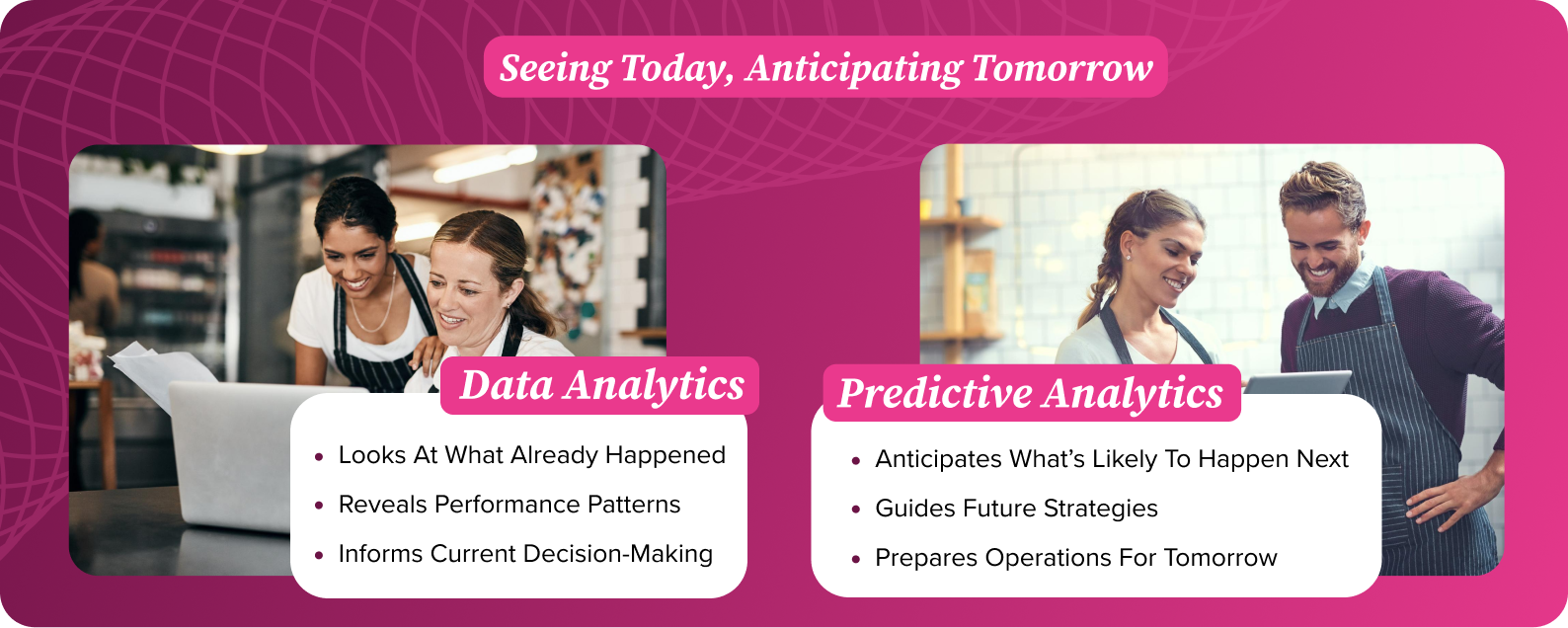
Here’s how these two approaches work together to support a strong data strategy:
- Data analytics looks at what already happened, while predictive analytics looks at what’s likely to happen next.
- Data analytics measures how your restaurant actually performed, while predictive analytics uses that data to anticipate upcoming operational needs.
- Data analytics improves your decision-making now, while predictive analytics prepares your decision-making for tomorrow.
Key Types of Restaurant Data and Where to Find Them
There’s a wealth of insights waiting to be unlocked through data analytics, but the challenge is knowing where to look. The data you need already exists within the systems you use every day. By understanding where your data lives, you can turn raw numbers into actionable intelligence that drives smarter decisions.
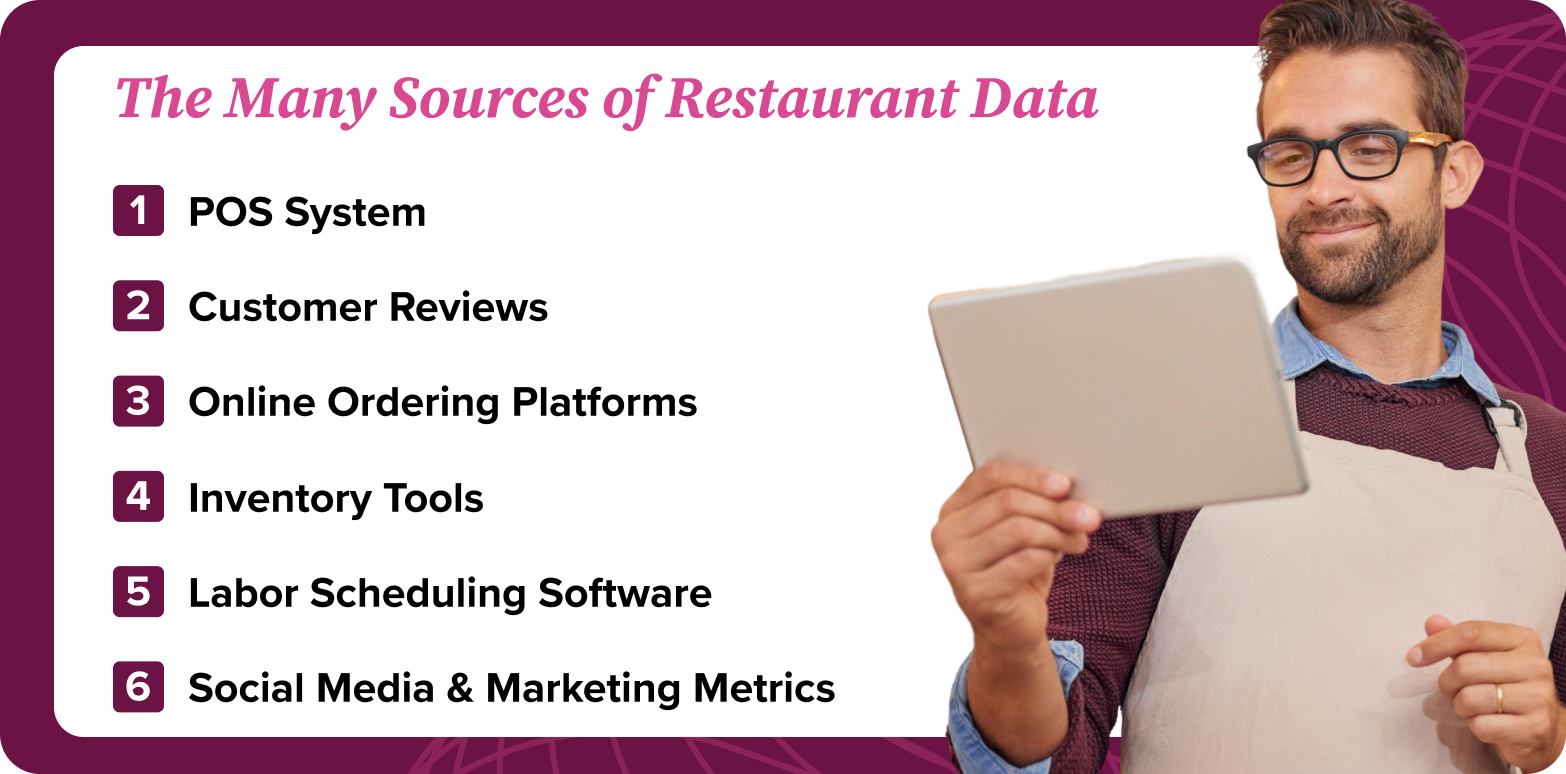
Point-of-Sale (POS) Systems and Transaction Data
Your POS is the heartbeat of restaurant analytics, capturing every sale, payment type, and order detail to identify best sellers, peak hours, and performance trends. To ensure accuracy, keep categories and item names consistent across your system, and use automated integrations between your POS and reporting tools to eliminate manual entry errors.
Customer Feedback and Review Platforms
Ratings, reviews, and survey responses reveal how guests perceive your food, service, and atmosphere. Track this feedback across platforms and use sentiment analysis to spot recurring issues, understand what customers value most, and take proactive steps to improve satisfaction and loyalty.
Online Ordering and Delivery Apps
Delivery and online order data shows which menu items perform best across platforms and how off-premise sales compare to dine-in trends. Integrate your ordering channels with your POS for insights on tailoring menus, adjusting pricing, and evaluating which channels bring the most profitable traffic to the restaurant.
Inventory and Supply Chain Data
Inventory systems track ingredient usage, purchase orders, waste levels, and cost fluctuations to reduce over-ordering and spoilage. Log deliveries immediately, standardize unit measurements, and reconcile inventory counts weekly to reveal opportunities for better pricing and greater ordering efficiency.
Labor and Scheduling Tools
Scheduling software captures labor hours, wage costs, and shift performance, helping you align staffing levels with demand. By syncing your time clock data with your POS, and setting clear guidelines around breaks and clock-ins, you can maximize both productivity and profitability.
Social Media and Marketing Metrics
Engagement data from social platforms shows which campaigns resonate most with your audience and drive traffic to your restaurant. Centralize your analytics from all marketing channels and track campaigns against sales periods to refine your marketing strategies, strengthen brand awareness, and deliver measurable ROI on your marketing efforts.
Practical Applications for Data Analytics in Restaurants
When used consistently, data analytics transforms information into action. It goes beyond simple number crunching to help you understand your operation from every angle, uncovering patterns, reducing inefficiencies, and making more profitable decisions across the board.

Increase Sales Through Smarter, Faster Business Decisions
By tracking sales trends, guest traffic, and promotional performance, analytics helps managers pinpoint what drives revenue and what slows it down. Acting on these insights leads to faster adjustments, stronger sales strategies, and measurable growth over time.
Reduce Costs Without Hurting Quality
Analyzing food, labor, and supply costs reveals where spending can be reduced without sacrificing standards. This focus on reducing costs leads to tighter financial control, healthier margins, and a restaurant that maintains profitability without ever compromising on food quality or guest experience.
Optimize Menu Items for Maximum Profitability
Menu performance data highlights which dishes sell best and which fall short, allowing you to maximize the precision of your menu engineering. Refining pricing, portions, or menu placement based on these insights turns each item into a stronger contributor to your bottom line.
Maximize Team Efficiency with Scheduling and Labor Data
Connecting scheduling tools with sales data helps align staffing with real demand rather than guesswork. This balance keeps labor costs in check, prevents burnout, and ensures your team performs efficiently during every shift.
Cut Food Waste with Smarter Inventory Controls
By comparing purchase, prep, and sales data, you can pinpoint where overproduction or spoilage occurs. This insight leads to leaner inventory management practices that cut waste, preserve freshness, and protect your margins.
Strengthen Customer Loyalty with Behavior Tracking
Analyzing guest behavior helps you understand what keeps customers coming back and personalize your marketing and loyalty programs accordingly. The payoff is building deeper customer connections, encouraging repeat visits, and increasing long-term customer value from every guest.
Stay Ahead of the Competition with Local Market Insights
Data analytics helps you benchmark performance against nearby competitors and spot emerging trends before they peak. Acting on these insights helps you adapt faster, set smarter prices, and maintain a competitive edge in your market.
Getting Started with Restaurant Data Analytics
Getting started with data analytics is simpler than you might think. The key is to take a few intentional steps that make data a normal part of your operational routine. By building these reporting habits, you can quickly turn everyday data into smarter decisions and greater profitability.
Select the Right Restaurant Analytics Tool
Choose a platform that integrates seamlessly with your POS, inventory, and scheduling systems. The best tools consolidate your data into one easy-to-read dashboard, allowing you and your team to view the metrics you’ll actually use.
Train Your Team
Offer hands-on training to help managers interpret key reports, identify trends, and connect data to day-to-day decisions. Once your team is trained to use the data independently, you’ll be freed up to focus on bigger-picture goals.
Set Up Dashboards and Reporting
Design dashboards tailored to each role and automate key reports so you always have the right data at the right time. With clear, consistent reporting in place, your team can spend less time digging for information and more time on keeping guests happy.
Monitor, Analyze, and Improve
Treat analytics as an ongoing process, not a one-time setup. Regularly review your reports, identify outliers, and let data guide your adjustments over time to build a culture of continuous improvement.
Common Myths About Restaurant Analytics
Myth 1: “Analytics is only for big chains.”
Reality: Data analytics can be accessible and valuable for restaurants of any size. Even a single-unit restaurant can analyze sales, waste, and labor with simple dashboards to uncover trends, achieve efficiencies, and drive meaningful process improvements that strengthen performance.
Myth 2: “It’s the same as forecasting.”
Reality: While they work hand in hand, analytics and forecasting serve different purposes. In fact, analytics feeds forecasting by identifying patterns and setting a reliable foundation. Without that clarity, any forecast is just a guess.
Myth 3: “You need an analyst or a data scientist.”
Reality: Today’s technology has made data analytics easier than ever to use. You don’t need specialized expertise to use the automated reporting tools and visual dashboards present in back-office tools. With intuitive, user-friendly platforms, restaurant managers can easily interpret their data and make confident, data-driven decisions on their own.
The Key Ingredient to Smarter, More Profitable Operations
Data analytics is the foundation of every strong restaurant operation. When you understand your numbers, you gain visibility, control, and confidence in every decision you make. The more disciplined your data habits become, the more powerful your insights grow.
Start by taking small steps, like reviewing sales trends weekly or tracking labor costs by shift, to build your data chops and sharpen your instincts for recognizing patterns that are out of line with your normal performance. As you grow in your confidence with data-driven decision making, explore Back Office tools that can provide deeper insights and streamline your data collection processes.