



Few operational decisions have a bigger impact on profitability than menu pricing. A strong menu pricing strategy helps restaurants stay profitable and adaptable over time. Rather than relying solely on formulas, even time-tested ones, operators should view pricing as an ongoing process informed by data, customer demand, and operational realities. In order to balance profitability with customer expectations, a thoughtful menu pricing strategy is essential.
How Menu Pricing Directly Impacts Profitability
Menu prices affect far more than revenue. They influence food cost percentages, guest perception, and overall financial performance. Even small pricing decisions can have a significant impact when multiplied across thousands of transactions. That makes menu pricing one of the most important profitability levers a restaurant can pull.
What Drives Menu Pricing at the Operational Level
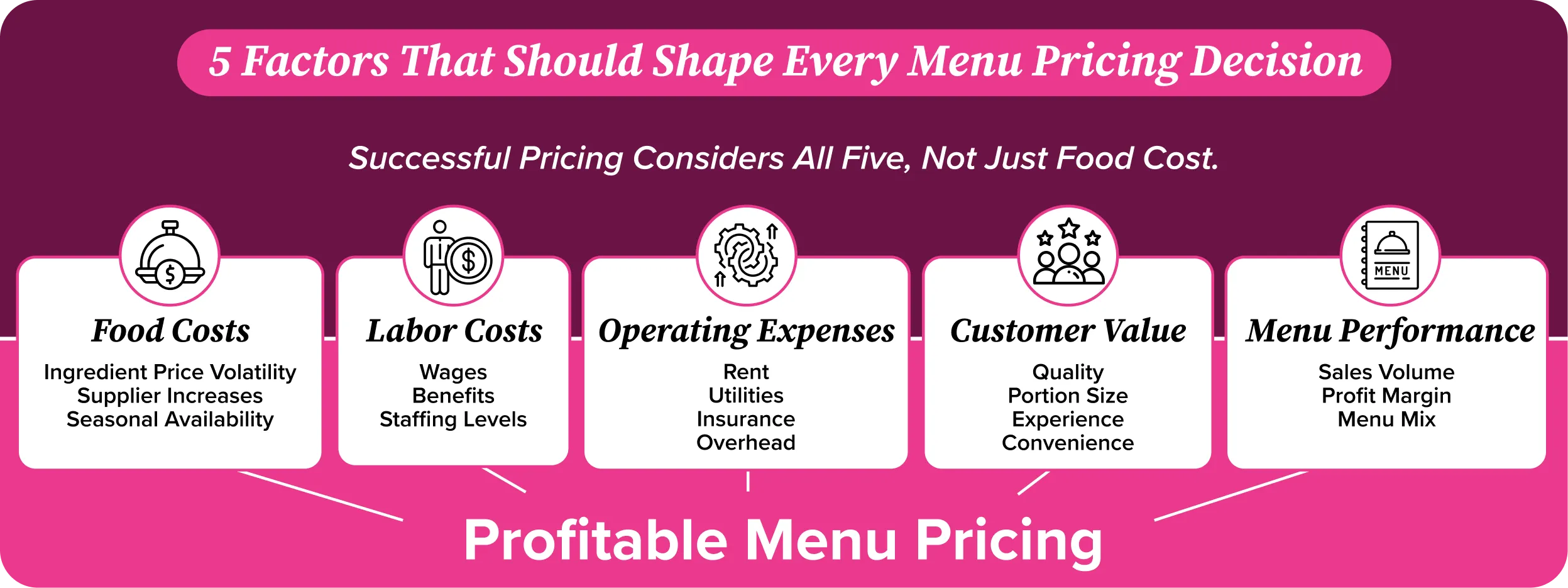
Food Costs and Ingredient Price Volatility
Ingredient costs can change quickly due to supply chain disruptions, seasonal availability, weather events, or supplier increases. When these changes are left unmonitored, margins can shrink even when sales remain strong.
Labor, Overhead, and Operating Pressure
Food costs are only part of the equation. Labor expenses, rent, utilities, insurance, and other overhead costs all influence pricing decisions. Menu prices should reflect the total cost of running the business, not just ingredients.
Customer Expectations and Perceived Value
Guest satisfaction depends on several factors, not just prices. Portion size, presentation, service quality, convenience, and overall dining experience all contribute to perceived value. That means restaurants that deliver exceptional experiences often have more flexibility when it comes to pricing.
Menu Mix and Item-Level Profitability
Menu items contribute to profitability in different ways. Some dishes generate strong returns and consistent sales, while others may sell well but produce smaller profit margins. Accurate inventory tracking and reporting help operators understand item-level performance so they can make better pricing decisions.
How Pricing Approaches Are Applied in Restaurants
Cost-Plus Pricing to Protect Margins
Cost-plus pricing starts with food cost and applies a target markup to determine a menu item’s selling price. This method is a simple framework that helps maintain consistent food cost percentages across the menu.
Value-Based Pricing to Increase Perceived Worth
Value-based pricing focuses on what customers are willing to pay, not just ingredient costs. Unique menu items, premium ingredients, and strong brand positioning typically support higher prices.
Competitive Pricing in Saturated Markets
In competitive markets, it’s common for operators to review local pricing trends when evaluating menu prices. But remember: While competitor pricing can provide useful context, it shouldn’t replace a brand’s own profitability analysis.
Psychological Pricing to Influence Purchase Behavior
Menu design and pricing presentation can dramatically influence purchasing decisions. Strategic item placement, price anchoring, and highlighting high-margin items often have a greater impact than minor pricing adjustments alone.
How to Build a Reliable Menu Pricing Strategy
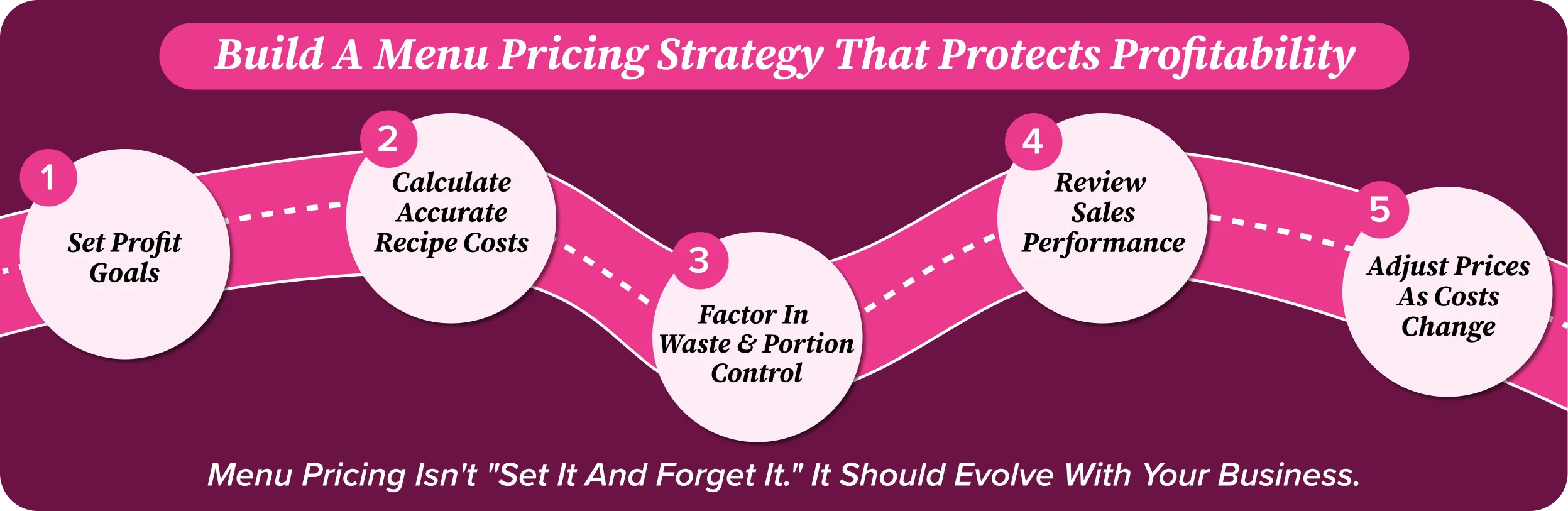
Set Target Food Cost Based on Profit Goals
Every restaurant should ensure that food cost targets align with the brand’s broader financial goals. Targets vary by concept, service style, and operating model. Fine dining restaurants may tolerate higher food costs, while quick-service operators often require tighter margins.
Calculate Item Prices Using Accurate Cost Inputs
Effective pricing starts with accurate recipe costing. When calculating menu prices, operators should account for every ingredient, garnish, sauce, and packaging component the recipe calls for. Even small inaccuracies can create meaningful profit losses over time.
Account for Portion Consistency and Waste
A recipe that looks profitable on paper may perform very differently in practice. Inconsistent portions, preparation errors, spoilage, and waste can significantly affect costs. For example, a burger priced around a four-ounce patty may sound good in theory, but the numbers fall apart if cooks regularly serve five-ounce portions during busy shifts. Pricing decisions should be realistic in terms of real-world kitchen performance.
Validate Pricing Using Actual Sales Behavior
The most profitable menu item is not always the most expensive one. Oftentimes the most profitable menu items balance healthy margins with strong sales volume. Reviewing sales reports helps operators identify which items generate the most profit.
Adjust Pricing Based on Margin Performance
A successful menu pricing strategy requires regular review. Operators should evaluate pricing performance routinely and adjust when ingredient costs, labor expenses, or customer demand patterns change.
How to Improve Menu Prices Without Losing Customers
Identify When Costs Are Impacting Margins
Rising food costs do not always require immediate menu price increases. The first step is understanding where margin erosion is occurring. Reviewing food cost reports and item-level profitability often reveals opportunities for improvement.
Introduce Pricing Changes Without Disrupting Demand
Gradual price adjustments are often easier for customers to accept than large increases. Small changes implemented consistently over time allow operators to be proactive about profitability while minimizing customer pushback.
Adjust Portions or Bundles Instead of Direct Price Hikes
In some situations, modifying portion sizes or creating bundled offerings is an alternative to raising prices. This approach can help maintain value perception while still improving margins.
Communicate Value Instead of Just Increasing Price
Customers are more likely to accept higher prices when they understand the value they receive. When guests believe the experience justifies the price, they are less likely to focus on the price alone. Product quality, consistency, service, and experience all contribute to the customer’s willingness to pay.
Maintain Customer Trust During Price Adjustments
Frequent or inconsistent pricing changes can create confusion and frustration for guests. Transparency and clear value delivery build customer trust, which is especially important during inflationary periods. The goal is to make pricing changes feel intentional rather than reactive.
How Menu Engineering Improves Profitability
Menu pricing strategy is much more effective when paired with menu engineering.
Menu engineering examines both popularity and profitability to identify which items deserve greater visibility and promotion. Instead of focusing only on food cost percentages, operators evaluate contribution margin and sales performance together.
This process often reveals opportunities that traditional pricing reviews miss. A high-margin item with strong sales may deserve prominent placement on the menu. A low-margin item with weak demand may need a recipe adjustment, a price increase, or removal altogether.
Menu design also influences purchasing behavior. Strategic placement, descriptive menu language, and visual emphasis can help guide guests toward more profitable choices without feeling overly promotional.
Menu engineering helps operators use menus as a financial tool by aligning pricing, product mix, and customer behavior.
Common Menu Pricing Mistakes That Reduce Profitability
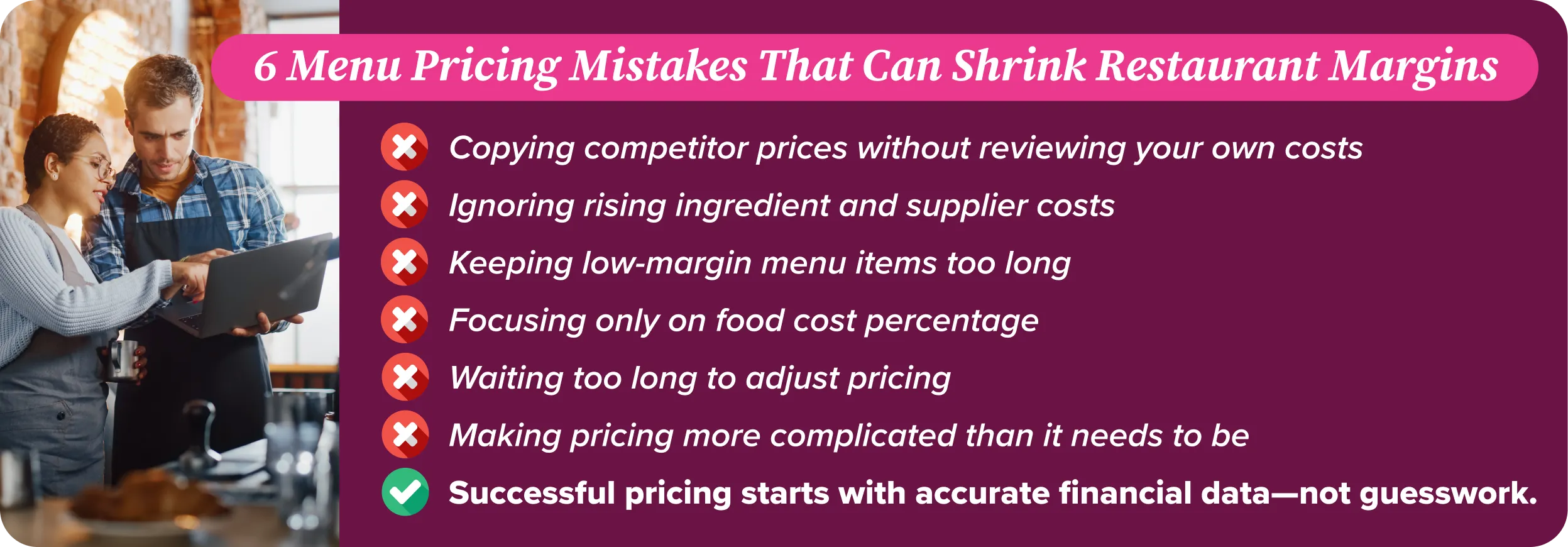
Relying Only on Competitor Pricing
Competitor pricing can provide useful market insight, but it should never be the primary pricing strategy. Costs, operating models, and profitability goals are different for every brand.
Ignoring Rising Costs and Supplier Changes
Regular monitoring helps prevent costly surprises. Operators who delay pricing reviews often discover margin problems after profitability has already declined.
Holding on to Low-Margin Items for Too Long
Some menu items remain in place because they are familiar rather than profitable. Regular performance reviews help identify items that may no longer support business goals.
Pricing Without Understanding Contribution Margin
Food cost percentage alone does not tell the full story. Contribution margin provides a clearer picture of how much profit each item generates after food costs are covered.
Failing to Update Pricing Based on Sales Performance
Customer preferences aren’t the only thing that changes over time. Menu pricing should evolve alongside sales trends, ingredient costs, and operational realities.
Overcomplicating Pricing Without a Clear Strategy
Pricing models needn’t be complex to be effective. The most effective systems are often built around accurate data, consistent review processes, and clear financial goals.
Pricing Is Never Finished
Many operators treat menu pricing as a one-time task. In reality, it requires ongoing attention.
The restaurants that perform best over time are not necessarily the ones with the lowest food costs or the highest menu prices. They’re the ones that understand their numbers and make adjustments according to current operational realities.
Your menu is one of the most powerful financial tools in your restaurant. Treat it accordingly.
Not sure if your pricing is keeping pace with rising costs? Reach out to the Back Office team.
FAQ’s
How often should menu prices be updated?
There isn’t a one-size-fits-all schedule. Rather than adjusting prices only once or twice a year, restaurants should review menu performance regularly using current food costs, inventory data, and sales reports. With better visibility into ingredient costs and margin trends, operators can identify pricing adjustments before shrinking margins become a larger profitability issue.
What pricing strategy works best for small restaurants?
The best pricing strategy is one that’s backed by accurate operational data. While many independent restaurants start with cost-plus pricing, that approach should be supported by recipe costing, inventory tracking, and sales reporting. Understanding food costs alongside item performance helps small operators price with confidence instead of relying on estimates or competitor pricing alone.
How should pricing differ for delivery vs. dine-in?
Delivery pricing should account for additional costs such as third-party marketplace fees, packaging, and transportation expenses. Many restaurants maintain separate pricing for delivery to help protect margins. Tracking costs across different sales channels gives operators better visibility into profitability and supports more informed pricing decisions.
How do you calculate the selling price of a menu item?
Start by calculating the complete recipe cost, including every ingredient, garnish, condiment, and packaging component. Then determine a target food cost percentage or desired profit margin to establish the selling price. Accurate recipe costing and inventory management help ensure pricing decisions reflect actual operating costs instead of rough estimates.
How do rising supplier costs affect menu pricing strategy?
As supplier costs increase, menu pricing should be evaluated alongside recipe costs, inventory usage, and overall food cost performance. Instead of making broad price increases, operators can use reporting and cost visibility to identify which menu items are most affected and make targeted pricing decisions that help preserve profitability while minimizing guest impact.
Should you remove low-margin items or reprice them?
First, evaluate how the item performs overall. Some lower-margin menu items drive traffic or encourage additional purchases, while others consistently reduce profitability. Reviewing item-level sales, recipe costs, and contribution to overall menu performance helps operators determine whether an item should be repriced, reformulated, promoted differently, or removed altogether.