



Knowing how much revenue is needed to cover expenses is an essential aspect of a restaurant operator’s financial planning. Break-even analysis provides a clear benchmark for measuring performance in order to make sound business decisions.
Understanding your break-even point helps guide pricing, staffing, purchasing, long-term planning, and more.
Why Is Break-Even Critical for Financial Stability?
Every restaurant has busy days and slow days. Consistent profitability, however, depends on knowing the minimum level of sales required to stay afloat. Break-even analysis compares your revenue with both fixed and variable costs to identify that target.
Knowing the break-even number helps operators recognize problems before they snowball and start to affect cash flow. If sales consistently fall below your break-even point, you can adjust pricing, control expenses, or find other ways to increase revenue before losses grow. Combined with strong reporting and restaurant analytics, break-even analysis gives operators another valuable tool for making smarter financial decisions.
How Break-Even Analysis Works
Fixed Costs vs. Variable Costs
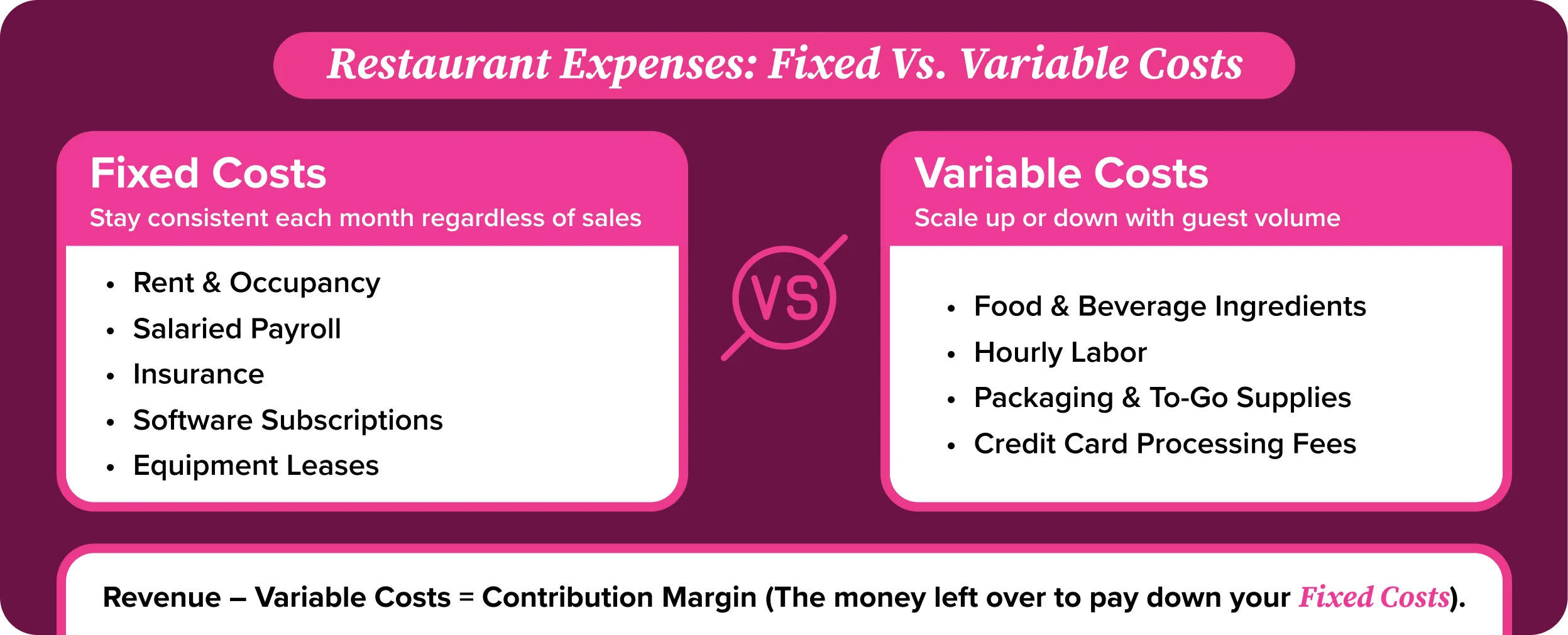
Break-even analysis starts by separating expenses into two categories. Fixed costs such as rent, insurance, and salaried payroll typically remain consistent each month. Variable costs, such as food, beverages, hourly labor, and packaging, can increase or decrease as sales change.
Understanding Contribution Margin per Order
Each customer order generates revenue, but not all of that revenue is available to cover your restaurant’s overhead. After subtracting the variable costs (ingredients, hourly labor, and packaging costs) associated with that sale, the remaining amount helps pay fixed expenses. This remaining amount is called the contribution margin.
Variable costs are paid first, then fixed costs. Once fixed costs are covered, the rest is profit.
The Break-Even Formula Explained
The basic break-even formula looks like this:
Break-Even Order Volume = Fixed Costs ÷ Contribution Margin per Order
The result tells you how many orders you must sell before your restaurant begins earning a profit.
Revenue Break-Even vs. Order Break-Even
Once you’ve calculated your break-even point, you can express it in two ways: the number of guest orders required or the total revenue required. Both represent the same financial target. Guest orders help managers track daily performance, while revenue targets align more closely with budgets and financial reporting.
How to Calculate Break-Even for Your Restaurant
Calculate Total Fixed Monthly Costs
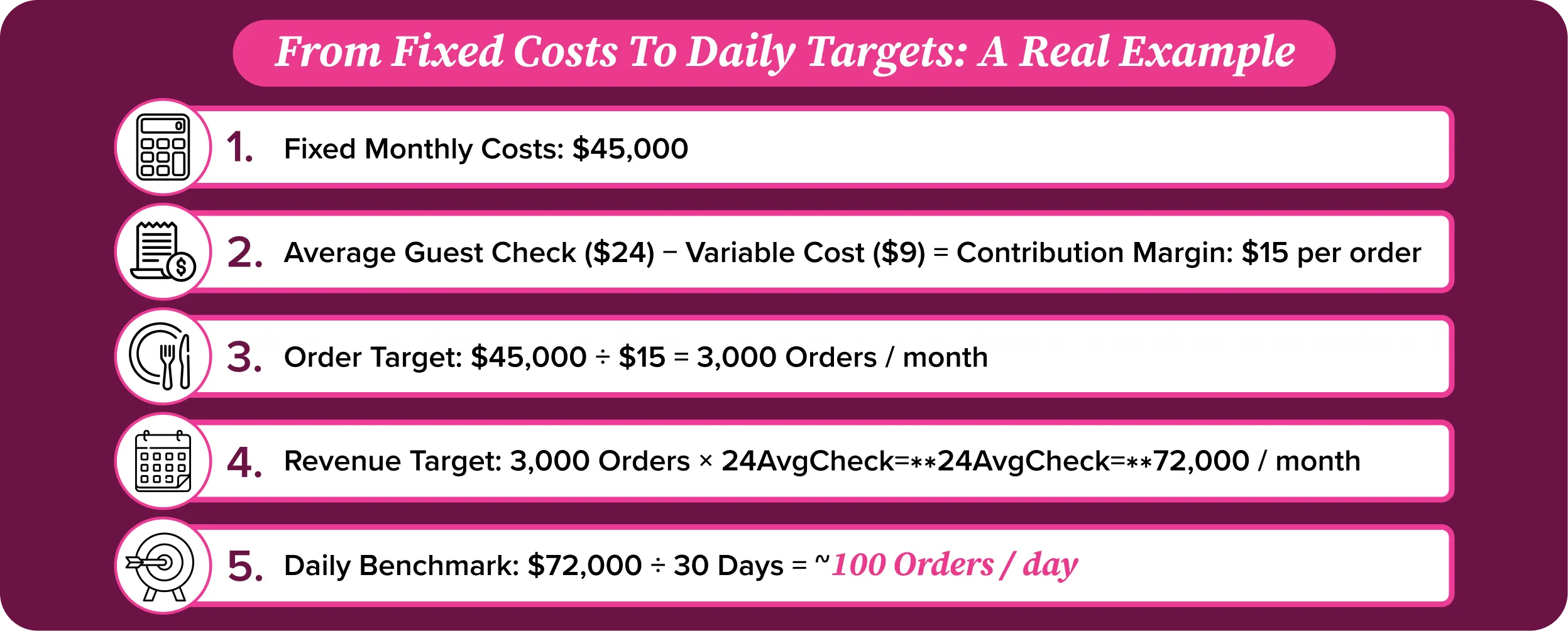
Start by adding together your monthly expenses that stay relatively consistent regardless of sales volume. These include rent, insurance, software subscriptions, equipment leases, and salaried payroll. Let’s assume your restaurant has $45,000 in fixed monthly costs. That’s the fixed-cost number you’ll use throughout the rest of the calculation.
Identify the Average Variable Cost Per Order
Next, determine the average variable cost for each guest order. This typically includes ingredients, packaging, and other costs that are part of every sale. Let’s say your average guest check is $24 and the average variable cost per order is $9.
Calculate Contribution Margin Per Order
Subtract the average variable cost from the average guest check. The remaining amount is your contribution margin, which helps cover fixed expenses. A $24 guest check minus $9 in variable costs leaves a contribution margin of $15 per order.
Apply the Break-Even Formula
Divide your total monthly fixed costs by the contribution margin per order. The result is the number of guest orders needed to reach your monthly break-even point. With $45,000 in fixed costs and a $15 contribution margin, your restaurant would need approximately 3,000 orders each month to break even.
Convert Break-Even Into Total Revenue Required
Multiply your break-even order volume by your average guest check. This shows the monthly revenue your restaurant must generate to break even. In this example, 3,000 guest orders multiplied by an average guest check of $24 equals $72,000 in monthly revenue.
Translate Break-Even Into Daily Sales Targets
Divide your monthly break-even revenue or order volume by the number of operating days each month. Daily targets make financial goals easier for managers and staff to understand and monitor. If your restaurant is open 30 days a month, you’ll need to average about 100 guest orders per day to reach your break-even point.
Break-Even Calculation Example for a Restaurant
Let’s continue with the same example. Your restaurant has $45,000 in monthly fixed costs, an average guest check of $24, and an average variable cost of $9 per order. That gives you a contribution margin of $15 per order and a break-even point of 3,000 guest orders, or $72,000 in monthly revenue.
If your restaurant is open 30 days each month, you’ll need to average about 100 guest orders per day to cover your operating expenses.
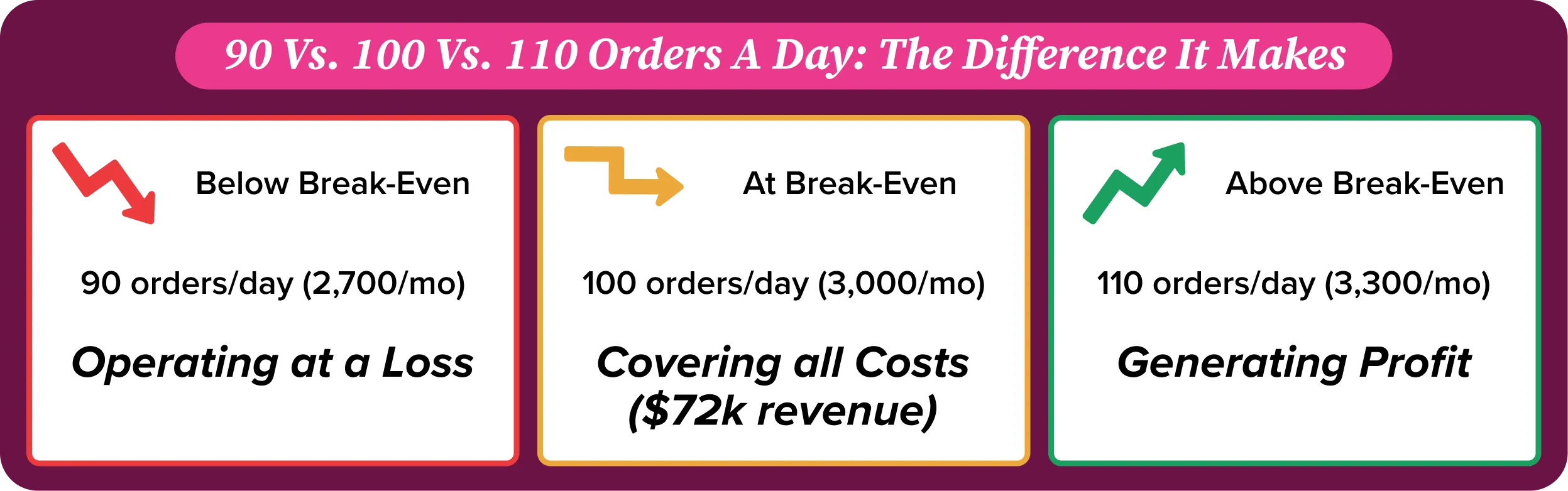
But what if your restaurant averages only 90 guest orders a day? You’ll likely finish the month below your break-even point and operate at a loss. Conversely, if you’re averaging 110 guest orders a day, you’ve exceeded your break-even target and are generating profit.
How to Use Break-Even Analysis in Restaurant Decisions
Set Realistic Revenue and Sales Targets
Break-even analysis gives restaurant operators a measurable sales target based on their actual costs. Knowing the minimum revenue needed each month creates realistic daily and weekly targets that support long-term profitability.
Evaluate Pricing and Menu Changes
Before changing menu prices or introducing promotions, calculate how those decisions affect your contribution margin and break-even point. Small pricing adjustments can significantly influence the number of sales required to stay profitable.
Decide When Cost Reductions Are Necessary
If sales consistently fall below your break-even point, you may need to reduce some unnecessary expenses to stay profitable. Adjusting labor, purchasing, and operating costs can lower the revenue needed to cover expenses.
Plan for Seasonal Demand Fluctuations
Restaurants do not typically generate the same sales every month. Break-even analysis helps operators prepare for slower seasons by adjusting staffing, purchasing, and budgets before revenue declines affect cash flow.
Assess Profitability Before Expansion or Scaling
Before adding locations, expanding dining space, or investing in new equipment, calculate how additional fixed costs will affect your break-even point. Understanding the financial impact helps reduce risk and supports more confident growth decisions.
How to Improve Your Break-Even Position
Increase Contribution Margin per Order
Increasing menu prices or lowering food costs can increase contribution margin. Even modest improvements reduce the number of sales needed to break even each month.
Reduce Unnecessary Fixed Costs
Operators should regularly review recurring expenses in search of opportunities for savings. For example, renegotiating vendor contracts, eliminating unused software subscriptions, or improving operational efficiency can lower your monthly break-even number.
Improve Sales Without Increasing Operational Strain
Growing average check size through upselling, suggestive selling, or menu optimization can improve profitability without requiring significant additional labor or overhead. Higher revenue from existing customers strengthens your financial position.
Make Break-Even Analysis Part of Every Financial Decision
Break-even analysis is more than an accounting exercise. From pricing and staffing to budgeting and expansion planning, it provides a practical framework for making smarter decisions throughout the entire restaurant.
Costs and sales change over time, so review your break-even point regularly. When combined with accurate bookkeeping and ongoing cost management, break-even analysis helps restaurant operators get the information they need to build a strong, profitable business.
Need help getting a clearer picture of your restaurant’s finances? Reach out to the Back Office team.