
Margins are tight. Labor is unpredictable. Food costs fluctuate without warning. In this environment, restaurant efficiency is a business necessity.
The restaurants that pull ahead don’t rely on instinct alone. They build disciplined systems around labor, inventory, workflow, and data. That structure protects profitability, reduces waste, and delivers the operational consistency guests expect, whether they’re dining in, picking up takeout, or ordering delivery.
What Is Restaurant Efficiency?
Restaurant efficiency is the ability to deliver consistent food and service quality using the least amount of time, labor, and resources possible. It means eliminating friction in daily operations, reducing waste at every stage, and building systems that allow your team to execute confidently and consistently.
Why Restaurant Efficiency Matters
Restaurant efficiency has never mattered more. According to the National Restaurant Association’s 2025 State of the Restaurant Industry report, food and labor costs remain the top two challenges operators face. Labor often represents 30-35% of sales in full-service restaurants, while food costs typically range from 28-35%, depending on the concept.
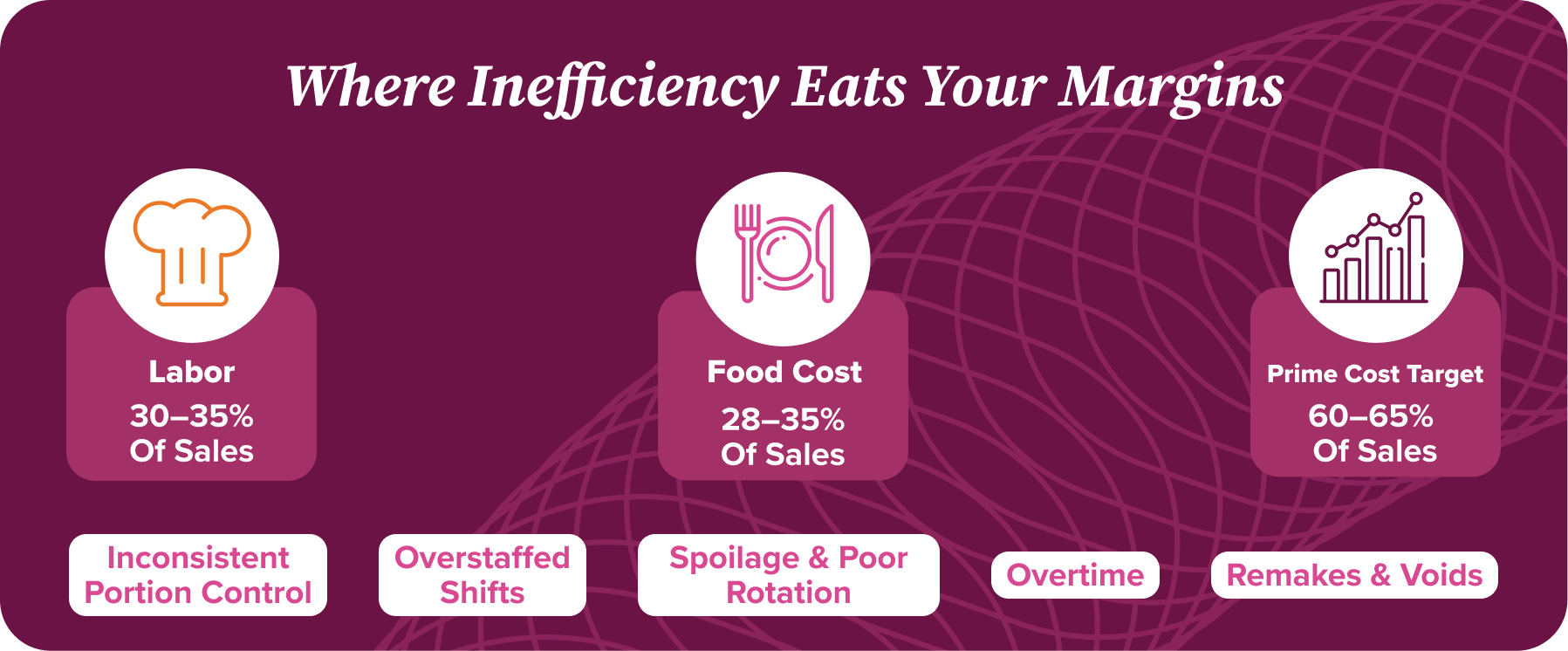
When your two largest expenses rise at the same time, inefficiency becomes expensive quickly. Inconsistent portion control, uninformed managers creating scheduling issues, or lapses in prep-team discipline can all squeeze margins that are already razor-thin.
Operational consistency also depends on efficiency. A streamlined kitchen produces predictable results, and predictable results build trust with guests. Off-premises dining continues to represent a significant share of restaurant revenue, which adds operational complexity and less control over the guest experience. Managing dine-in, takeout, and delivery simultaneously requires clear systems and strong communication.
Restaurant operational efficiency ultimately protects profitability, stabilizes execution, and positions your business for long-term sustainability.
Common Causes of Inefficiency in Restaurants
Before you improve efficiency, you need to recognize what undermines it.
Poor workflow and process gaps create daily friction. Disorganized prep stations, unclear communication, and inconsistent opening and closing procedures compound across shifts, slowing operations and increasing errors.
Inventory waste and over-ordering quietly inflate costs, as does inconsistent portion control. Consider this: up to 70% of food waste in restaurants is the food left on guests’ plates. You paid a lot for those fries and puddles of steak sauce headed for the compost or trash, so consider tightening things up. Industry research suggests restaurants can lose between 4-10% of purchased food to waste if not tightly managed, contributing to the broader 30-40% food waste seen across the U.S. food supply. Spoilage, overproduction, and poor rotation distort the cost of goods sold and weaken menu profitability.
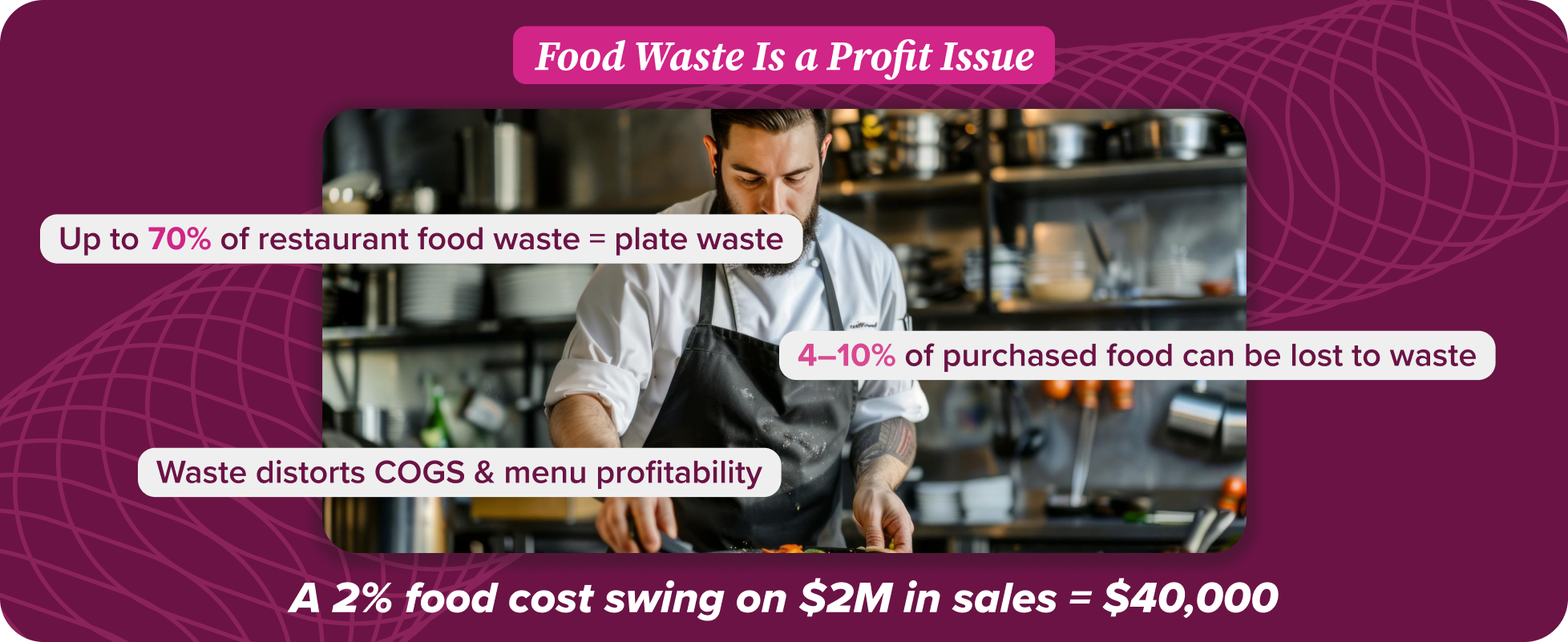
Scheduling and staffing imbalances also drive inefficiency. Overstaffing drains labor budgets, while understaffing slows service and stresses the team.
Finally, a lack of data and performance visibility forces operators to react instead of lead. If you’re not consistently tracking labor percentage, food cost variance, and sales per labor hour, you’re managing your business on assumption.
10 Proven Strategies to Improve Restaurant Efficiency and Reduce Waste
1. Standardize Operating Procedures
Clear standard operating procedures eliminate inconsistency. Documented prep lists, opening and closing checklists, and recipe standards remove guesswork. When execution varies by employee, waste increases and service slows. Standardization protects consistency and strengthens measurable restaurant efficiency.
2. Optimize Staff Scheduling and Labor Allocation
Align staffing with forecasted demand using historical sales data. Data-driven scheduling reduces unnecessary overtime and redundant coverage. When labor is managed strategically rather than reactively, labor costs stabilize and team performance improves. Use tools to forecast sales and align labor accordingly.
3. Improve Inventory Tracking and Control
Real-time inventory tracking minimizes spoilage and prevents ordering mistakes. Setting clear par levels and conducting regular counts instills purchasing discipline. Strong inventory control improves cost of goods sold performance and strengthens recipe costing accuracy, which directly supports smarter menu analysis and pricing decisions.
4. Reduce Food Waste Through Better Portion and Prep Management
Standardized recipes and portion controls protect margins. Yield testing and portion training ensure that dishes reflect their intended cost. Even a small reduction in waste can improve annual profitability. AI-driven waste tracking tools can further identify patterns and opportunities for improvement.
5. Simplify Menus to Improve Speed and Consistency
Large menus create complexity, which drives longer prep times, more inventory SKUs, and increased execution errors. Menu analysis should focus on high-volume, high-margin items. Use seasonal ingredients to avoid paying a premium for out-of-season produce, and cut novelty items that aren’t selling. Simplifying the menu improves efficiency and supports faster, more consistent service. Giving managers time for structured costing and menu analysis leads to better margins and less waste.
6. Streamline Kitchen Workflow and Communication
Evaluate your physical layout and station design. Are high-volume items positioned for efficiency? Are handoffs between line and expo seamless? Workflow design directly affects ticket times and remakes, and even small layout adjustments can yield measurable performance gains.
Leverage technology where it helps. Order monitoring systems can streamline expediting, while outdated printers that frustrate cooks and expos only slow the process.
7. Use Data to Monitor Performance and Identify Gaps
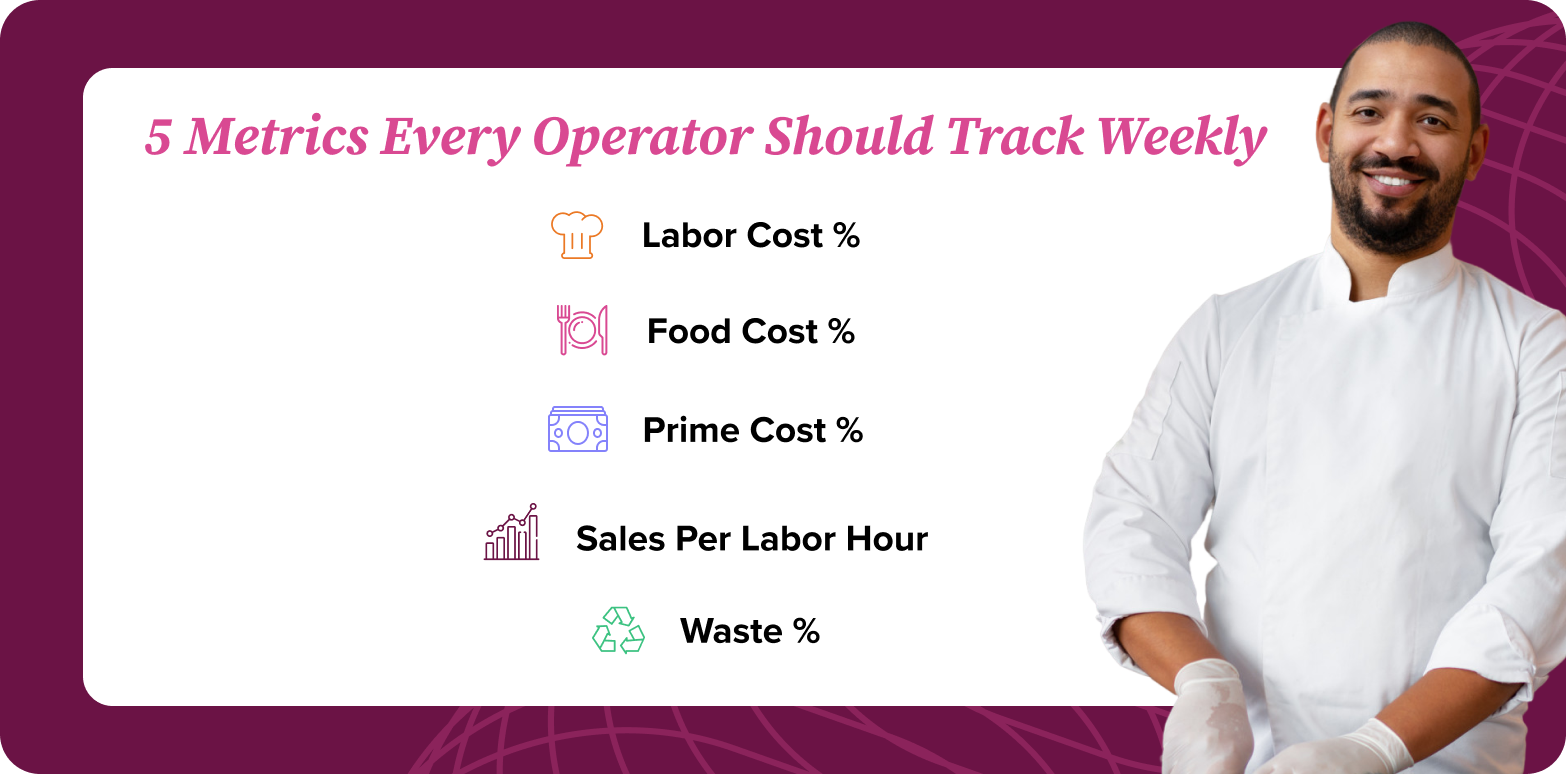
Track labor percentage, food cost percentage, waste, voids, and sales per labor hour consistently. Many operators use prime cost as a guiding metric, often aiming to keep it between 60-65%. When prime cost drifts upward, inefficiencies are present. Data replaces assumption with clarity, so use tools to track this data and allow your managers to work with staff to keep them motivated and ensure they are future-ready.
8. Automate Manual Administrative Tasks
Manual invoice entry, spreadsheet tracking, and payroll reconciliation consume valuable manager time. Automation in data analysis reduces human error and provides clean, real-time reporting. Back office efficiency strengthens operational performance across the entire restaurant.
9. Improve Supplier and Purchasing Management
Regularly review vendor pricing and monitor cost fluctuations. Strategic consolidation and disciplined purchasing reduce volatility, while strong food-cost management enables more accurate menu pricing and maximizes the upside of cross-utilization of ingredients. Remember that efficiency extends beyond your kitchen walls, so coach up management on building relationships with suppliers and keep them vigilant on cost increases and alternative products..
10. Train Teams for Efficiency-Focused Execution
High turnover in hospitality drives training demands and execution variability. Clear systems shorten ramp-up time and create consistency. When teams understand how portion control, storage, and workflow affect profitability, they operate with ownership. Small tweaks can go a long way, and cross-training and thoughtful scheduling help maintain performance, even with leaner staffing. Efficiency becomes cultural, supported by frequent check-ins and clear communication.
How Technology Supports Restaurant Efficiency
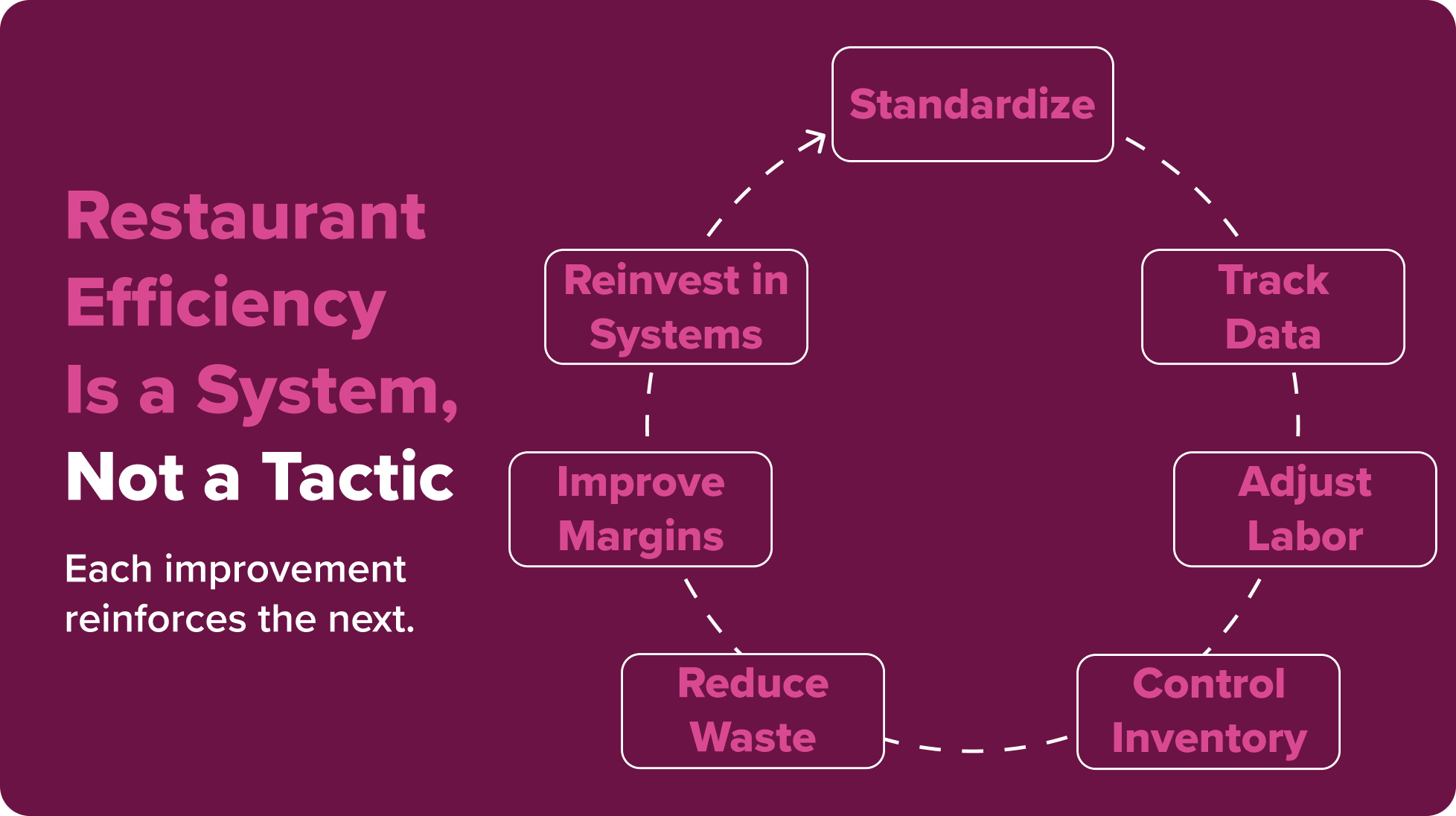
Technology strengthens restaurant efficiency by connecting systems that were once isolated. Point-of-sale data feeds inventory tracking, inventory links to recipe costing, recipe costing informs menu analysis, and labor scheduling aligns with sales forecasts.
Operators across all segments are investing in technology to boost productivity and reduce costs. Integrated systems eliminate duplicate data entry, reduce errors, and provide real-time visibility. Even guest-facing technology helps streamline operations, allowing your team to focus on the guest experience. Technology doesn’t replace management—it equips managers with precision and frees up time to work more closely with staff and guests.
Key Metrics to Track Operational Efficiency
To measure restaurant operational efficiency, consistently monitor labor cost percentage, prime cost percentage, sales per labor hour, waste percentage, and inventory turnover rate.
These metrics reveal where inefficiencies live. If labor creeps upward, scheduling requires adjustment. If food cost fluctuates, portioning or purchasing may be misaligned. Also, if waste increases, prep discipline needs review. Your management team must believe in the notion that you can’t manage what you do not measure.
Restaurant efficiency depends on systems that reduce waste, clarify operations, and ensure consistent execution. Key practices include:
- Standardize procedures.
- Align labor with demand.
- Tighten inventory and recipe costing.
- Use data consistently. Automate administrative work.
- Train your team with purpose.
Each improvement reinforces the next. Over time, these strategies will create a streamlined, waste-conscious operation and collective mindset amongst the team that protects margins and strengthens your competitive position. In today’s environment, restaurant efficiency is not a luxury. It is the operational discipline that determines whether your restaurant merely survives or scales with confidence.
For operators ready to improve margins, the Back Office team can provide the visibility and guidance needed to turn data into actionable efficiency improvements.
FAQs
How can restaurants improve efficiency without increasing labor costs?
Instead of hiring more people, restaurants can make their systems work better by tightening them up. Standardized recipes, prep lists, and clear operating procedures make mistakes less likely and speed up the process. Using past sales data to plan labor more accurately also stops you from hiring too many or too few people, which can be expensive. Managers can focus on operations and team performance instead of doing manual tasks like keeping track of inventory, making reports, and sending out invoices.
What are the best ways to reduce waste while improving efficiency?
Start by being strict about portion sizes and keeping track of your stock. To keep things from going bad, set clear par levels, use FIFO to rotate products correctly, and count your inventory on a regular basis. You can also cut down on extra stock and make buying more accurate by simplifying menus and using the same ingredients in different dishes.
Which areas of a restaurant have the biggest efficiency gaps?
The biggest gaps usually show up in scheduling workers, keeping track of inventory, and the flow of work in the kitchen. Slow service and higher costs can come from reactive staffing, not being able to see inventory well, and poorly designed stations. Fixing these problems often leads to the quickest improvements in how things work.
How do you measure efficiency in restaurant operations?
Operators usually keep an eye on things like the prime cost, the percentage of labor costs, the percentage of food costs, the number of sales per labor hour, and the percentage of waste. Keeping an eye on these numbers on a regular basis helps find problems and make better business decisions.