

Running a franchised restaurant is a bit of a balancing act. You’ve got guests, staff, and the daily rush to handle, and then there’s a second set of numbers your franchisor wants on time and in the right format. It sounds like a lot, but the right habits make it very doable. Here’s how restaurant franchise accounting works, what to track, and how to keep your reports clean.
What Is Restaurant Franchise Accounting?
Restaurant franchise accounting is the practice of recording, reporting, and reconciling a franchised location’s finances in line with the franchisor’s standardized requirements. While this provides a significant advantage in terms of market entry and reduced risk, it also requires strict adherence to financial reporting standards and deadlines. This unique position demands a disciplined approach to accounting—one that balances your entrepreneurial spirit with the need for compliance and consistency to help you master the art of financial management within a structured framework.
Start With Your Franchise Agreement & Operations Manual

Before you touch a single ledger, get comfortable with three documents. Your franchise agreement is where the rules begin. It spells out what you owe the franchisor, how often you report, and what happens if you slip. Your operations manual gets into the day-to-day details, like deadlines, formatting requirements, and which expense categories to use.
Then there’s the Franchise Disclosure Document, or FDD. It lays out the franchisor’s fees and obligations up front, so it’s a handy way to double-check the costs you’re expected to track. Read all three more than once. Highlight anything tied to money or dates, and keep copies where your bookkeeper can find them. Most reporting headaches come from one missed line in these documents, not from the math. If something’s unclear, ask your franchisor’s accounting team before it becomes a problem.
Accounting Principles for Franchisees
As a franchisee, your accounting processes must support both the financial needs of your business and the reporting requirements established by your franchisor. This responsibility requires a precise approach to bookkeeping and a deep understanding of your franchisor’s accounting procedures to avoid unnecessary penalties.
Challenges for Franchisees
As a franchisee, you’re responsible for running your day-to-day operations while meeting the franchisor’s meticulous requirements. This includes strict adherence to reporting deadlines, comprehensive proof of submitted financial data, and aligning your operations within a predetermined, standardized system.
Depending on your franchise agreement, you may be required to adapt to unfamiliar accounting systems or restrictive reporting formats. Along with your routine operational reporting, you should also be prepared to provide transparent documentation of royalty payments and marketing contributions. Maintaining clear, open lines of communication with your franchisor’s accounting team is essential for ensuring you properly fulfill your obligations as a franchisee.
Key Financial Statements Every Franchisee Should Know
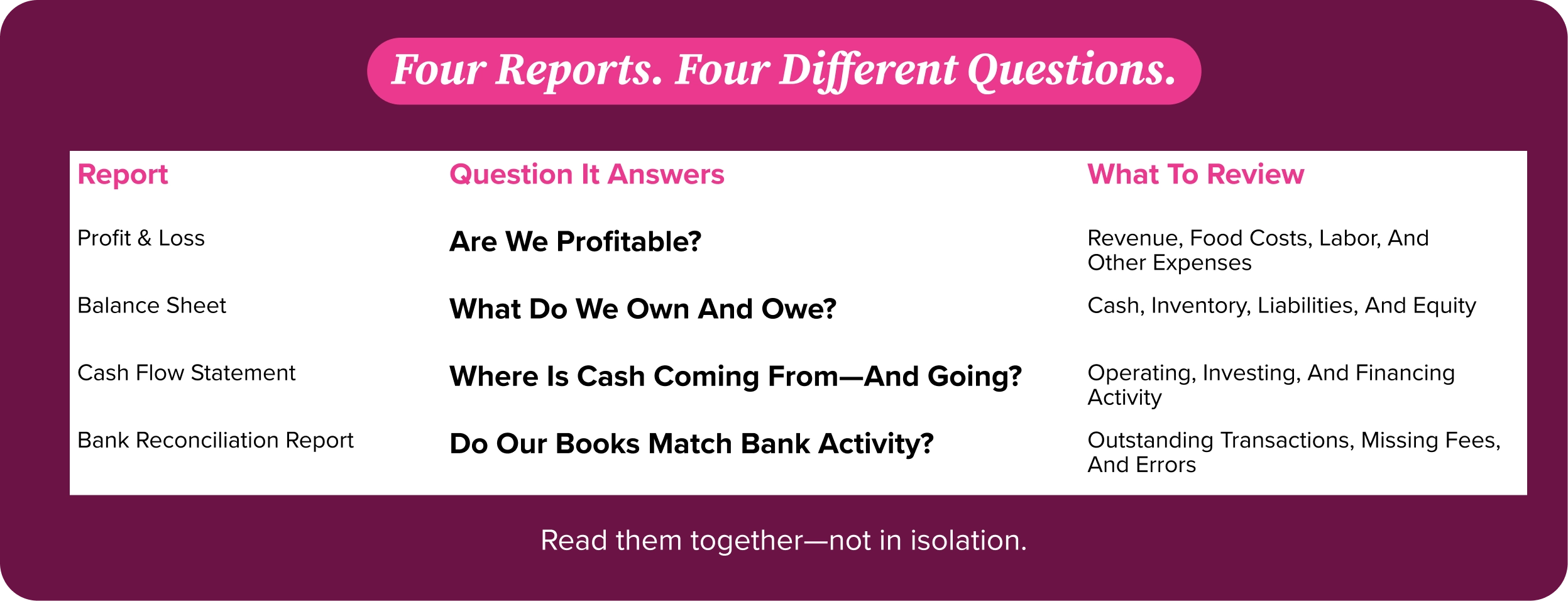
Your franchisor will almost certainly ask for three reports, so it helps to know what each one is really telling you.
P&L
Are sales covering the cost of running your restaurant? Your P&L shows revenue, expenses, and the resulting profit or loss for a period. Compare actual results with your budget and prior periods. If sales increased but profit fell, look at what changed in food costs, labor, and other expenses before celebrating the higher sales number.
Balance Sheet
What does your restaurant own, what does it owe, and what remains as equity? The balance sheet captures those amounts at a specific date. Review cash, inventory, outstanding bills, and debt together. A profitable period doesn’t necessarily mean you have the cash available for the next round of payments.
Cash Flow
Where did the cash come from, and where did it go? Your cash flow statement separates operating, investing, and financing activity. Review it alongside upcoming payroll, vendor bills, and franchise payments so you can plan spending around actual cash needs.
Bank Reconciliation Report
Do your books agree with your bank activity? Reconciliation helps you identify missing fees, timing differences, and recording errors. Resolve unexplained differences before using your cash balance to make purchasing or payment decisions.
Tracking Royalties, Marketing Fees & Brand Contributions
Royalties and marketing fees are some of your biggest recurring costs, so give them room to breathe in your books. The simplest approach is a separate general ledger (GL) account for royalties and another for ad-fund or marketing fees. Don’t lump them together under “franchise fees.” When they’re split, you can see exactly what each one costs you and answer questions fast.
Most of the time these fees are a percentage of gross sales, though your franchise agreement has the final word on the rate and how gross sales are defined. Base the calculation on your POS sales for the period, and record the expense in the same period as the sales it relates to. That keeps your P&L honest.
Then reconcile. Each period, compare what you recorded to what your franchisor’s statement says you owe. If the numbers don’t match, look at timing or how gross sales were defined first. Keep the statements and your backup with your records, because you’ll want transparent documentation of every payment.
Managing Taxes & Compliance
Franchised or not, you still have to handle taxes, and franchisor reporting doesn’t replace any of it. Here are the big three.
- Sales tax: rates and rules can change from one jurisdiction to the next, especially if you run more than one location. Track what you collect as money owed to the government, not as revenue, and file for each location on its own schedule.
- Payroll tax: withholdings and employer taxes need to be recorded every pay period and paid on time. Late payments get expensive quickly.
- Tip reporting: declare all tips accurately, and in the period they were generated. It’s a common audit trigger when it’s sloppy.
State and local laws vary, so run the specifics by a qualified accountant who knows your area.
Daily Sales Reconciliation (POS, Cash & Cards)
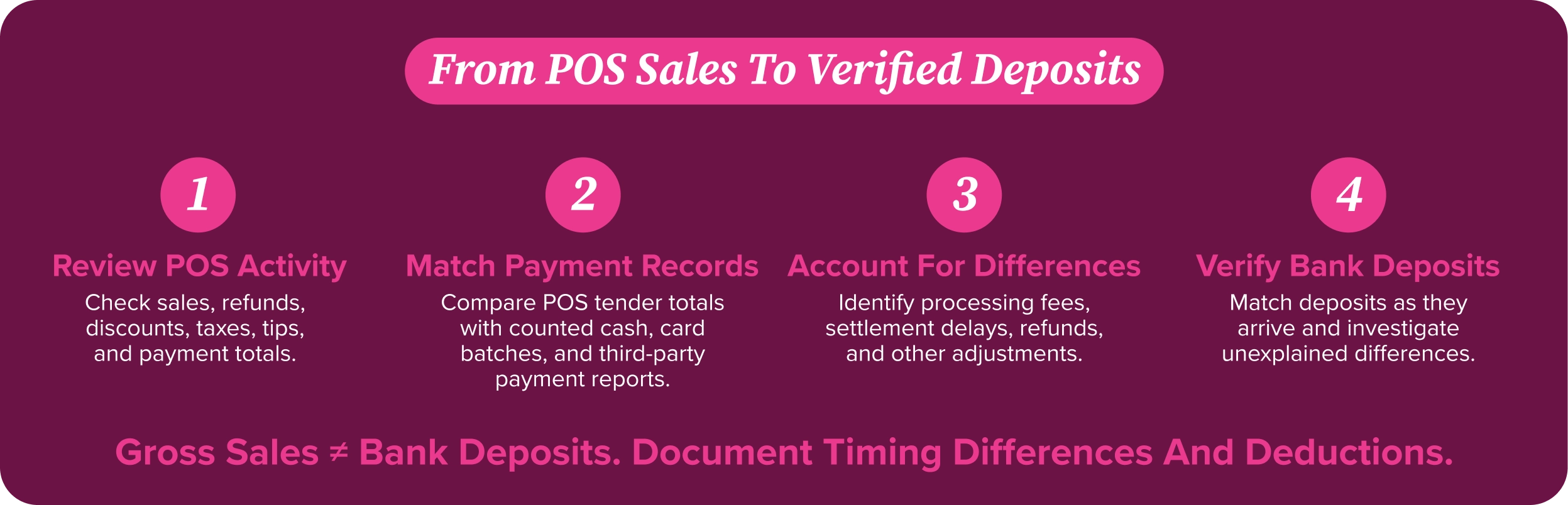
If you only do one habit from this whole guide, make it this one. Every day, compare your POS gross sales to what actually landed in the bank. That means cash counted, card batches, and any third-party payments.
When the numbers match, you’re done in a few minutes. When they don’t, you’ve caught the problem while it’s still fresh, like a missed deposit or a keying error, instead of discovering it at month end. Clean daily sales also mean your royalty calculation starts from a number you can trust.
Tips for Smoother Accounting Management
Even with your franchisor’s specific accounting requirements, you can achieve greater financial control and operational efficiency by adopting a few strategic steps.
- Improve your knowledge of the franchisor’s accounting systems by taking advantage of any training or support provided.
- Establish a consistent accounting routine for recording transactions, reconciling receipts, and submitting reports to ensure all your obligations are met on time.
- Use Back Office’s reporting features to automate generating required financial reports for your franchisor, minimizing effort and ensuring timely submissions.
- Build a strong relationship with your franchisor’s accounting team to address any questions immediately and ensure you understand reporting expectations.
Franchise Reporting Requirements Checklist
- Obtain and review the franchise operations manual, taking note of key deadlines, formatting requirements, and documentation guidelines.
- Learn how to access and review the standardized chart of accounts your franchisor provides.
- Add calendar reminders for all reporting deadlines to ensure timely submissions.
- Use only approved accounting software to avoid any integration errors.
- Maintain detailed records, including backups.
- Follow expense categorization guidelines and ask for clarification when necessary.
- Prepare period-ending financial statements that align with franchisor formatting requirements.
- Provide comprehensive supporting documentation for all financial statements.
Best Accounting Software for Restaurant Franchisees
The right technology makes compliance easier. Back Office helps franchisees stay compliant with franchisor reporting by aligning your Chart of Accounts, automating financial reports, and ensuring your submissions always meet formatting and timing standards.
When you’re comparing options, start with the basics. Is it approved by your franchisor? Can it use their chart of accounts? Does it build the reports they ask for without a weekend of spreadsheet work? Look for easy record backups and solid support, too. If a tool checks those boxes, you’ll spend a lot less time chasing numbers.
FAQ’s
How is franchise accounting different from independent restaurant accounting?
A franchisee must follow the franchisor’s standardized system on top of its own bookkeeping. It also requires strict adherence to financial reporting standards and deadlines, including standardized formats, approved software, and documented royalty and marketing contributions.
What financial reports do franchisees need to submit?
At the very least, period-ending financial statements that align with franchisor formatting requirements, with comprehensive supporting documentation for all financial statements.
Can franchisees use their own accounting software?
Not typically — use only approved accounting software to avoid any integration errors.
How are franchise royalties recorded in accounting?
Record royalties as an expense in their own GL account, separate from ad-fund or marketing fees. They’re typically a percentage of gross sales, so calculate them from your POS sales for the period and record them in that same period. Then reconcile the amount to your franchisor’s statement so both sets of books agree.
What happens if a franchisee misses a reporting deadline?
Missing a reporting deadline can result in penalties under your franchise agreement, making it important to establish a consistent reporting routine to avoid unnecessary penalties.