Restaurant owners depend on technology to keep track of their finances, inventory, employees, and performance across their operations. As operations grow more complex, selecting the right back-office software becomes critical for both independent operators and multi-location brands.
Back Office by Buyers Edge Platform and MarginEdge are two platforms that frequently come up for operators looking to better manage their financials and operations. Both solutions bring together financial and operational management, but they do it in different ways.
In this comparison, we look at features, operational approach, implementation considerations, and overall fit to help operators evaluate which platform best aligns with how they run their business.
Back Office by Buyers Edge Platform vs MarginEdge Overview
Back Office and MarginEdge are both platforms designed to help restaurant operators manage financial and operational performance.
MarginEdge focuses primarily on invoice automation, recipe costing, inventory visibility, and food cost management. It is designed to reduce manual administrative work through invoice OCR, purchasing insights, and operational reporting.
Back Office is designed for restaurant operators seeking operational visibility, financial clarity, and day-to-day management tools through restaurant-focused workflows. It emphasizes operational reporting and financial insights while supporting organizations looking to manage accounting, inventory, reporting, payroll, scheduling, and purchasing within a unified platform.
Back Office also centralizes financial and operational data while pairing its technology with hands-on support and operational guidance from restaurant-focused experts.
While both platforms provide visibility into restaurant costs and operations, they differ in their overall approach to accounting functionality, feature breadth, and operational management.
For many independent restaurants and growing multi-unit groups, the conversation is less about automating invoices alone and more about gaining fast, usable visibility into food costs, labor performance, purchasing, and profitability.
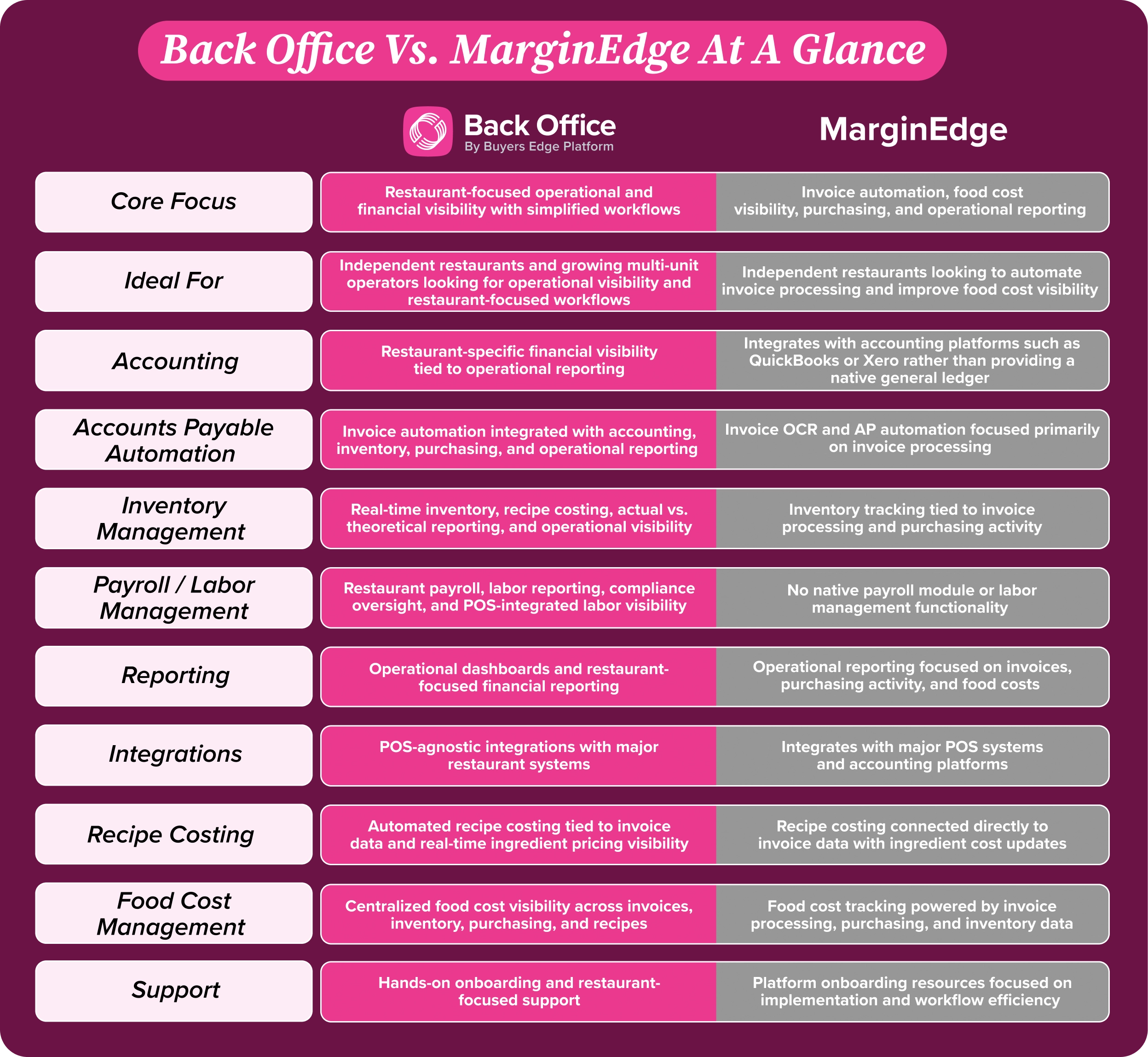
The following comparison shows how each platform handles restaurant financial management, operational reporting, and technology integration.
| Feature | Back Office | MarginEdge |
|---|---|---|
| Core Focus | Restaurant-focused operational and financial visibility with simplified workflows | Invoice automation, food cost visibility, purchasing, and operational reporting |
| Ideal For | Independent restaurants and growing multi-unit operators looking for operational visibility and restaurant-focused workflows | Independent restaurants looking to automate invoice processing and improve food cost visibility |
| Accounting | Restaurant-specific financial visibility tied to operational reporting | Integrates with 3rd party accounting platforms rather than providing a native general ledger |
| Accounts Payable Automation | Invoice automation integrated with accounting, inventory, purchasing, and operational reporting | Invoice OCR and AP automation focused primarily on invoice processing |
| Inventory Management | Real-time inventory, recipe costing, actual vs. theoretical reporting, and operational visibility | Inventory tracking tied to invoice processing and purchasing activity |
| Labor Management & Payroll | Restaurant payroll, labor reporting, compliance oversight, and POS-integrated labor visibility | No native payroll module or labor management functionality |
| Reporting | Operational dashboards and restaurant-focused financial reporting | Operational reporting focused on invoices, purchasing activity, and food costs |
| Integrations | POS-agnostic integrations with major restaurant systems | Integrates with major POS systems and accounting platforms |
| Recipe Costing | Automated recipe costing tied to invoice data and real-time ingredient pricing visibility | Recipe costing connected directly to invoice data with ingredient cost updates |
| Food Cost Management | Centralized food cost visibility across invoices, inventory, purchasing, and recipes | Food cost tracking powered by invoice processing, purchasing, and inventory data |
| Support | Hands-on onboarding and restaurant-focused support | Platform onboarding resources focused on implementation and workflow efficiency |
Download a copy of the comparison table here
Key Software Capabilities
Accounting
Both platforms offer restaurant financial management, but they approach accounting differently.
MarginEdge works alongside existing 3rd party accounting platforms and organizes financial data for export into external systems.
Back Office connects accounting with purchasing, inventory, invoice, and operational reporting data to help operators understand how daily operational decisions impact profitability.
Rather than relying on separate accounting software for core financial management, Back Office includes restaurant-specific accounting functionality with native general ledger capabilities. This gives operators visibility into financial and operational performance within a single platform.
Accounts Payable Automation
Both platforms help restaurants automate invoice workflows and reduce manual administrative work.
MarginEdge is known for invoice OCR and accounts payable automation that reduces manual invoice entry while updating purchasing and food cost information.
Back Office also automates invoice workflows while connecting invoice data directly to accounting, inventory, reporting, and operational visibility.
Instead of treating invoices as a standalone process, Back Office incorporates invoice activity into broader financial reporting and operational insights, helping operators understand how purchasing impacts overall restaurant performance.
Inventory Management
Both platforms provide inventory visibility and support restaurant purchasing decisions.
MarginEdge focuses on inventory tracking tied to invoice processing and purchasing activity, helping operators monitor usage and food costs in real time.
Back Office connects inventory usage directly to purchasing, recipe costing, accounting, and financial reporting visibility.
The emphasis is less on inventory tracking alone and more on helping operators compare actual versus theoretical usage, identify cost trends, evaluate performance across locations, and improve operational consistency.
Labor Management
Labor remains one of the largest controllable expenses for restaurant operators.
MarginEdge can integrate labor information from connected systems but does not provide native payroll, scheduling, or labor management functionality.
Back Office supports payroll visibility, labor reporting, scheduling, and POS-integrated operational insights while allowing operators to continue using existing restaurant technologies where appropriate.
By combining labor data with financial reporting and operational performance, operators gain greater visibility into labor costs and their impact on profitability.
Reporting & Analytics
MarginEdge emphasizes operational reporting focused on invoice activity, purchasing, and food costs.
Back Office emphasizes operational reporting designed for restaurant decision-making.
Instead of focusing primarily on invoice and purchasing activity, Back Office prioritizes visibility into the metrics operators interact with most often, including food cost trends, purchasing activity, labor performance, weekly financial reporting, and overall profitability.
Integrations
Both platforms integrate with restaurant technology systems.
MarginEdge integrates with major POS systems and accounting platforms to support invoice processing, inventory management, and operational reporting.
Back Office also integrates with leading restaurant systems, including Toast, Square, and Lightspeed.
Rather than competing on the number of integrations alone, Back Office focuses on ensuring restaurant data flows into unified operational reporting and financial visibility tools.
Recipe Costing
Both platforms support recipe costing and food cost visibility.
MarginEdge connects recipe costing directly to invoice data, allowing ingredient pricing updates as vendor costs change.
Back Office automatically updates ingredient pricing based on invoice activity, helping operators maintain current recipe costs by incorporating real-time purchasing data into ingredient pricing.
This can help operators respond faster to vendor price fluctuations and changing margin pressure.
Food Cost Management
MarginEdge provides food cost visibility through invoice processing, purchasing data, inventory tracking, and recipe costing.
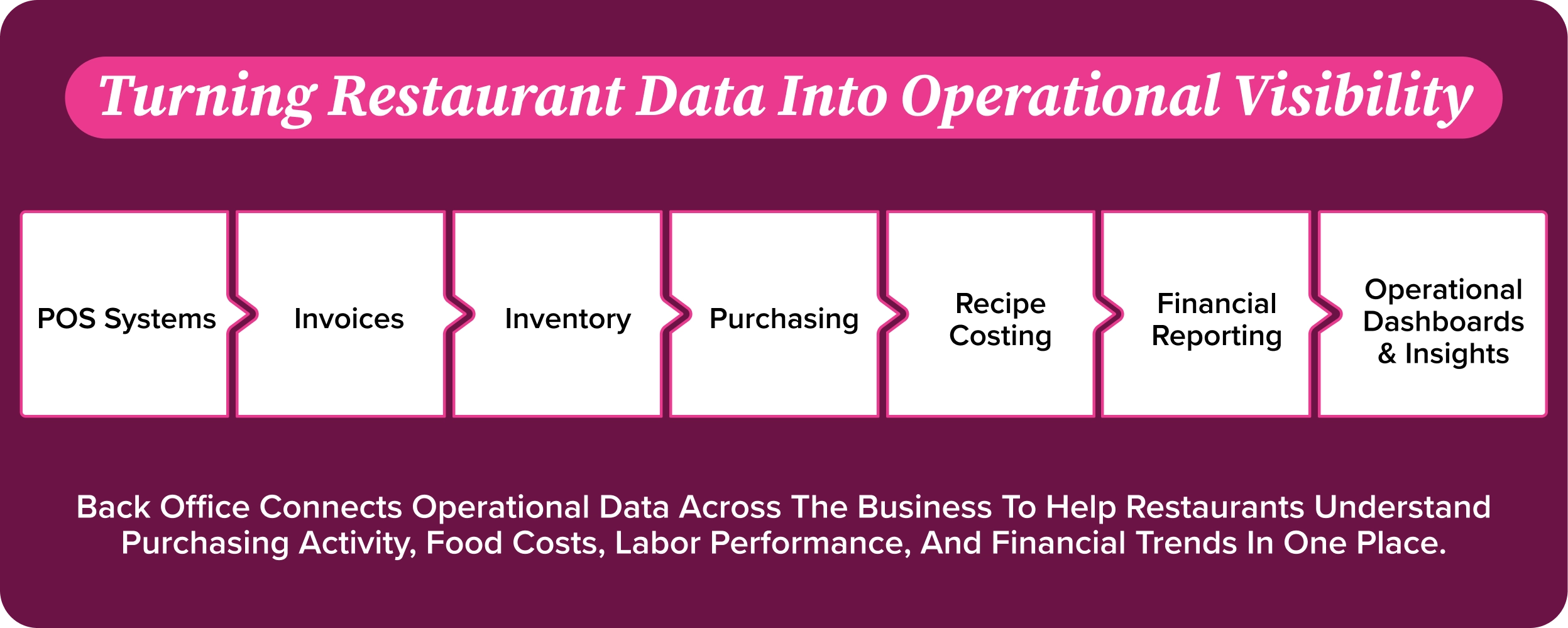
Back Office centralizes purchasing, invoice, inventory, labor, recipe, and financial data into a unified operational view.
The focus is less about monitoring food costs alone and more about helping operators understand what is driving those costs across the business.
For many restaurant operators, that broader operational visibility becomes increasingly important as food costs, labor pressure, and supplier pricing volatility continue to impact margins.

Support & Implementation
MarginEdge provides onboarding resources designed to help operators adopt the platform and improve workflow efficiency.
Back Office takes a more hands-on, restaurant-focused support approach.
Operators are supported by teams with restaurant operations and financial experience who help configure workflows, validate reporting accuracy, and improve visibility across the business.
This support model can be especially valuable for independent restaurants and growing operators that may not have large internal finance, IT, or analytics departments.
Back Office also emphasizes guided onboarding and operational adoption. Implementation timelines for either platform vary depending on organizational size, integrations, and deployment requirements.
Pricing
Pricing is an important consideration when evaluating restaurant back-office software, but subscription cost is only one part of the overall investment. Operators should also consider what functionality is included, whether additional software is required, and how the platform fits into their existing technology stack.
MarginEdge uses a flat monthly pricing model per location, with invoice processing, inventory tracking, recipe costing, and reporting included in the subscription.
Back Office uses a modular pricing approach, allowing operators to select the functionality they need, including accounting, inventory, reporting, payroll, scheduling, and food cost management.
When comparing costs, operators should also evaluate whether separate accounting software, payroll solutions, or additional operational tools are needed to support their workflows.
Pros and Cons
Back Office Pros
- Restaurant-focused accounting with native general ledger functionality
- Unified visibility across accounting, inventory, purchasing, reporting, and operational data
- Payroll, scheduling, and labor reporting capabilities
- Automated recipe costing and real-time food cost visibility
- POS-agnostic integrations with major restaurant technologies
- Hands-on onboarding and restaurant-focused customer support
Back Office Considerations
- May require integrations depending on existing systems
- Some advanced functionality may depend on the modules selected
MarginEdge Pros
- Strong invoice OCR and accounts payable automation
- Automated recipe costing tied to invoice data
- Real-time food cost and purchasing visibility
- Flat per-location pricing that’s easy to budget
- Integrates with major POS and accounting platforms
MarginEdge Considerations
- Does not include a native general ledger and typically relies on 3rd party accounting
- No native payroll or labor management functionality
- May require additional accounting software depending on business needs
Questions To Ask When Comparing Restaurant Back Office Software
- Does the platform manage both operational and financial workflows?
- Will you need separate accounting software?
- Does it provide payroll and labor management?
- Does it integrate with your existing POS and restaurant technology?
- How much operational visibility do you need beyond invoice processing?
- Will the platform scale as your restaurant grows?
The Right Solution Depends On Your Operational Needs, Technology Stack, And Long-Term Growth Goals.
Final Verdict
Both Back Office and MarginEdge help restaurant operators improve visibility into food costs and reduce manual administrative work.
MarginEdge is a strong option for operators primarily focused on invoice automation, recipe costing, purchasing visibility, and food cost management. Its OCR capabilities and streamlined workflows can help reduce manual invoice processing while providing better insight into ingredient costs.
Back Office takes a broader restaurant management approach by combining accounting, inventory, reporting, payroll, scheduling, purchasing, and food cost visibility within a restaurant-focused platform.
For independent restaurants and growing multi-unit operators, that unified operational visibility can simplify day-to-day management while supporting long-term growth and better financial decision-making.
When evaluating restaurant software, operators should consider not only feature lists, but also how much of their financial and operational workflow they want managed within a single platform.
FAQs
Is Back Office more comprehensive than MarginEdge?
For many operators, yes. While MarginEdge focuses heavily on invoice automation, recipe costing, and food cost visibility, Back Office combines accounting, inventory, reporting, payroll, scheduling, and operational insights within a single restaurant-focused platform.
Does MarginEdge include full accounting functionality?
MarginEdge integrates with 3rd party accounting platforms, but does not include a native general ledger. Restaurants typically continue using a separate accounting system for financial management.
Why is Back Office better for multi-location restaurants?
Back Office centralizes financial and operational information across locations, making it easier to compare performance, monitor trends, and manage purchasing, labor, inventory, and reporting from one platform.
Which platform provides stronger reporting and visibility?
Both platforms provide operational visibility, but they emphasize different areas. MarginEdge focuses primarily on invoice processing, purchasing activity, and food costs, while Back Office combines those insights with accounting, labor, inventory, and financial reporting to provide a broader view of restaurant performance.
Can Back Office fully replace MarginEdge?
For most core operational needs, yes. Back Office operations package delivers the core operational capabilities restaurants rely on from MarginEdge, including invoice automation, inventory management, recipe costing, food cost visibility, purchasing insights, and reporting. As restaurants grow, they can also expand into Back Office Accounting and Payroll to manage their entire back office within one connected platform instead of relying on multiple software solutions.