



Running a restaurant requires making dozens of decisions every day, from how much inventory to order to how many employees to schedule for the next shift. But without the right points of comparison, it can be difficult to know whether those decisions are actually moving the business in the right direction. A specific food cost percentage may look acceptable on its own, but it can often tell a much different story when compared against historical trends, similar restaurant types, or target performance goals.
That’s where restaurant benchmarking becomes a powerful tool for operators. By comparing key metrics across the various segments of the operation, restaurant owners can better understand where their business is strong, where inefficiencies are hiding, and what needs to change. More importantly, benchmarking restaurants gives operators a practical framework for setting realistic targets, monitoring progress over time, and making smarter decisions as the industry continues to shift.
What Is Restaurant Benchmarking and Why Does It Matter?
Restaurant benchmarking is the process of measuring one key metric against the same metric in another context. For example, you might compare this year’s average guest check to last year’s performance, or compare your food cost percentage to food cost percentages at similar restaurants in the same service category. Instead of looking at operational metrics in isolation, benchmarking provides a clearer point of reference for what “good” performance actually looks like. With the right benchmarks in place, restaurant operators can spot strengths, uncover inefficiencies, set realistic targets, and make smarter decisions as market conditions shift.
Core Restaurant Benchmarking Metrics Every Operator Should Track
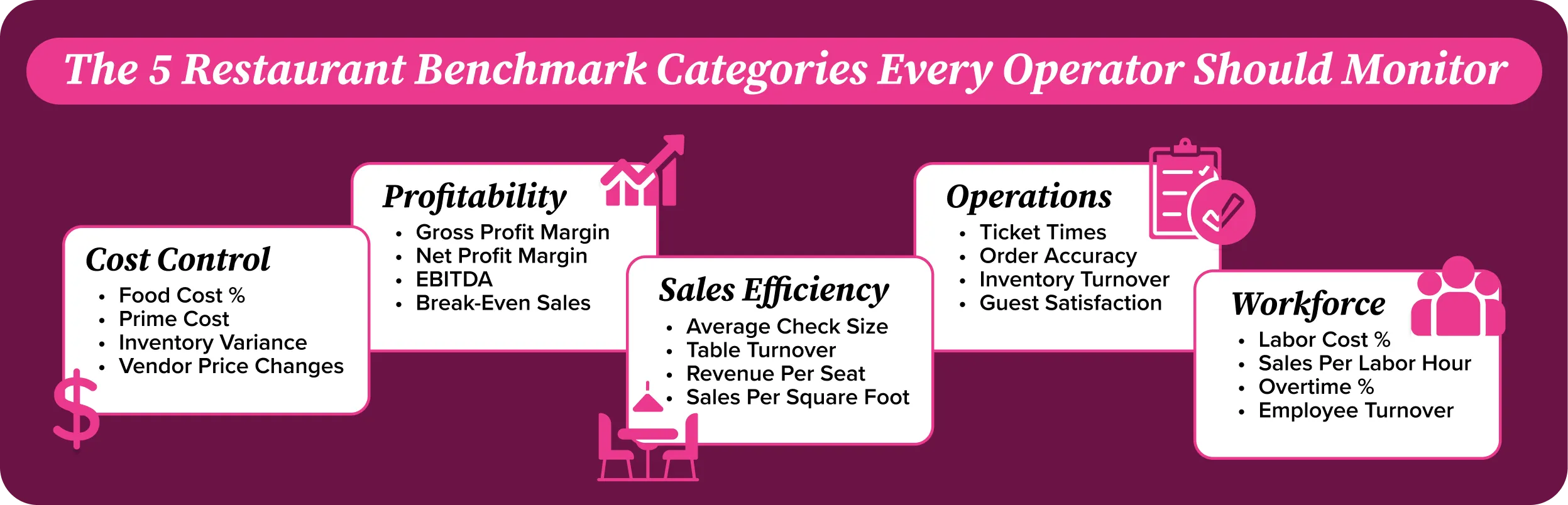
To make benchmarking restaurants meaningful, operators should track a focused set of metrics that connect daily decisions to financial and operational outcomes. Start your benchmarking journey by focusing on these key benchmark areas:
- Cost Control Benchmarks: These metrics reveal how efficiently the restaurant is managing expenses tied to food, beverages, labor, and other controllable operating costs. Common metrics include food cost percentage, prime cost, waste percentage, inventory variance, and vendor price changes.
- Profitability Benchmarks: These metrics show whether the restaurant is generating enough revenue to cover all expenses (and hopefully generate meaningful profit). To assess profitability, monitor gross profit margin, net profit margin, EBITDA, contribution margin, and break-even sales.
- Sales and Space Efficiency Benchmarks: These benchmarks measure how well the restaurant turns physical space, seating capacity, and menu activity into revenue. Key metrics include sales per square foot, revenue per available seat hour, average check size, table turnover rate, and sales by daypart.
- Operational Performance Benchmarks: These indicators reveal how consistently the restaurant executes across service, inventory, and guest experience. This involves tracking ticket times, order accuracy, inventory turnover, voids and comps, guest satisfaction scores, and online review trends.
- Staffing and Workforce Benchmarks: These values help operators evaluate whether labor is aligned with sales volume, service expectations, and employee retention goals. Important metrics include labor cost percentage, sales per labor hour, overtime percentage, turnover rate, schedule variance, and absenteeism.
Restaurant Benchmarking by Restaurant Type
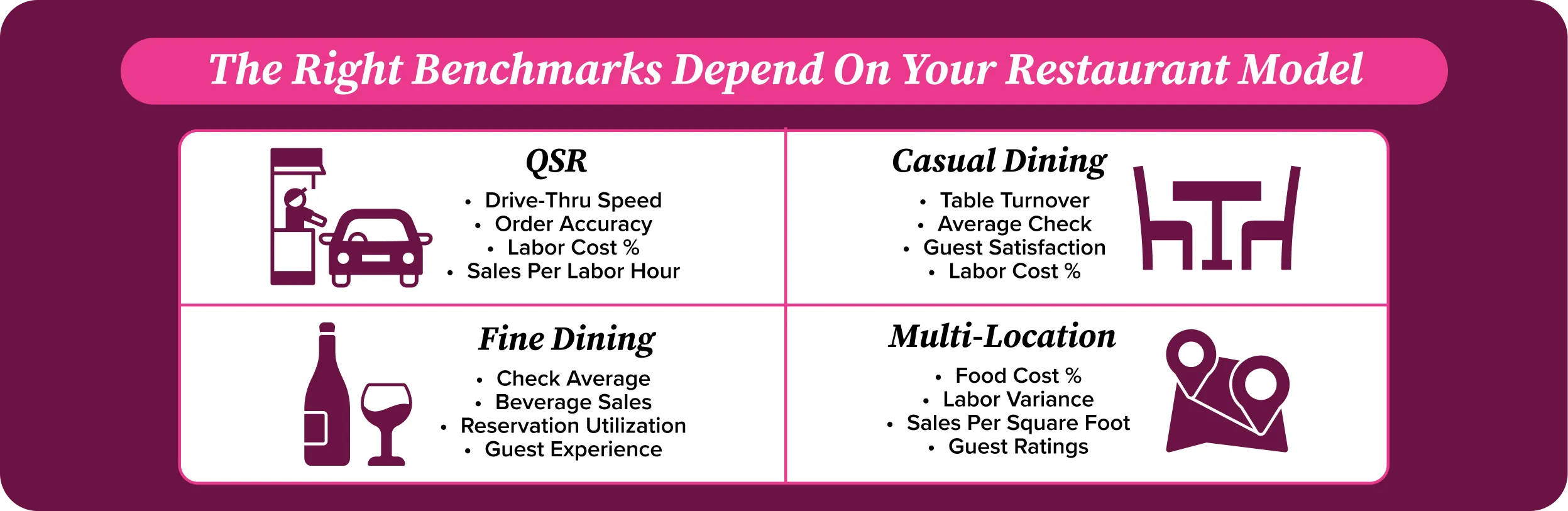
While most operators know to monitor costs, profitability, sales, and labor, the most useful benchmarks will depend on the restaurant’s service model. A quick-service restaurant (QSR), for example, may prioritize speed and volume, while a fine-dining restaurant may care more about check average, guest experience, and menu profitability.
Identify the metrics that matter most for your restaurant by focusing on the metrics that align most closely with your service model:
Quick-Service Restaurant (QSR) Benchmarks
For QSRs, customers want to get in and get out, making speed, order accuracy, and transaction volume key operational differentiators. QSR operators should prioritize benchmarks like drive-through times, labor cost percentage, sales per labor hour, and order accuracy, while metrics like table turnover rate may matter far less.
Casual Dining Benchmarks
For casual dining restaurants, operators must balance efficient service with a comfortable guest experience, making labor planning, table management, and check averages especially important. Casual dining benchmarks should include table turnover rate, average check size, labor cost percentage, and guest satisfaction scores, while metrics like drive-through speed would typically be irrelevant.
Fine Dining Benchmarks
For fine-dining restaurants, the guest experience is often just as important as the meal itself, making service quality, menu profitability, and premium inventory control critical. Operators should track benchmarks like average check size, wine and beverage sales, reservation utilization, and guest satisfaction, while speed-of-service metrics may be less meaningful than items like pacing or overall quality scores.
Multi-Location and Franchise Benchmarks
For multi-location and franchise restaurants, consistency across units is one of the most important measures of operational success. Operators should compare location-level benchmarks such as food cost percentage, labor variance, sales per square foot, manager performance, and guest ratings, while outlier metrics such as highest one-day sales may matter less, particularly if those outliers can be attributed to external factors rather than controllable operational patterns.
How to Benchmark Your Restaurant

Having a clear benchmarking process can help turn performance data into practical, measurable improvements for your restaurant. To develop your benchmarking process, follow these simple steps:
Step 1: Set Clear Benchmarking Goals
Start by identifying what you want to improve, such as lowering food costs, increasing sales, reducing labor variance, or improving guest satisfaction. Choose one or two priorities at a time so your team can focus on specific outcomes instead of tracking too many disconnected numbers.
Step 2: Choose the Right KPIs
Select KPIs that directly connect to your benchmarking goals and restaurant type. For example, a QSR may track speed of service and sales per labor hour, while a casual dining operator may focus on table turnover, average check size, and labor cost percentage.
Step 3: Collect Accurate Financial and POS Data
Pull consistent data from your POS, accounting, payroll, inventory, and scheduling systems. Review the same reporting periods each time, clean up duplicate or incomplete entries, and use centralized reporting tools to improve operational efficiency by reducing manual spreadsheet work and data-entry errors.
Step 4: Compare Against Benchmarks
Compare your results against industry standards, similar restaurant types, historical performance, and internal targets. Look for patterns across weeks, months, or locations instead of reacting to one unusual reporting period, since benchmarking is most valuable when it reveals consistent performance trends.
Step 5: Analyze Gaps and Take Action
Identify where your restaurant is outperforming, underperforming, or trending in the wrong direction. Then assign specific next steps, such as adjusting menu pricing, revising schedules, renegotiating vendor costs, retraining staff, or setting new targets to keep performance moving in the right direction.
Common Restaurant Benchmarking Mistakes to Avoid
Even well-intentioned benchmarking efforts can create confusion when operators rely on incomplete data, poor comparisons, or inconsistent reporting practices. As you implement your benchmarking process, try to avoid these common mistakes:
- Looking at One Reporting Period in Isolation: One strong weekend or one unusually slow week can make performance look better or worse than it really is, especially when sales are affected by weather, holidays, local events, or staffing disruptions. To avoid overreacting, compare results across multiple weeks, months, or seasons to determine whether the data reflects a true trend.
- Tracking Too Many Metrics at Once: Benchmarking can quickly become overwhelming when trying to monitor every available KPI. Start with a focused set of metrics tied to your top business priorities, then expand your benchmarking process as your team becomes more comfortable interpreting and acting on the available data.
- Comparing Against the Wrong Benchmark: Broad industry averages can be misleading when they do not reflect your restaurant type, service model, market, or menu structure. Choose benchmarks that align with how your restaurant actually operates by comparing your performance against restaurants with similar service models, customer profiles, and revenue drivers.
- Relying on Inaccurate or Inconsistent Data: Benchmarking becomes less helpful when your calculations come from outdated spreadsheets, incomplete POS data, inconsistent inventory counts, or error-filled manual reports. Using an automated system like Back Office can help centralize reporting, reduce manual data issues, and give your team more reliable numbers to guide performance decisions.
Best Practices for Ongoing Restaurant Benchmarking
Benchmarking works best when it becomes a regular operating habit, not a one-time reporting exercise. To build an easy-to-follow benchmarking routine, follow these best practices:
- Monitor trends over time: Review performance across comparable daily shifts, weeks, months, and seasons before making major operational changes.
- Focus on a manageable set of priority metrics: Start with the KPIs tied to your biggest goals, then expand only when your team is ready.
- Choose benchmarks that match your restaurant model: Compare your performance against restaurants with similar service styles, menus, markets, and operational structures.
- Leverage automation to improve data accuracy: Use integrated systems to reduce manual entry, centralize reporting, and keep financial, labor, and sales data consistent.
- Review benchmarks with your management team regularly: Build benchmark reviews into weekly or monthly meetings so managers understand trends and own next steps.
- Turn benchmarking insights into specific action plans: Assign clear actions, owners, and timelines for improvements in targeted operational areas, such as scheduling, training, or menu performance.
How Back-Office Software Simplifies Restaurant Benchmarking
Benchmarking restaurants is most effective when operators can trust the data behind every decision. Back-office software helps simplify this process by centralizing financial, labor, inventory, sales, and restaurant analytics data in one place. Instead of manually building reports, operators can use automated tools to monitor trends, compare performance, and take action faster. As the industry changes, solutions that automate benchmarking and key restaurant processes can help operators stay focused, informed, and ready to grow.
Want to see how smarter benchmarking can support your restaurant goals? Reach out to the Back Office team to learn more.
FAQ’s
How often should restaurants review benchmarking data?
Restaurant operators should review key benchmarking metrics at least monthly, though high-impact metrics such as food cost percentage, labor cost percentage, and sales performance may warrant weekly reviews. Regular benchmarking helps operators identify trends early and make adjustments before small issues become larger profitability challenges.
How can inaccurate reporting affect restaurant benchmarking?
Benchmarking is only as useful as the data behind it. When operators rely on spreadsheets, disconnected systems, or manual processes, reporting errors can make it difficult to identify trends and compare performance accurately. Centralized back-office software helps improve data accuracy by automating data collection and reporting, giving operators greater confidence in their benchmarking efforts and operational decisions.
This case study helped develop this ^ one.
Which benchmarking metrics have the biggest impact on restaurant profitability?
While every operation is different, food cost percentage, labor cost percentage, prime cost, average check size, and net profit margin are often among the most important metrics to monitor. Together, these benchmarks provide visibility into both revenue generation and expense management, helping operators make more informed business decisions.
How can multi-unit restaurant operators benchmark performance across locations?
Multi-unit operators can compare metrics such as food costs, labor costs, sales per square foot, guest satisfaction scores, and manager performance across locations. Consistent benchmarking helps identify top-performing units, uncover operational inconsistencies, and share best practices throughout the organization.
How does restaurant back-office software improve benchmarking accuracy?
Restaurant back-office software automates data collection from multiple operational systems, reducing manual reporting errors and providing a more complete view of business performance. With centralized reporting and real-time visibility into financial and operational metrics, operators can benchmark performance more confidently and take action faster when trends emerge.