

Most restaurant operators approach pricing with a simple cost-plus formula: calculate food costs, then multiply by three. That approach might keep the lights on, but it’s leaving money on the table.
The restaurants thriving in today’s challenging environment know that restaurant pricing strategy is a powerful lever that can drive profitability and shape customer perception. They’re using behavioral psychology, market positioning, and data-driven insights to maximize every dollar.
Why Cost-Plus Pricing Isn’t Enough Anymore
The traditional cost-plus formula that’s been taught in culinary schools for decades is designed to cover labor costs and overhead and build in a modest profit margin while hitting a 30–35% food cost percentage. However, this approach treats every menu item the same way and ignores factors like customer demand, competitor positioning, and profit optimization.
Consider this: Your signature burger might have the same food cost percentage as your house salad, but customers are willing to pay a premium for the burger because it’s unique to your establishment. Meanwhile, the salad competes with every other restaurant on the block. Same cost formula, completely different profit potential.
With rising food costs, labor shortages, and increasing competition, restaurants that stick to basic cost-plus pricing are missing opportunities to boost profitability.

The Psychology Behind Menu Pricing
Customers don’t just buy food — they buy the story your prices tell. A $12 sandwich suggests something different than a $22 sandwich, regardless of the actual ingredients.
Price anchoring is your secret weapon. When customers see a $28 steak on your menu, that $18 chicken entrée suddenly feels like a reasonable middle option. Psychologically, high-priced signature items make everything else feel more accessible.
Menu placement matters just as much as the numbers themselves. Items positioned in the middle and upper right corner of a menu typically see higher sales than those at the bottom. Meanwhile, removing dollar signs and decimal points can increase average order values by reducing the “pain” customers feel when spending money.
Pricing by Restaurant Type
Different restaurant formats require completely different restaurant menu pricing strategies. What works for quick-service will backfire in fine dining, and vice versa.
Quick-Service and Fast-Casual Restaurants
Speed and value perception drive fast-casual and quick-service restaurant (QSR) pricing. Smart QSR operators find profit opportunities through bundle pricing that increases average ticket size while maintaining perceived value. For instance, a combo meal might cost $9.99 when items would total $11.50 separately, encouraging customers to spend more yet feel like they’re saving money.
Tiered pricing offers good-better-best options. A basic burger at $6.99, a deluxe version at $9.49, and a premium option at $12.99 can give customers choices while guiding them toward higher-margin items.
Casual Dining Establishments
Casual dining has more pricing flexibility than QSRs but faces pressure from both fast-casual below and fine dining above. These restaurants benefit from experience-based pricing where atmosphere, service, and presentation justify higher margins.
Beverage profit optimization is critical here, since alcohol carries much higher margins than food. Strategic pricing in this category can significantly impact overall profitability.
Fine Dining and Upscale Restaurants
Fine dining is where price can enhance perceived value. Customers expect to pay more and often associate higher prices with better quality and exclusivity.
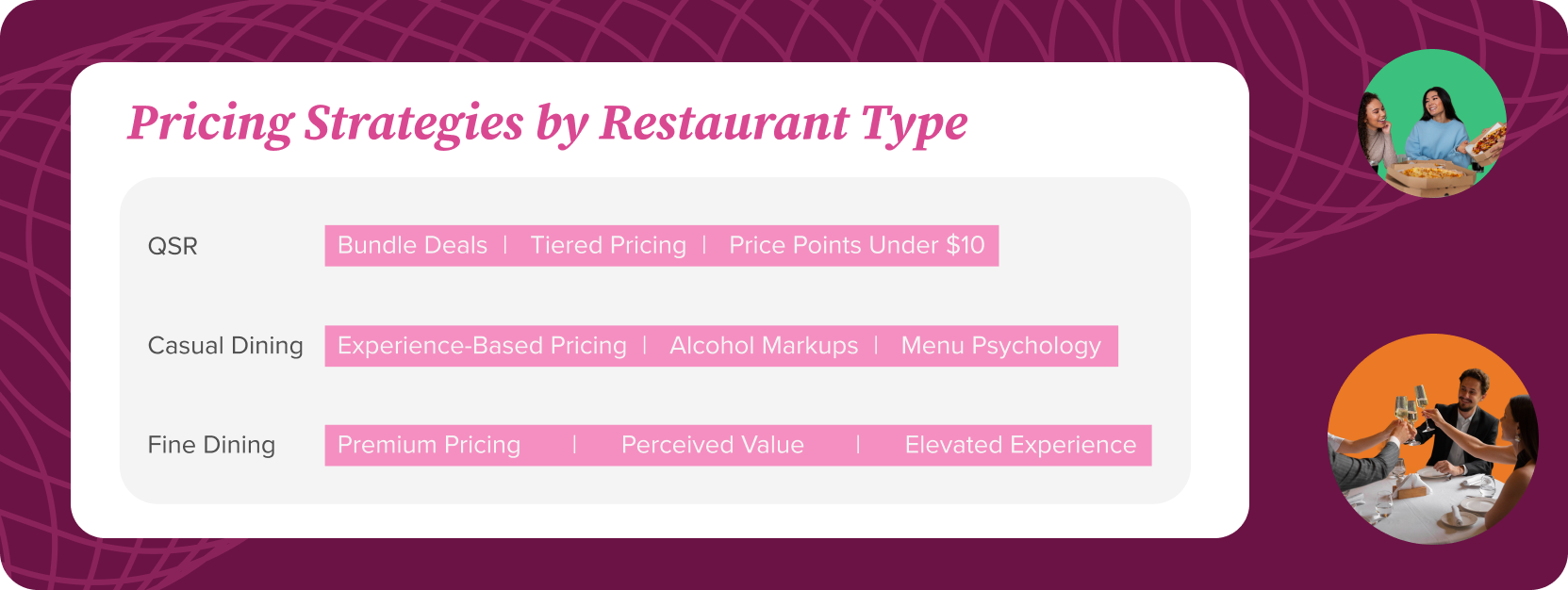
These establishments succeed with premium positioning where pricing reflects the total experience — ingredients, preparation, service, and ambiance. A $45 entrée isn’t just about food costs; it’s about the story and the experience customers can’t get elsewhere.
What Should Influence Your Prices
Restaurant menu pricing strategy considers far more than just ingredient costs. Labor intensity, preparation time, and equipment usage all impact true menu item profitability. A simple salad might have low food costs but require significant prep time, while a slow-braised entrée ties up expensive equipment for hours.
Market positioning plays a huge role in pricing power. Are you the neighborhood’s comfort food destination, the trendy spot for date nights, or the reliable lunch option for office workers? Each has different customer expectations and requires a different restaurant pricing strategy.
Seasonality creates opportunities for dynamic pricing. For example, local asparagus can command premium prices during spring when the ingredient is at peak freshness. Smart operators adjust prices throughout the year to reflect both costs and customer excitement about seasonal offerings.
Local competition sets the playing field, but it doesn’t have to limit your options. Understanding competitor pricing can help you position strategically — either as the value option, the premium choice, or the sweet spot in between.
Menu Engineering Is Your Pricing Strategy’s Best Friend
The most profitable restaurants don’t just price individual items — they engineer their entire menu to guide customer behavior and maximize profitability. This means categorizing menu items based on both popularity and profit margins, then using pricing to influence customer choices.
High-margin dishes that customers love should be your star menu items. Promote them heavily and consider slight price increases to test demand elasticity. Popular items with low margins are a sure way to bring in customers. These are candidates for cost reduction or careful repricing. Low-margin, unpopular items should be eliminated or completely reimagined.
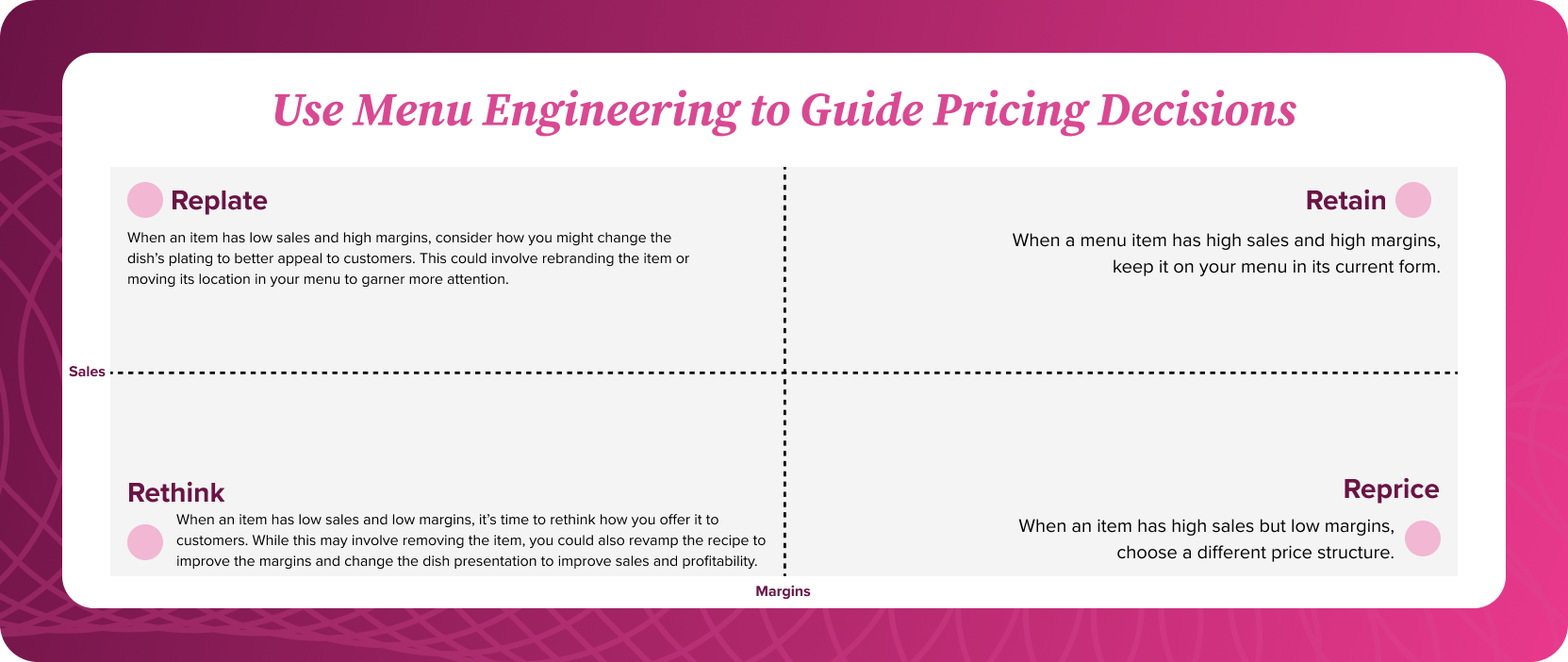
Strategic pricing can move items between categories. A dish with great margins but low sales might just need better menu placement and competitive pricing to become a star.
Technology’s Role in Pricing Decisions
Today’s successful restaurants use data to inform pricing decisions rather than relying on gut feelings or industry rules of thumb. Modern restaurant management systems can track which items sell and at what quantities, revealing price sensitivity and profit optimization opportunities.
When ingredient prices fluctuate, real-time cost tracking becomes essential. For instance, if avocado prices spike 40% overnight, you need systems that can immediately show the impact on menu item profitability. This can help you make informed decisions about temporary pricing adjustments.
Integration between your point-of-sale, inventory management, and financial reporting systems can create a complete picture of true menu item profitability. This visibility can help identify which items deserve pricing increases, which need cost reduction, and which should be eliminated.
Start Optimizing Your Pricing Strategy Today
Smart pricing isn’t a one-time decision. It’s an ongoing strategy that evolves with your costs, competition, and customers. Start by analyzing your current menu through both profitability and popularity lenses. Which items are making you money? Which are just taking up menu space?
Test pricing changes strategically rather than making wholesale adjustments. Try increasing prices on one or two high-margin items and monitor customer response. You might discover more pricing flexibility than you expected, especially for unique dishes customers can’t get elsewhere.
Most importantly, ensure your pricing decisions are based on accurate, real-time data about food costs, labor expenses, and sales patterns. Guessing about profitability in today’s environment is a luxury most restaurants can’t afford.
The restaurants that thrive over the next few years won’t just serve great food — they’ll price it strategically. While your competitors stick to simple formulas, you can use a smart restaurant pricing strategy to maximize profitability, enhance customer perception, and build a more resilient business.