


Restaurant technology has never been more powerful—or more confusing. Between POS upgrades, inventory platforms, labor tools, and analytics dashboards, operators are often swimming in software, yet still struggling with visibility, cost control, and decision-making. The answer isn’t more tools. It’s a smarter restaurant technology stack built around the realities of how restaurants actually operate.
What Is a Restaurant Technology Stack?
A restaurant technology stack is the collection of digital tools a restaurant uses to manage its operations, finances, and data. Rather than functioning as standalone systems, the most effective stacks integrate to create a single source of truth.
Why Building the Right Restaurant Tech Stack Matters
Margins in foodservice are tight, labor costs remain volatile, and ingredient prices continue to fluctuate. In this environment, visibility is everything. Operators need to understand—not guess—what’s happening across purchasing, labor, inventory, and sales.
Recent data shows that most operators are already moving in this direction: According to the National Restaurant Association’s (NRA) 2025 State of the Industry Report, 67% of restaurant operators (73% of limited-service operators and 60% of full-service operators) said they incorporated more technology into their restaurant operation during the past two to three years, across both customer-facing and operational areas.
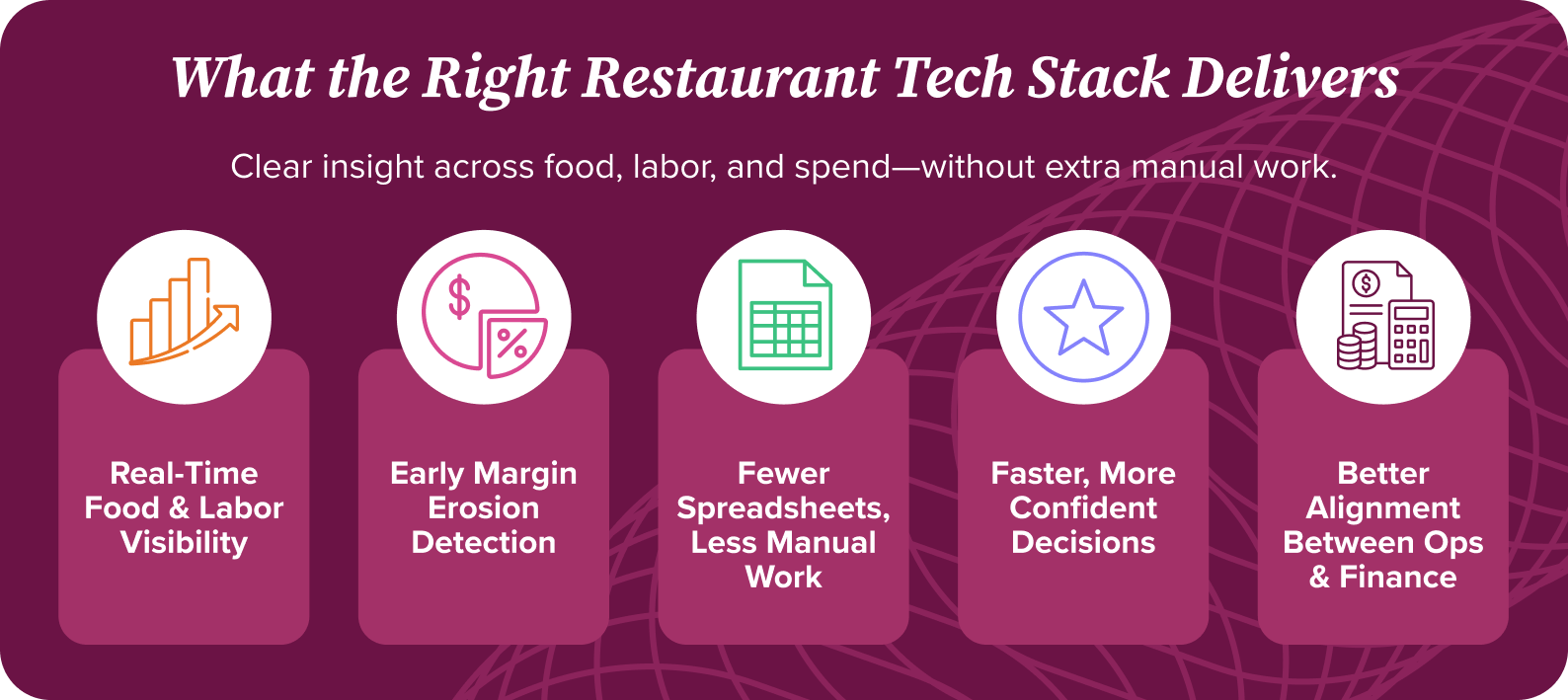
The right restaurant technology stack helps operators:
- See real-time food and labor costs
- Identify margin erosion early
- Reduce manual work and spreadsheet dependency
- Make faster, more confident decisions
Among operators who adopted more technology during the past two to three years, 69% said those investments made their restaurant more efficient and productive, reinforcing the direct link between smart tech adoption and operational performance.
Without an integrated stack, restaurants often operate in the dark. POS data might show sales trends, but it won’t explain why margins are shrinking. Accounting software may track spend, but without operational context, insights arrive too late to act on.
A well-built stack closes those gaps by connecting systems and aligning data across the business.
The Restaurant Technology Stack Ecosystem
A modern restaurant tech stack is best thought of as an ecosystem. Each tool plays a role, but the real value comes from how those tools connect and share data.

Restaurant Management Software
This acts as the operational hub, connecting locations, users, and workflows. It supports consistency across the business while allowing flexibility at the store level.
Restaurant Accounting Software
Accounting systems track invoices, payments, and financial reporting. When integrated with purchasing and inventory data, they provide a clearer picture of actual versus expected costs.
Restaurant Inventory Management Software
Inventory tools track ingredient usage, ordering, and on-hand quantities. Integrated inventory reduces food waste, prevents over-ordering, and improves forecasting accuracy. The NRA’s State of the Industry Report revealed that 47% of operators planned to invest in inventory management software in 2025, underscoring the growing importance of inventory visibility in cost control strategies.
Food Cost Management Software
Food cost tools translate purchasing and inventory data into actionable insights. They help operators understand cost fluctuations, vendor pricing changes, and margin impact in near real time.
Restaurant Payroll Software
Payroll systems manage wages, scheduling, and labor compliance. When labor data connects with sales and cost data, operators can better align staffing with demand. In fact, 51% of operators plan to invest in workforce management software and apps to support hiring, scheduling, training, and payroll, reflecting ongoing labor complexity across the industry.
Recipe Costing Software
Recipe costing tools tie ingredient prices to menu items. This ensures pricing decisions are informed by actual costs, not outdated assumptions.
Restaurant Reporting Software
Reporting platforms bring all this data together. Rather than pulling numbers from multiple systems, operators get centralized, customizable dashboards that support faster decisions.
Common Mistakes When Building a Restaurant Tech Stack
Even well-intentioned tech investments can create friction if the stack isn’t thoughtfully designed.
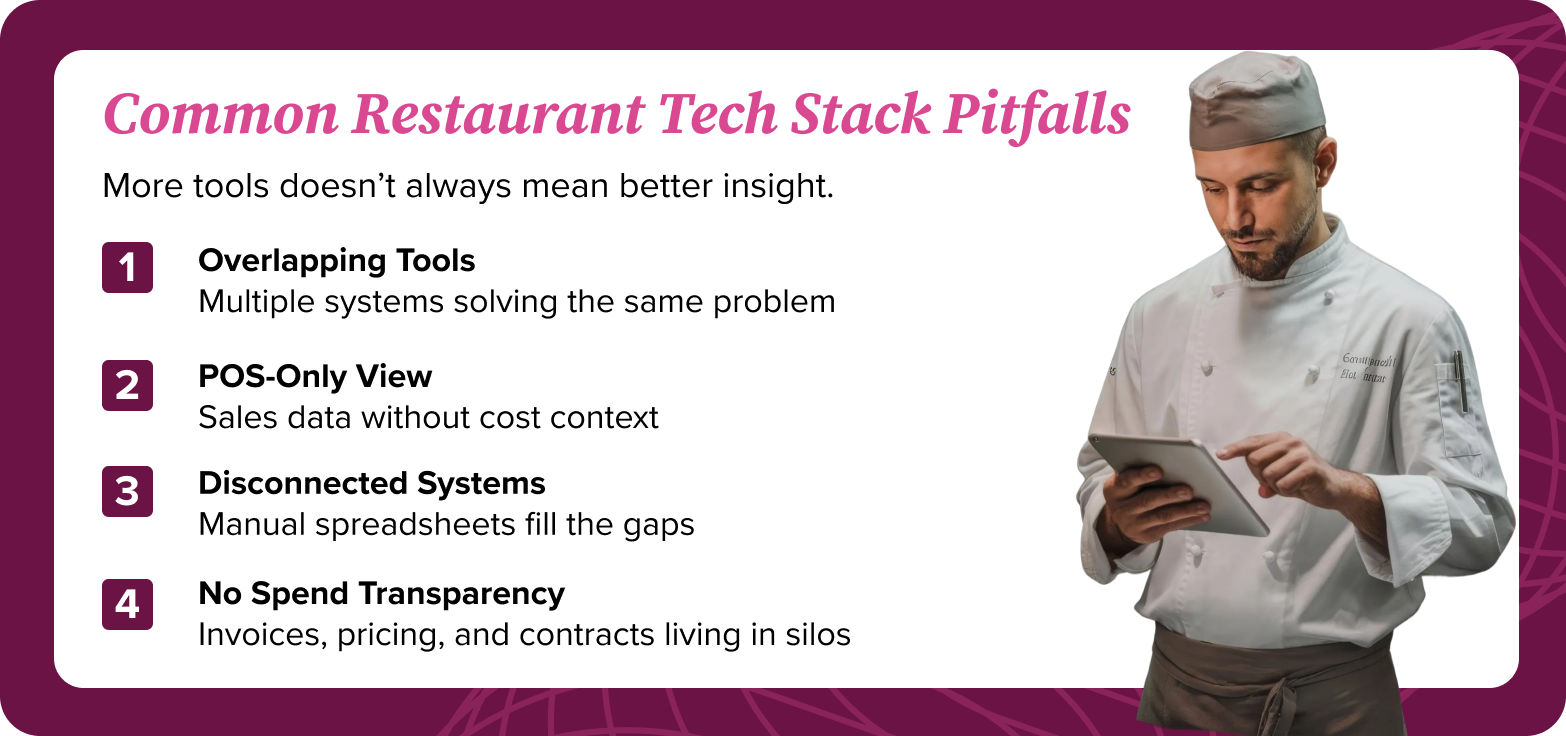
Overlapping Tools With No Clear Ownership
Using multiple tools to solve the same problem often leads to conflicting data and wasted spend. It can also create internal confusion when different teams—operations, finance, and leadership—rely on different systems to evaluate performance.
Relying on POS Data Alone
POS data shows sales, not profitability. Without cost and spend context, it’s only part of the story. Without visibility into food costs, labor, purchasing, and vendor pricing, operators are left reacting to margin issues after the damage is already done. This is especially risky as 52% of operators plan to devote resources to point-of-sale systems, which can unintentionally reinforce a sales-only view of performance if not paired with back-office intelligence.
Lack of Spend and Cost Transparency
If invoices, vendor pricing, and contracts aren’t visible in one place, operators can’t react quickly to cost changes. This lack of transparency makes it difficult to spot price creep, enforce negotiated pricing, or hold vendors accountable over time. Fifty-four percent of operators say they are planning to incorporate technology into back-office functions such as payroll, finance, tax compliance, and food safety—areas where cost transparency directly impacts profitability.
Choosing Tools That Don’t Integrate
Disconnected systems force teams back into spreadsheets, undoing the benefits of automation and increasing the risk of errors. Over time, the manual effort required to reconcile data can outweigh any initial value those tools were meant to deliver. This fragmentation can also introduce security risks, which stands out as 47% of operators say they plan to invest in cybersecurity as their technology environments become more complex.
How to Choose Tools for Your Restaurant Tech Stack
There’s no universal stack that works for every restaurant. The right setup depends on size, service model, and growth stage. However, certain criteria matter across the board.
Integration Capability and Data Accuracy
Tools should connect seamlessly and share clean, reliable data. Strong integrations are essential for meaningful analytics, as outlined in this look at data analytics in restaurants.
Scalability Across Locations
What works for a single unit may not work for 10, 50, or 100. Systems should scale without requiring a complete overhaul.
Usability for Operators and Finance Teams
If tools are too complex, they won’t be used consistently. Adoption matters as much as features.
Ability to Centralize Financial and Operational Data
A centralized view reduces confusion and speeds up decision-making across teams.
Reporting Flexibility and Customization
Operators should be able to analyze data by location, timeframe, or category without custom development.
Vendor Support and Implementation Experience
Strong onboarding and ongoing support reduce disruption and help teams realize value faster.
Restaurant Technology Stack Trends to Watch
As restaurant operations grow more complex, the focus is shifting from tool accumulation to intelligence and efficiency.
Real-Time Cost Visibility
Operators want insights now, not at month-end. Real-time visibility allows faster course correction.
Automation in Back Office Operations
Invoice processing, reconciliation, and reporting are increasingly automated, reducing manual work for finance teams.
Data-Driven Margin Optimization
Integrated data helps identify where margins are leaking—and where opportunities exist to protect profitability.
AI-Powered Forecasting and Spend Analysis
AI is being applied to demand forecasting, purchasing patterns, and waste reduction. This trend is already reshaping how restaurants approach cost control, as explored in this piece on AI for restaurant food waste management.
Greater Focus on Back Office Intelligence
Technology investments are shifting behind the scenes, where better data delivers measurable financial impact.
Fewer Tools, Deeper Integrations
Operators are simplifying stacks and prioritizing platforms that integrate seamlessly.
Build a Smarter Restaurant Tech Stack With Back Office
A strong restaurant technology stack delivers clarity, connection, and confidence across the business. By choosing integrated tools that align with your operations, you can make decisions based on real data, not gut instinct.
Back Office brings those systems together, helping operators simplify their technology ecosystem and turn data into actionable insight.
FAQs
How much does a restaurant technology stack cost?
The price of a restaurant technology stack depends on how many locations there are, what integrations are needed, and which software providers are chosen. Operators should look at the total cost of ownership, which includes not only the subscription price but also the costs of implementation, training, support, and integration.
Can a restaurant technology stack work for small or single-location restaurants?
Yes. A restaurant technology stack isn’t only for big chains. Integrated POS, inventory, and reporting tools that cut down on manual work and make costs easier to see are good for even one-unit businesses. The most important thing is to choose solutions that can grow with the business.
How long does it take to implement a restaurant technology stack?
The length of time it takes to implement a system depends on how complicated it is and how well it needs to work with other systems. Setting up a simple system could take a few weeks, but integrating systems in multiple locations could take months. Proper onboarding and vendor support are very important for a successful rollout.
How does integration improve data accuracy in a restaurant technology stack?
When systems work together, data moves automatically between the POS, purchasing, inventory, and accounting platforms. This cuts down on duplicate entries, makes mistakes less likely, and makes sure that operators are always working with the same, up-to-date information.
How does a restaurant technology stack support multi-location growth?
A unified restaurant technology stack makes reporting the same for all locations, keeps an eye on finances from one place, and lets you see everything that’s going on. This makes it easier to compare performance, enforce contracts and pricing, and grow the business without making things more complicated for the people in charge.