Restaurant owners depend on technology to keep track of their finances, inventory, employees, and performance across their operations. As operations grow more complex, selecting the right back-office software becomes critical for both independent operators and multi-location brands.
Back Office and Craftable are two platforms operators may consider when looking to better manage their finances and operations. Both offer tools for tracking costs and improving visibility into restaurant performance, but they approach day-to-day management in different ways.
In this comparison, we look at features, operational approach, implementation considerations, and overall fit to help operators evaluate which platform best aligns with how they run their business.
Back Office by Buyers Edge Platform vs Craftable Overview
BEP Back Office and Craftable both help restaurant operators connect purchasing and inventory data with a clearer view of costs and operational performance.
Craftable focuses on purchasing, inventory, recipes, accounts payable, and operational financial reporting. Its beverage inventory and pour-cost tools are particularly relevant for restaurants and hospitality groups managing complex bar programs. It also supports food cost management across kitchen operations.
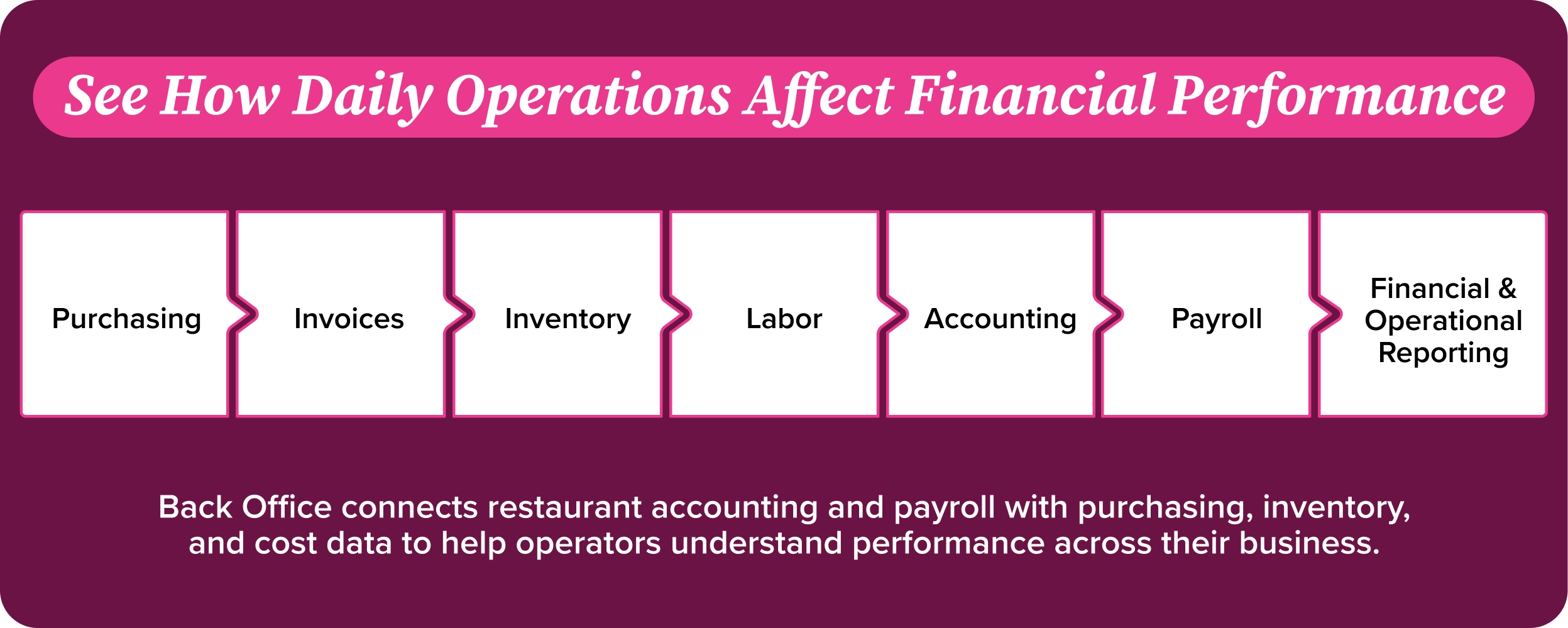
BEP Back Office brings restaurant accounting, food cost management, payroll services, and operational reporting together. It connects purchasing, invoices, inventory, and financial data so operators can see how day-to-day decisions affect profitability.
BEP Back Office also pairs its restaurant-focused workflows with hands-on onboarding and support from a team familiar with restaurant operations. Craftable provides implementation assistance, training resources, and customer care as well.
While both platforms help operators track costs and manage purchasing, they differ in how accounting and payroll fit into the overall setup. Craftable connects its purchasing, inventory, AP, and operational reporting tools with external accounting and payroll systems. BEP Back Office offers restaurant accounting and payroll services alongside its food cost and operational tools.
For independent restaurants and growing multi-unit groups, the choice comes down to which parts of the operation they want their software to connect and where they need the most visibility. The following comparison shows how each platform handles financial management, inventory, labor, reporting, and integrations.
| Feature | Back Office | Craftable |
|---|---|---|
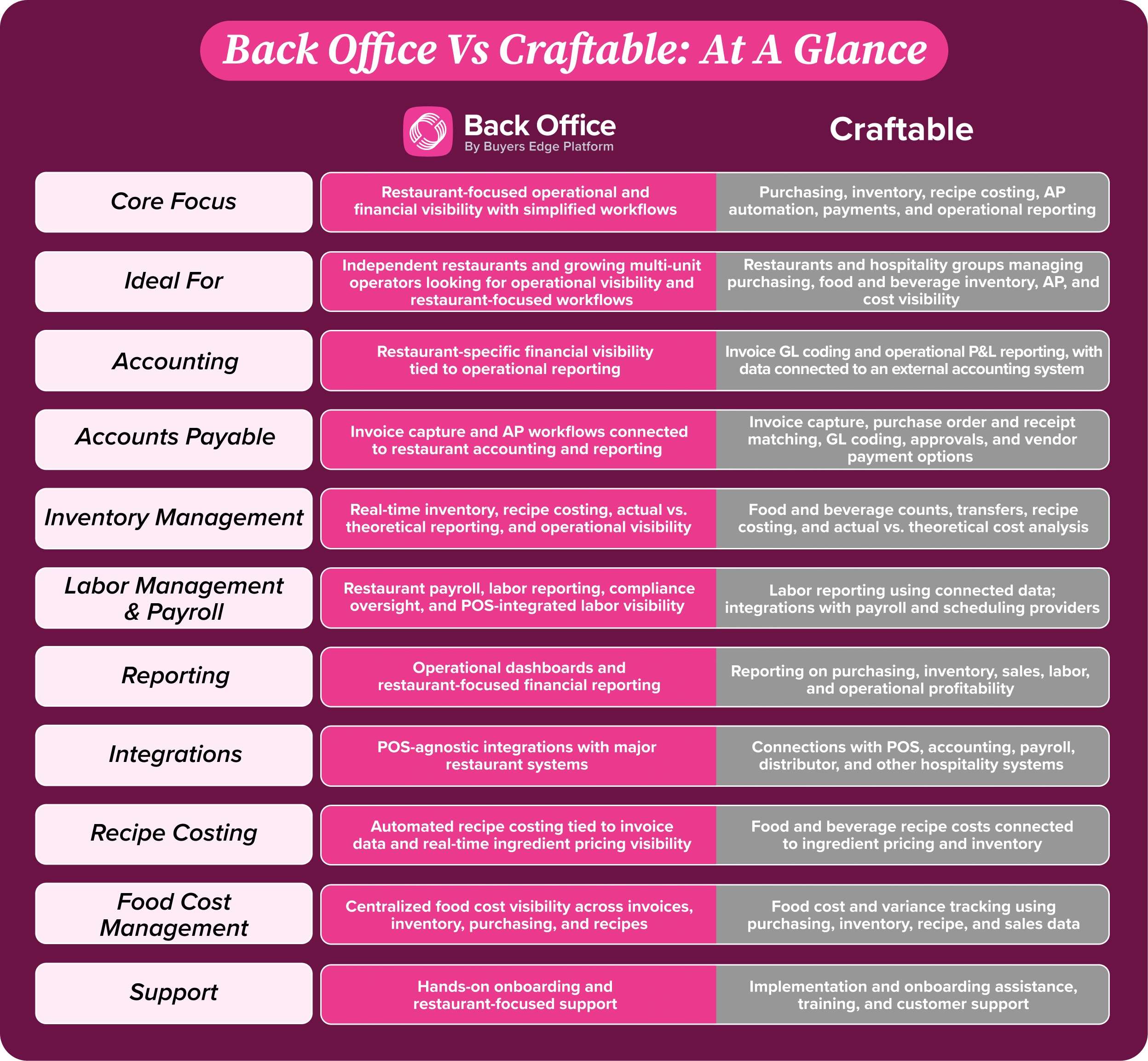
| Core Focus | Restaurant-focused operational and financial visibility with simplified workflows | Purchasing, inventory, recipe costing, AP automation, payments, and operational reporting |
| Ideal For | Independent restaurants and growing multi-unit operators looking for operational visibility and restaurant-focused workflows | Restaurants and hospitality groups managing purchasing, food and beverage inventory, AP, and cost visibility |
| Accounting | Restaurant-specific financial visibility tied to operational reporting | Invoice GL coding and operational P&L reporting, with data connected to an external accounting system |
| Accounts Payable | Invoice capture and AP workflows connected to restaurant accounting and reporting | Invoice capture, purchase order and receipt matching, GL coding, approvals, and vendor payment options |
| Inventory Management | Real-time inventory, recipe costing, actual vs. theoretical reporting, and operational visibility | Food and beverage counts, transfers, recipe costing, and actual vs. theoretical cost analysis |
| Labor Management & Payroll | Restaurant payroll, labor reporting, compliance oversight, and POS-integrated labor visibility | Labor reporting using connected data; integrations with payroll and scheduling providers |
| Reporting | Operational dashboards and restaurant-focused financial reporting | Reporting on purchasing, inventory, sales, labor, and operational profitability |
| Integrations | POS-agnostic integrations with major restaurant systems | Connections with POS, accounting, payroll, distributor, and other hospitality systems |
| Recipe Costing | Automated recipe costing tied to invoice data and real-time ingredient pricing visibility | Food and beverage recipe costs connected to ingredient pricing and inventory |
| Food Cost Management | Centralized food cost visibility across invoices, inventory, purchasing, and recipes | Food cost and variance tracking using purchasing, inventory, recipe, and sales data |
| Support | Hands-on onboarding and restaurant-focused support | Implementation and onboarding assistance, training, and customer support |
Download a copy of the comparison table here
Key Software Capabilities
Accounting
Both platforms help restaurant operators understand financial performance, but they approach accounting differently.
Craftable helps teams code invoices to general ledger accounts and review an operational P&L that brings together revenue, costs, expenses, and available labor data. It connects with accounting software so transaction information can move into the system an operator uses to maintain its books.
BEP Back Office offers restaurant accounting capabilities that include a general ledger, bank reconciliation, and financial reporting. Its accounting tools connect with purchasing, invoice, inventory, and operational information to help operators see how activity in the restaurant affects financial results.
The distinction is between operational financial visibility and the accounting system used to maintain the books. Operators should consider whether they want restaurant accounting within their Back Office setup or prefer to keep an existing accounting system connected to their operational tools.
Accounts Payable Automation
Both platforms help restaurants reduce manual invoice work.
Craftable captures invoice information, matches invoices against purchase orders and delivery receipts, suggests GL codes, and routes invoices for approval. Its payment offering also lets teams pay vendors through the platform and track payment status.
BEP Back Office provides invoice capture and AP workflows connected to restaurant accounting and reporting. Teams can process and approve invoices while using that information to monitor expenses and purchasing activity.
The most useful comparison follows an invoice through the full process. Operators should see how each platform handles an incorrect price or quantity, who approves the invoice, how the vendor is paid, and when the expense appears in financial reporting.
Inventory Management
Both platforms connect inventory activity with purchasing and recipe costs.
Craftable supports food and beverage counts, transfers, vendor price tracking, and variance analysis. Its recipe tools connect ingredient prices with menu costs, while actual versus theoretical reporting helps teams investigate the gap between expected and recorded usage. Mobile inventory tools support tasks such as counts and barcode scanning.
BEP Back Office connects inventory with purchasing, recipe costing, and food cost reporting. Operators can use that information to monitor usage, identify cost changes, and review performance across locations.
Restaurants should compare the inventory work their teams perform most often, from counting kitchen ingredients and bar products to investigating a variance after the count is complete.
Labor Management
Both platforms can show labor costs in the context of restaurant performance, but their payroll offerings differ.
Craftable uses connected labor and sales data in its reporting and analytics. Operators can review labor alongside purchasing and other costs while using connected providers for scheduling and payroll.
BEP Back Office offers restaurant payroll services that address tipped wages, tax reporting and filing, and other payroll needs. It also connects labor information with restaurant reporting.
An operator evaluating these platforms should consider the entire labor process: where hours are recorded, how managers review labor costs, which system runs payroll, and how payroll expenses reach financial reports.
Reporting & Analytics
Both platforms help operators review costs and performance before the end of the month.
Craftable reports on purchasing, inventory, vendor pricing, sales, labor, and operational profitability. Its operational P&L gives teams a current view of revenue, costs, and expenses. Reports and dashboards can also help teams examine variances across locations.
BEP Back Office connects restaurant financial and operational information through its reporting tools. Depending on the selected package, operators can review food cost and purchasing activity alongside weekly financial reporting.
The right reporting setup depends on who needs the information and what they need to do with it. A general manager investigating a food cost increase, a finance team reviewing payables, and an owner comparing locations may each need a different view.
Integrations
Both platforms connect with other restaurant technology.
Craftable lists integrations with POS systems, accounting platforms, payroll and workforce providers, and distributors. Those connections help bring sales, labor, purchasing, and invoice data into its operational workflows.
BEP Back Office integrates with POS and other restaurant systems to support food cost, payroll, accounting, and reporting workflows.
Before choosing either platform, operators should confirm that their specific systems connect and understand what information moves between them. The details of an integration matter more than the length of a provider’s partner list.
Pricing
Restaurant software costs depend on the number of locations, selected features, implementation requirements, and services included in the agreement.
BEP Back Office publishes pricing for several operations, accounting, and payroll options. Features vary by package, and some services or add-ons may carry separate charges. Craftable uses custom quotes, so operators should request pricing for the capabilities and locations their business needs.
To make the comparison useful, ask both providers to price the same scope. Include inventory, AP, accounting, payroll, integrations, implementation, and support. If one setup requires another software provider to complete a workflow, include that cost in the total.
Pros and Cons
Back Office Pros
- Restaurant accounting and payroll options
- Food cost, purchasing, inventory, and financial visibility
- Weekly financial reporting with applicable accounting packages
- Restaurant-focused onboarding and ongoing support
- Integrations with existing restaurant systems
Back Office Considerations
- Available capabilities depend on the package selected
- Teams should confirm the connections needed for their existing systems
- Operators should review any additional services or implementation needs in the proposal
Craftable Pros
- Food and beverage inventory management
- Recipe costing and actual versus theoretical analysis
- Purchasing and vendor ordering workflows
- Invoice matching, AP approvals, and vendor payment options
- Operational P&L and labor visibility
- Integrations with hospitality systems
- Implementation assistance and customer support
Craftable Considerations
- Operators seeking to replace their current general ledger should review how Craftable works with an external accounting system
- Scheduling and payroll workflows should be evaluated alongside the connected providers
- The total setup cost depends on the quoted Craftable scope and any other systems the operation needs
Final Verdict
Both BEP Back Office and Craftable help restaurant operators improve visibility into costs and reduce manual work across purchasing, inventory, and accounts payable.
Craftable is a strong option for operators focused on food and beverage inventory, purchasing controls, invoice workflows, and operational cost reporting. Its tools connect information from ordering through payment, while its dashboards and operational P&L help teams monitor performance across the business.
BEP Back Office takes a different approach by offering restaurant accounting and payroll services alongside food cost management, AP automation, and operational reporting.
For independent restaurants and growing multi-unit operators, the decision should reflect more than a list of features. Consider where accounting and payroll will happen, which tools your teams already use, and how easily managers can follow a cost change from purchase to financial report.
Ask each provider to demonstrate the same scenario using your operation’s needs. A vendor price increase that affects an invoice, a recipe, and a financial report will show how the tools work together much more clearly than a general product tour.
FAQs
Why is BEP Back Office an alternative to Craftable?
BEP Back Office is an alternative for operators who want to evaluate restaurant accounting and payroll alongside food cost management, AP automation, and operational reporting. Craftable offers substantial purchasing, inventory, AP, and reporting capabilities that connect with an operator’s accounting and payroll providers. The best fit depends on the complete workflow each restaurant needs.
Which platform offers stronger financial visibility?
Both provide financial visibility, though the reports serve different needs. Craftable offers an operational P&L and reporting across sales, labor, purchasing, and inventory. BEP Back Office offers restaurant accounting and financial reporting options connected with operational information. Operators should compare both the daily reports managers use and the accounting reports their finance team needs.
Can Craftable support multi-location restaurants?
Yes. Craftable supports purchasing, inventory, AP, and reporting across locations. BEP Back Office also serves multi-unit restaurant groups. Operators should compare how each proposed setup handles their location structure, permissions, reporting, accounting, and support needs.
How does BEP Back Office improve operational control?
BEP Back Office connects information from purchasing, invoices, inventory, food costs, labor, and accounting. That helps operators investigate cost changes and understand their effect on financial performance. The specific tools available depend on the selected package.
What should operators consider before switching from Craftable to BEP Back Office?
An operator might evaluate a switch if its accounting, payroll, reporting, or support needs have changed. The decision should be based on the current setup and the proposed one, including required integrations, implementation work, and total cost. A demonstration using the restaurant’s own invoices, recipes, labor data, and reports can help show whether a change would improve its workflow.