

An audit request lands in your inbox, and suddenly you’re wondering where last year’s records ended up. Sound familiar? Restaurant audit preparation doesn’t have to mean putting everything else on hold. The trick is keeping your statements, supporting documents, and accounting routines organized before anyone asks for them. This checklist walks you through what to gather, what auditors review, and how to stay ready. For franchisees, it also fits alongside a franchise reporting requirements checklist without replacing your franchisor’s instructions.
What Is a Restaurant Accounting Audit?
An accounting audit is a comprehensive review of your restaurant’s financial reports and performance conducted by an independent auditor.
The goal of any audit is not to pass judgment or assign blame but rather to objectively assess the accuracy and reliability of your financial statements. During an audit, the auditor may interview staff, request proof of certain documentation, and compare data across multiple accounting periods. An audit is not necessarily a cause for alarm, but as a business owner, you should be an active and engaged part of the audit process.
What Is GAAP (and Why Auditors Check It)?
GAAP stands for Generally Accepted Accounting Principles. Think of it as a shared framework for preparing financial statements, rather than everyone recording the numbers their own way. Back Office’s guide lists GAAP compliance among the items auditors check, alongside accurate expense recognition and categorization. It also highlights two accounting basics: recognizing expenses in the same period as the related revenue and tracking financials consistently from period to period. For your restaurant audit preparation, review those practices with your accountant and make sure you can explain how your records are maintained.
When You May Need an Audit
An audit of your business records may be requested or required if your restaurant is:
- Requesting additional business funding
- A publicly traded company
- Part of a franchise
- Working with a consultant to improve business operations
In each of these scenarios, your business may not have done anything wrong. Instead, an audit is a normal part of an associated process to ensure that the picture of your operation’s financial health is clear and accurate before taking additional actions that could have a financial impact.
What Auditors Look For
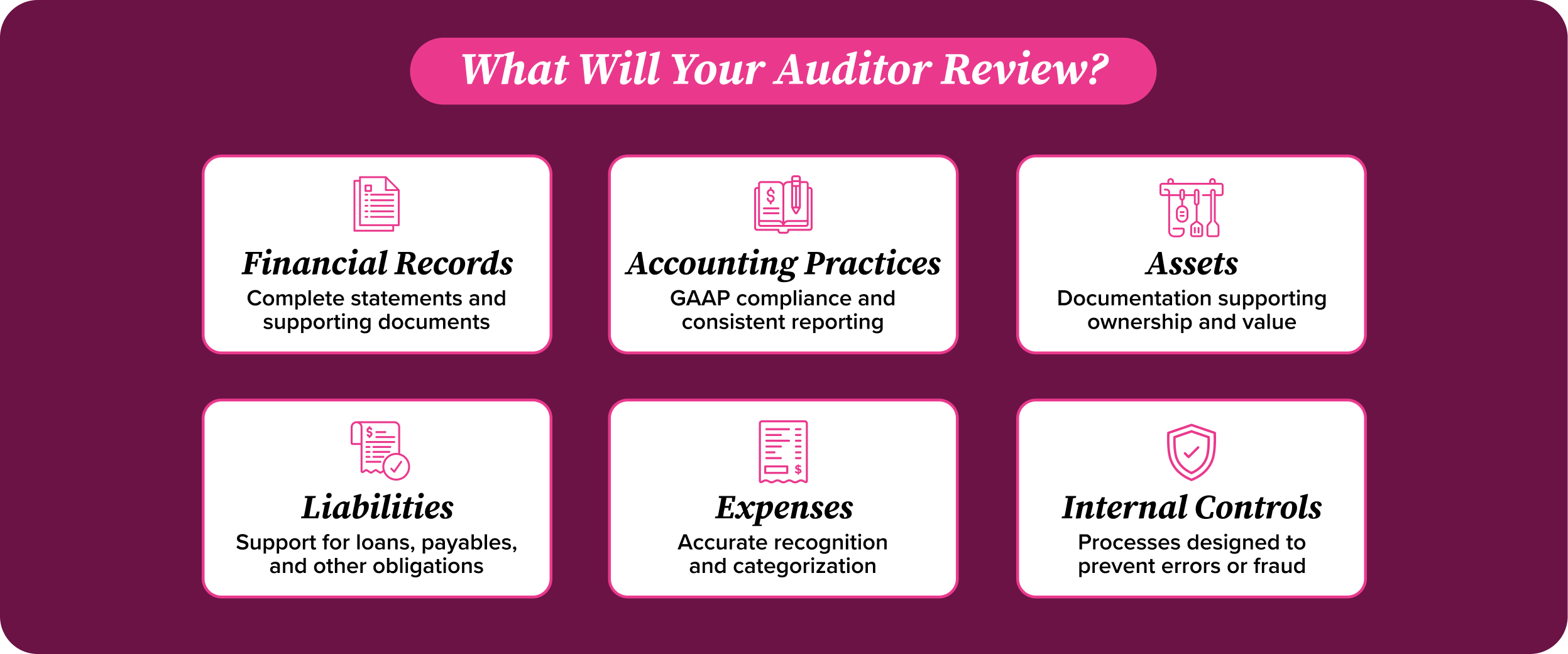
When performing their review, auditors look for evidence that your financial statements are free from gross misstatements, errors, or omissions that could potentially misrepresent the actual financial position of your business. Even if these issues were unintentional, it’s important to identify and fix them before any further decision-making. Specifically, auditors check for:
- Complete and accurate financial records and supporting data
- Compliance with Generally Accepted Accounting Principles (GAAP)
- Proof of documented assets and their current value
- Validation of all liabilities, such as loans or accounts payable
- Accurate expense recognition and categorization
- Internal control systems to prevent errors or fraud
The Restaurant Audit Preparation Checklist
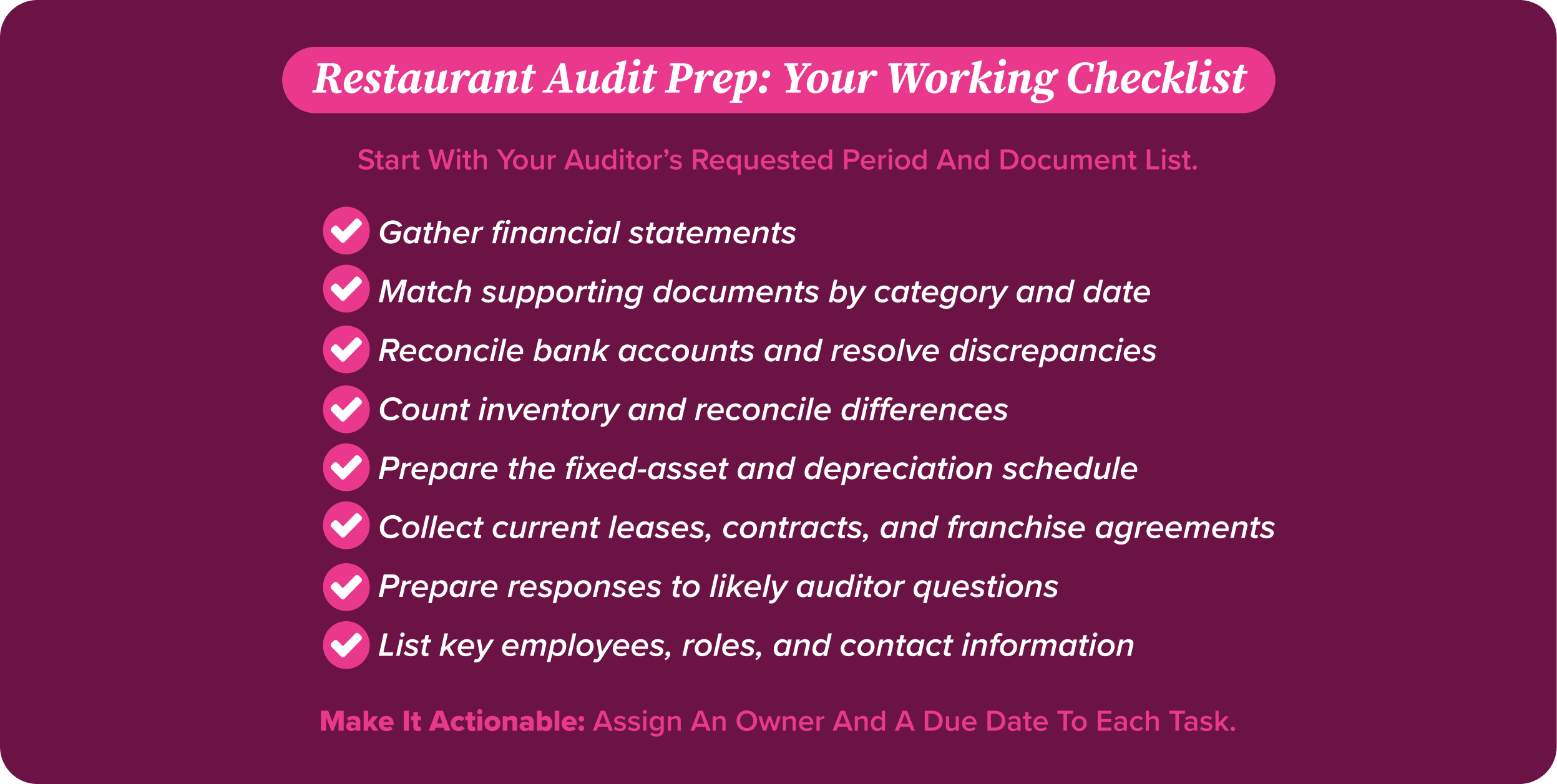
Sometimes audits are necessary and unavoidable—such as when preparing for investor presentations. If you’re anticipating an audit, you can streamline the process with these proactive measures:
- Gather all relevant financial statements for the requested timeline (typically 3-5 years).
- Organize supporting documentation, matching the documents to the relevant financial statements by category and date.
- Reconcile bank accounts and resolve any identified discrepancies.
- Conduct a thorough inventory count and reconcile it with current inventory reporting.
- Prepare a schedule of long-term or fixed assets—such as equipment, vehicles, buildings, and furniture—that includes acquisition dates, costs, and depreciation.
- Review any current contracts, such as leases or franchise agreements.
- Anticipate auditor questions and prepare clear, concise responses proactively.
- Prepare a list of key employees with their job descriptions and contact information to share with the auditor.
Use the auditor’s requested timeline as your starting point. The guide’s typical 3-5 years is a preparation reference, not a universal record-retention rule.
How to Stay “Audit-Ready” Year-Round
Maintaining an “audit-ready” position year-round can significantly reduce the disruption to your operations if an audit becomes necessary. To ensure you are prepared for an audit at any time, take these key steps:
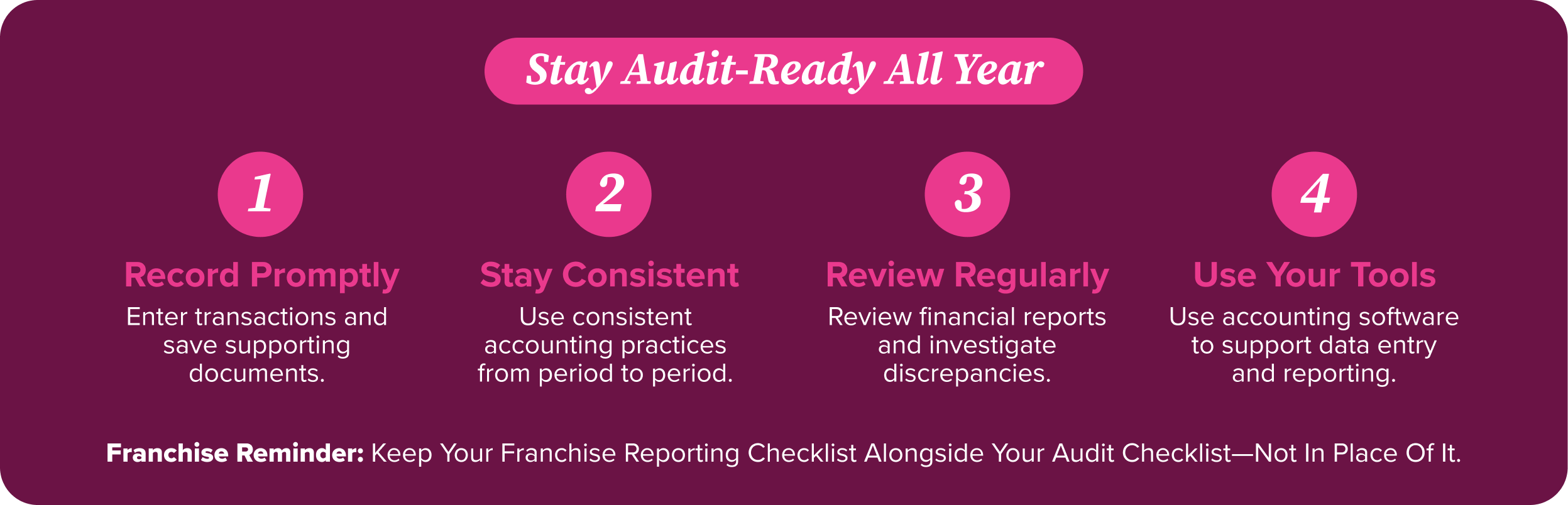
- Maintain up-to-date records: Enter all transactions promptly and keep a copy of receipts or bank statements with records as proof.
- Use consistent accounting practices: Auditors can more easily follow your calculations and confirm accuracy when transactions are documented the same way from period to period.
- Regularly review your financial statements: You’ll be better prepared to answer questions and support the audit process if you are deeply familiar with your financial reports.
- Leverage accounting technology: Using software like Back Office can automate your data entry, helping to catch errors before they are identified in an audit.
For franchisees, build your franchise reporting requirements checklist into that routine. Keep your operations manual, reporting deadlines, approved software, and expense categorization guidelines close at hand. Back Office’s reporting features can automate generating required financial reports for your franchisor, helping you spend less time preparing submissions.
Common Mistakes When Preparing for an Audit
Waiting until the audit request arrives is an easy trap. Start with the checklist now, rather than trying to reconstruct several years of records while running a busy restaurant.
Another mistake is collecting financial statements without the documents behind them. A report is only part of the picture. Match supporting records by category and date so you’re not hunting for proof during the review.
Don’t leave bank discrepancies or inventory differences unresolved, either. Reconcile accounts, count inventory, and work through mismatches before handing over your reports. Remember the less obvious items, too: asset acquisition dates, depreciation, current contracts, and employee contact details.
For franchisees, treating a franchise reporting requirements checklist as a substitute for audit preparation leaves gaps. Keep it alongside your audit checklist, and confirm what the auditor needs. Finally, don’t overlook your own financial review. You’ll be better prepared to answer questions when you already know your reports.
How to Reduce Your Risk of an Audit
While you can’t avoid all audits, following these steps can reduce your risk of audits resulting from non-compliance or financial inaccuracies:
- Maintain accurate and complete financial records.
- File all financial reporting requirements, including taxes, on time—every time.
- Declare all income, including tips and online sales, accurately and in the period it was generated.
- Only claim legitimate deductions, report all legitimate expenses, and keep detailed supporting documentation.
- Avoid common audit triggers, such as drastic fluctuations between reporting periods or financial metrics that are vastly different from industry averages.
- Separate business and personal finances to avoid any confusion or suspicion of wrongdoing.
Keep the distinction in mind: accurate reporting won’t remove an audit required for funding or under a franchise arrangement. And if your numbers change sharply, document the real reasons. Don’t change accurate figures just to make them look more typical.
Free Restaurant Audit Prep Checklist
Need something practical to keep handy? Save or print the restaurant audit preparation checklist above and use it as your free working list. Add a person responsible and a due date beside each item, then check off tasks as you finish them. If you operate a franchise, keep your franchise reporting requirements checklist alongside it so reporting deadlines and documentation guidelines stay visible. Revisit both during financial reviews, not just when an audit is scheduled. A little upkeep beats scrambling.
Want help making these routines easier to manage? Back Office centralizes key business functions and offers financial reporting, inventory management, and employee labor and payroll tools. Contact our team to see how Back Office can support your restaurant’s accounting workflows.
FAQ’s
When does a restaurant need an accounting audit?
An audit of your business records may be requested or required if your restaurant is requesting additional business funding, a publicly traded company, is part of a franchise, or is working with a consultant to improve business operations.
What do auditors look for in a restaurant?
Auditors look for evidence that your financial statements are free from gross misstatements, errors, or omissions that could potentially misrepresent the actual financial position of your business, including GAAP compliance, documented assets, validated liabilities, and internal controls.
How many years of records do auditors request?
Gather all relevant financial statements for the requested timeline (typically 3-5 years).
How can a restaurant reduce its risk of an audit?
Maintain accurate and complete financial records, file all financial reporting requirements, including taxes, on time, and separate business and personal finances.
What is the first step in preparing for an audit?
Gather all relevant financial statements for the requested timeline (typically 3-5 years) and organize supporting documentation, matching the documents to the relevant financial statements by category and date.